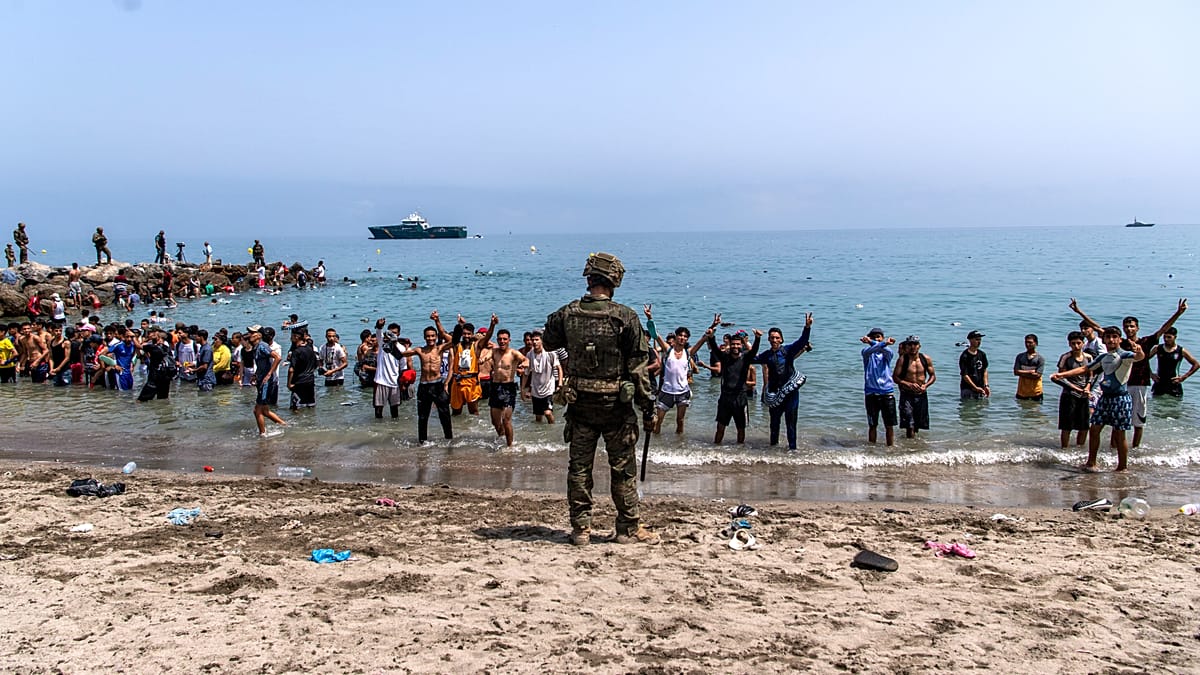
An unprecedented migration crisis unfolded in Ceuta last Wednesday and escalated dramatically on Thursday, when tens of thousands of people entered the Spanish enclave illegally. ADVERTISEMENT ADVERTISEMENT In the end, between 60,000 to more than 70,000 migrants crossed from Morocco into Cueta, marking the territory's largest migration crisis. Footage showed thousands of people swimming, navigating around breakwaters or climbing down steep areas in the autonomous city. The influx prompted Spain to deploy its military and police to contain the situation. Most of those who had entered the North African enclave returned to Morocco within hours, largely due to a lack of accommodation and basic supplies. Most of the new arrivals were young men, but the footage also showed women with children and entire families, on a journey fraught with the risk of drowning and exhaustion. At least 88 people died, Spanish officials said on Monday, though Moroccan officials later presented a lower estimate. Amid criticism from Ceuta's president, Juan Jesús Vivas, as well as growing calls to amend immigration laws to allow for immediate push backs of those who crossed by swimming, Spain and Morocco reached an agreement to speed up the repatriation of migrants. The Spanish government and Moroccan authorities have attributed the surge to rumours circulating on social media that falsely claimed a recent Supreme Court ruling prevented the immediate return of migrants, as well as to the activities of people-smuggling networks. What neither side has adequately explained is why, according to reports from the area, Moroccan security forces initially allowed large crowds to advance towards the border unhindered, or how thousands of people from Casablanca, Rabat, Tangier and Marrakech were able to travel north without the closure of access routes. The delayed intervention of Moroccan authorities only fuelled suspicions that the surge was coordinated from within. The New York Times reported accounts from several young men explaining how the country's authorities encouraged them to cross into the Spanish city. Alaoui, 26, said that when his group approached the border on Thursday, several Moroccan police officers pointed them in the right direction, telling them to "go that way, go that way," the US outlet reported. Spain's Civil Guard reportedly spotted Moroccan intelligence agents among the group of migrants Sources within Spain's Civil Guard also claimed that officials from Morocco's intelligence service had infiltrated the crowds entering Ceuta. According to 'El Español' (source in Spanish), they were able to detect so through a camera surveillance system installed at the Ceuta border. Civil Guard analysts identified several individuals operating on the ground, dressed in civilian clothes and mingling with groups of migrants, acting as guides, gathering information and coordinating the crossings. If accurate, these findings challenge the theory that the surge was a spontaneous phenomenon driven largely by social-media rumours and instead suggests a degree of cooperation involving state intelligence actors. Who was pulling the strings inside Morocco? According to Spanish newspaper 'The Objective' (source in Spanish), which cited Moroccan sources familiar with the kingdom's power structures, the man identified as the possible mastermind of the operation is Fouad Ali El Himma, a close friend and advisor to King Mohammed VI who is described in some circles as Morocco's 'viceroy'. A former senior Interior Ministry official and founder of the Authenticity and Modernity Party (PAM) in 2008, El Himma is said to have sought to exploit the migration chaos for a dual purpose: to weaken the government of Prime Minister Aziz Akhannouch and to strengthen PAM's position ahead of Morocco's general elections. This timing would not be accidental. On Wednesday, Mohammed VI delivered a speech marking the 27th anniversary of his accession to the throne, projecting an image of stability and progress. Hours later, thousands of Moroccans were attempting to reach Ceuta, highlighting the stark contrast between the speech and the scenes at the borders. Supporters of this theory point to events of 2021, when about 10,000 people entered Ceuta after Moroccan forces relaxed border surveillance during the diplomatic crisis sparked by Spain's decision to admit Polisario Front leader Brahim Ghali for hospital treatment. This instance demonstrated Rabat's ability to control migration flows in ways that can exert political pressure on Spain. Migration as a bargaining chip and Pedro Sánchez's role in Spain's relations with Morocco Spain has a long history of migration tensions along its southern border, but the Ceuta crisis cannot be understood without consiering the complex relationship between Madrid and Rabat, nor without the disagreements between Pedro Sánchez's government and several of its European partners over migration policy. In 2022, Sánchez endorsed Morocco's autonomy plan for Western Sahara, backed by the United States. The move—which marked a historic shift from Spain's traditional position of neutrality—was welcomed in Rabat and widely criticised in Spain, including by the Polisario Front and by some parties within the coalition government. The mass regularisation of migrants driven by the Spanish government has also triggered an open conflict with leaders from 22 European Union countries, who signed a letter explicitly linking that policy to the so-called pull factor and to the Ceuta crisis. From Italy, Meloni justified the joint letter by saying that "defending borders is a shared responsibility". Italy itself last week introduced stricter temporary Schengen controls for non-EU citizens travelling from Spain. It is worth noting that the European Union offered to deploy the European Border and Coast Guard Agency (Frontex) in Ceuta, given the gravity of the situation, but the Spanish government rejected the offer. European Commission President Ursula von der Leyen welcomed the return to Morocco of most of those who crossed into Ceuta. However, tensions between Madrid and Brussels remain high. Pedro Sánchez sent a letter to Brussels criticising the "lack of solidarity" of some EU partners. The letter contained no mention of Morocco's responsibility for the crisis. The Socialist leader also requested an emergency videoconference of EU interior ministers. The Trump factor: facts and context behind Washington's role Days before the Ceuta crisis, US President Donald Trump sent a message to Mohammed VI for the occasion of Throne Day, reaffirming Washington's recognition of Moroccan sovereignty over Western Sahara and calling Morocco's autonomy proposal "the only basis for reaching a fair and lasting solution". The message came just days after Morocco named one of its main motorways after the US president. In April 2026, a Capitol committee approved a budget proposal that included a non-binding recommendation calling on the US diplomatic service to open discussions on Ceuta and Melilla, arguing that the two lie in "Moroccan territory". The proposal received 35 votes in favour, all from Republican members, and 27 against. During the crisis in Ceuta, the Trump administration has used its platform to warn for the risks of illegal immigration and of laws that fail to curb migrant flows, blaming the "far left" for the situation. One of the few voices to focus on Morocco's responsibility was Anna Paulina Luna, a member of the House of Representatives for the Republican Party. According to correspondent David Alandete (source in Spanish), the Republican Party's closer ties with Morocco responds to a clear strategic logic: Rabat has demonstrated its willingness to take significant steps to strengthen its relationship with Washington, from recognising Israel to allowing the port of Tangier to be used by arms-carrying ships, naming a road in Western Sahara after Trump and cooperating militarily when requested. Meanwhile, Pedro Sánchez's government has increasingly become a more difficult partner for Washington, amid repeated disagreements over the war in Gaza, NATO defence spending and the recognition of Palestine. According to Alandete, US officials don't doubt that Morocco has at times used irregular migration as a means of applying pressure, but there is little political appetite in Washington to back Sánchez against Rabat. A historical footnote provides further context: in 1967, dictator Francisco Franco warned US President Lyndon B. Johnson in a letter about the risks of rearming Morocco, describing it as an "aggressive and destabilising" nation. Decades later, former Prime Minister Adolfo Suárez responded to Moroccan threats to annex Ceuta and Melilla with a direct warning: "You know we can bomb Rabat within 48 hours". This approach to managing pressure from Spain's southern neighbour stands in stark contrast to the current government's stance. The strategic position of Gibraltar: is the control of the Strait of Hormuz what is really at stake? Several European geopolitical analysts, including French commentator Laurent Ozon (source in Spanish) and historian Édouard Husson, have recently argued that the Ceuta crisis goes beyond the question of migration or internal power struggles in Morocco. Their main argument is that, with the Strait of Hormuz under growing strain following the joint US-Israeli strikes on Iran, as well as pressures on the Red Sea and the Suez Canal, the Strait of Gibraltar—whose territorial waters are under Spanish sovereignty—is gaining exceptional strategic value as the only secure access route to the Mediterranean for international shipping. According to this interpretation, the United States and Israel would be seeking to establish an alternative corridor through Morocco that would not rely on Spain or, by extension, on the wider European alliance. Under this scenario, Ceuta would be a key asset: control over the city would enable Rabat, acting as a proxy power for the Washington-Tel Aviv axis, to challenge Spain's control of the gateway to the Mediterranean. Ozon also argues that European anti-immigration right-wing parties and certain media outlets are, consciously or not, helping to isolate Spain by framing the issue solely around migration policy while overlooking the wider European interest in preserving Spanish sovereignty over Ceuta. However, this hypothesis, which is gaining traction in certain European geopolitical circles, is not currently backed by any official documentation. It should be read as an interpretative framework proposed by analysts. A crisis contained but far from over The Ceuta crisis cannot be viewed as an isolated event. It is the latest development in a broader sequence of events, which includes the 2021 migration incident, Spain's shift in position on Western Sahara, allegations that Pegasus spyware was used against Spanish government officials from Morocco, ignored warnings from the CNI intelligence service, mass migrant regularisation and the gradual deterioration of Spain's standing in its relations with Washington and Brussels. But beyond the competing theories, several points remain clear: Morocco has once again demonstrated its ability to influence migration flows; that, according to police intelligence sources, Spanish authorities were warned and did not act; that at least 88 people have lost their lives attempting the crossing and that hundreds remain in Ceuta with no short-term solution in sight. Many local residents have voiced their frustration over the government's response to a situation that is not new, and which they say makes them feel unsafe and unprotected. Spain's King Felipe VI also sought to send a message of suppor to the people of Ceuta, expressing his "indignation" and recalling that "the state must safeguard the security of Ceuta and Melilla". The question now facing Spain, is whether the country still has the capacity and political will to manage its southern border with relying on Morocco's cooperation, and whether the European bloc can maintain a united response when crises like last week's in Ceuta emerge again.
Ceuta explained: How Spain's biggest migration crisis unfolded
Full Article
Original Source
Read the full article at Euronews →KhanList aggregates and links to publicly available news content. We do not host full articles from third-party sources. Always verify important information with original sources.