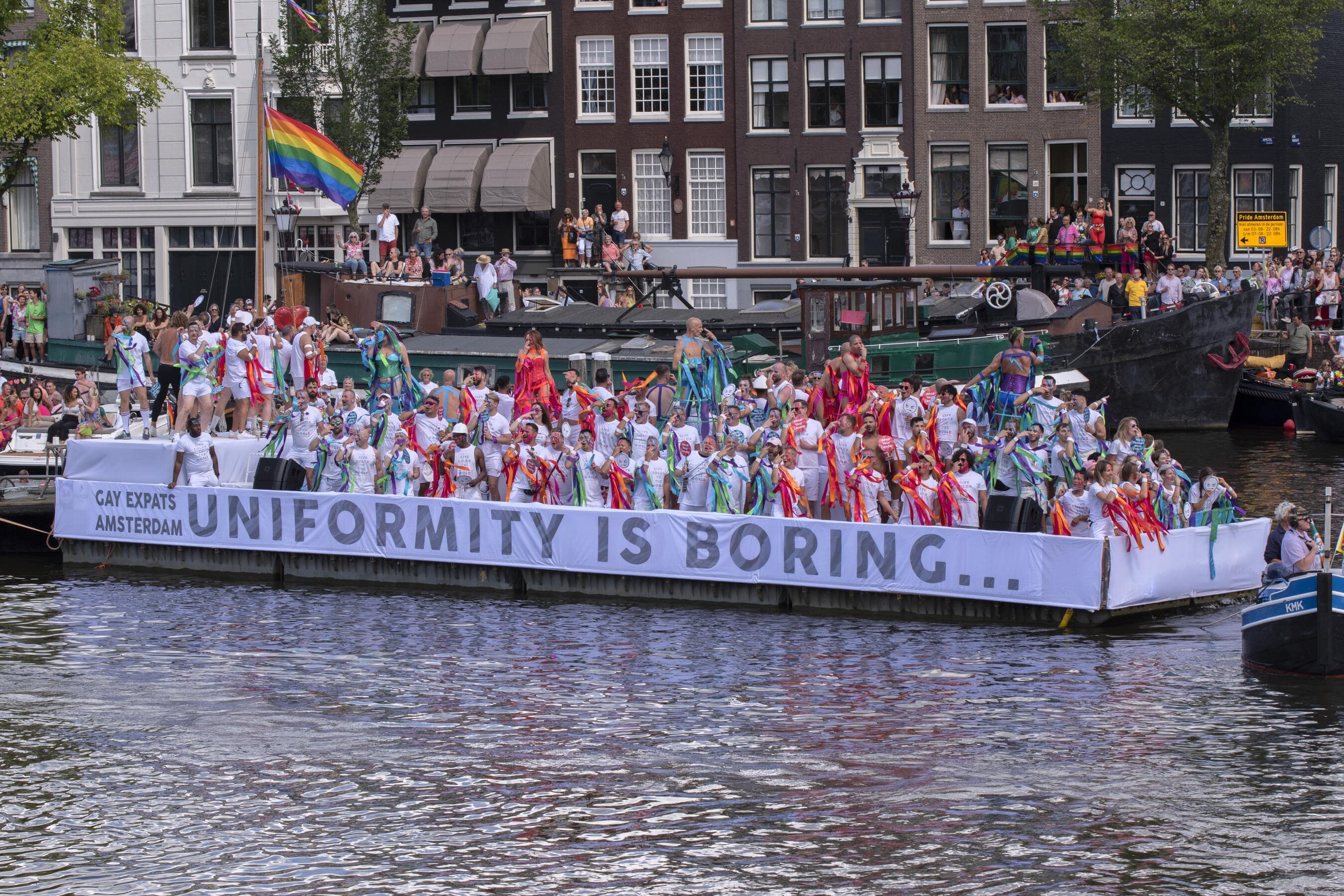
WorldPride Amsterdam celebrated 25 years of marriage equality in the Netherlands while highlighting renewed corporate support, global LGBTQ+ advocacy, and resilience in the face of rising threats.There are a number of reasons I only intermittently attend Pride events.Some of these are practicalities unrelated to Pride: I don’t particularly like crowds or portable toilets and my RBF usually means I spend a good amount of time reassuring people I’m actually having fun. Others hit closer to purpose: I’m apprehensive the events could be targets for violence, and I quickly tire of many of the divisions and factionalism that unfortunately tend to accompany Pride. But when I got an invitation to attend World Pride in Amsterdam this past weekend, I jumped at it. I was curious to see what a globally facing Pride event looks like in what is largely one of the most gay-affirming cities in the world. The Netherlands was the first country to legalize same-sex marriage, and reached the 25-year milestone this year. Amsterdam has long had an openly gay-friendly culture—it’s home to the first major public memorial to gay men and lesbians persecuted for their sexual orientation, which dates back to 1987. Continue Reading Article After Our Video Recommended Fodor’s Video I was also curious how Pride—events that have now been running for decades—has evolved at a time when many countries are restricting rights for LGBTQ+ individuals and rights in the United States continue to require vigorous defense, and many corporate entities have reduced or eliminated their support for Pride and Pride Month events for various reasons, not least of which is the real fear that any federal contracts they may have or have applied for could come under scrutiny from an executive branch bent on dismantling Diversity, Equity, and Inclusion (DEI) programs through a variety of means.There are the usual controversies, among them: Pride is too corporate/too broke; Pride is too activist/not activist enough; Pride is too sexual/too restrained; Pride is too political/not political enough. Here are some takeaways I had from World Pride in Amsterdam. Corporate Sponsorships Are Slowly RecoveringWorld Pride’s corporate sponsorships peaked in 2019 in New York, and reached their low point in 2025 in Washington, D.C., largely owing to the U.S. political climate and waning interest from corporations in funding pride events. The Amsterdam event had major Amsterdam-based sponsors including main partner Booking.com, official partners KLM and SkyTeam partner Delta Air Lines, Tommy Hilfiger, the Dutch retailer Katja. Many other sponsors were specifically Dutch, including Heineken, ING, and Rabobank. PwC was also a sponsor, a notable return to supporting Pride events for the company, which pulled funds from New York City Pride in 2025. Booking.com was our host for the event, and took the opportunity to share some details about a Pride milestone of their own—it’s the fifth anniversary of their Travel Proud program, which provides a training and certification program for hotels selling through the site. Hotels and hotel brands complete trainings on how to be welcoming to LGBTQ+ travelers, and those searching for accommodations on the site can filter results by properties carrying that certification. Some of the company’s own research underlines the need for the program. A study published earlier this year, from responses among 13,300 LGTQ+ found that only around a third of respondents said they were “out” when they traveled. Berlin Weighed Heavy in Two Big WaysWorld Pride in Amsterdam came just a week after one person was killed and 16 were injured after a vehicle was driven into a crowded Berlin Pride event. Diana Rodriguez, CEO of Pride Live and Co-Founder of the Stonewall National Monument Visitor Center was visibly shaken while giving remarks at the Booking.com event, noting that her remarks were written before the attacks in Berlin, but still salient in their message of the need for Pride events to continue in spite of growing hostility. Police involvement in Pride events has generally been contentious, as many who were present at the Stonewall Inn riots in New York City in 1969 recall that the riots were in protest of police raids on LGBTQ bars. The crowd response to law enforcement floats and law enforcement providing security for the event, however, was more enthusiastic with the floats and police boats getting big cheers. Unabashed PoliticsPerhaps the biggest conversation float in the parade evoked the famous Berlin Wall Art depicting a kiss between Soviet Leader Leonid Brezhnev and East German leader Erich Honecker. The float evoked the “Kissing Couple” a common pose of a Dutch couple kissing whilst holding tulips behind their backs, typically found on souvenir items for visitors. The couple, however, was current U.S. and Russian Presidents Donald Trump and Vladimir Putin. Other floats supported books from queer voices, and another that called out the 63 countries around the world where homosexuality is criminalized, pointing out that even in the progressive Netherlands, 4 in 10 young people said they consider LGBTQ+ people inferior. World Pride 2026 continues in Amsterdam through August 8. World Pride 2028 will be hosted by Cape Town, South Africa.
The Biggest Surprise at WorldPride Amsterdam Had Nothing to Do With the Parade
Full Article
Original Source
Read the full article at Fodors →KhanList aggregates and links to publicly available news content. We do not host full articles from third-party sources. Always verify important information with original sources.