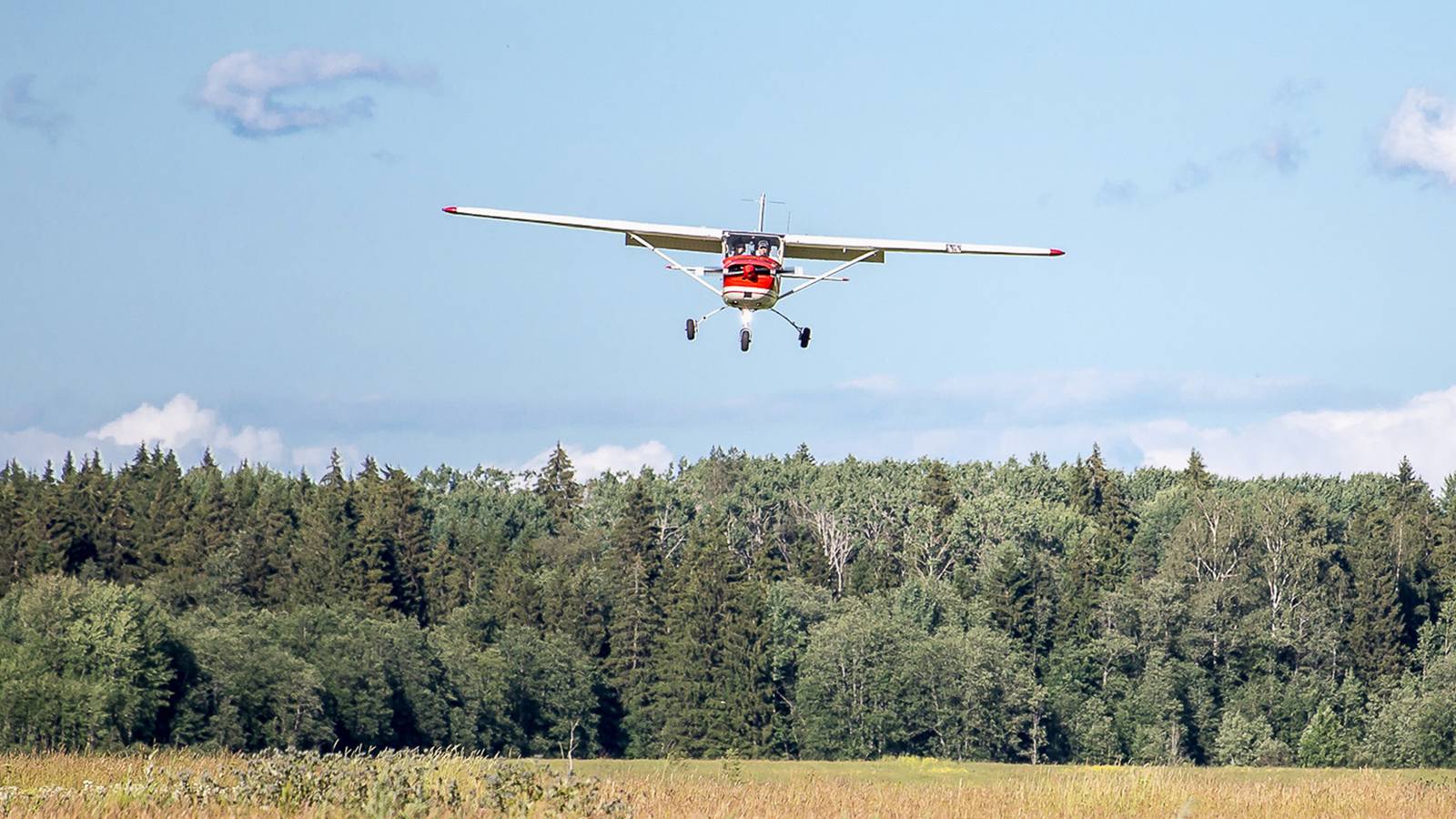
Published Aug 20, 2026, 1:06 AM EDT Luke has over a decade of experience as a travel writer and aviation analyst. As a passionate traveler based across the Middle East and Asia, Luke offers strong insights into the industry. Based in South East Asia. The pilot of a Cessna 150 was killed and two State Police troopers were hurt when the small plane collided with a police Bell 407 helicopter at Carlisle Airport, Pennsylvania, on Wednesday evening. Early reports suggest that the helicopter had been conducting routine training and was hovering a few feet above a grass area when the Cessna struck it from behind. Both troopers onboard the helicopter were briefly trapped in the wreckage before escaping through a window. However, the Cessna pilot — believed to be the only person onboard the small aircraft — died at the scene. One Dead After Cessna 150 And Police Helicopter Midair Collision Credit: Shutterstock The accident occurred at the small public-use airfield of Carlisle Airport, which is primarily used for general aviation flights. The collision occurred just before 7:00 PM local time, flipping the Pennsylvania State Police Bell 407 (registration: N873ST) onto its side. According to State Police Commissioner Lt. Col. George Bivens, the Cessna plane (registration: N23330) "struck the helicopter from the rear," adding that the two pilots of the police chopper "would not have been able to even see that airplane approaching them." Video footage of the aftermath shows a huge emergency service presence at the scene. The two injured pilots were named as Corporal Bryce Corman and Trooper Jason Mills of the state police aviation unit, while the deceased pilot of the Cessna 150 has yet to be named. Both troopers escaped through a window and were transported to a local hospital with minor injuries. Bivens said, "As that Cessna came down along that runway, for an unknown reason, it veered hard to the right at the last moment." A Small Airport Without A Control Tower Credit: Shutterstock Carlisle Airport has a single runway, 10/28, which is over 4,000 feet long, but does not have its own control tower. This means that pilots operating in and out of the airfield use see-and-avoid rules, as is the case with the majority of non-towered airports in the US. Rather than following instructions from air traffic controllers, pilots broadcast their position and intentions on a shared radio frequency. There is no radar service available, so the responsibility of spotting and avoiding other traffic is entirely on the crews of each aircraft. According to FAA data, the vast majority of aircraft based at Carlisle Airport are single-engine aircraft, although there are also a number of helicopters and multi-engine planes. The Pennsylvania State Police Aviation Section was established in 1968 and operates six helicopters and three fixed-wing aircraft, with more than 30 trooper pilots under its command. Its Bell 407GX fleet, which can seat up to seven passengers, was delivered between 2013 and 2014, but is now down to five airframes. Among the helicopter's duties include search and rescue, pursuit, and aerial surveillance. Scrutiny Over Mixed Airspace Credit: Shutterstock Officials from the National Transportation Safety Board (NTSB) arrived in Carlisle overnight to begin their investigation into the collision, aided by investigators from the FAA. According to Bivens, video and photographs recovered from the airport would be used to reconstruct what happened. The crash occurred during a period of heightened attention on airspace shared between helicopters and fixed-wing aircraft, driven by the tragedy of American Airlines Flight 5342 on January 29, 2025. A US Army Black Hawk helicopter collided with a PSA Airlines CRJ700 operating under the American Eagle brand while on approach to Ronald Reagan Washington National Airport (DCA), killing all 67 people onboard the two aircraft. This tragedy led to a review of procedures around areas where helicopters and planes operate in close proximity. In the aftermath of the collision, the FAA introduced several measures aimed at reducing the risk of similar accidents, including changes to helicopter operations around DCA.
Cessna 150 Pilot Killed, 2 Troopers Hurt In Midair Crash With State Police Helicopter
Full Article
Original Source
Read the full article at Simpleflying →KhanList aggregates and links to publicly available news content. We do not host full articles from third-party sources. Always verify important information with original sources.