
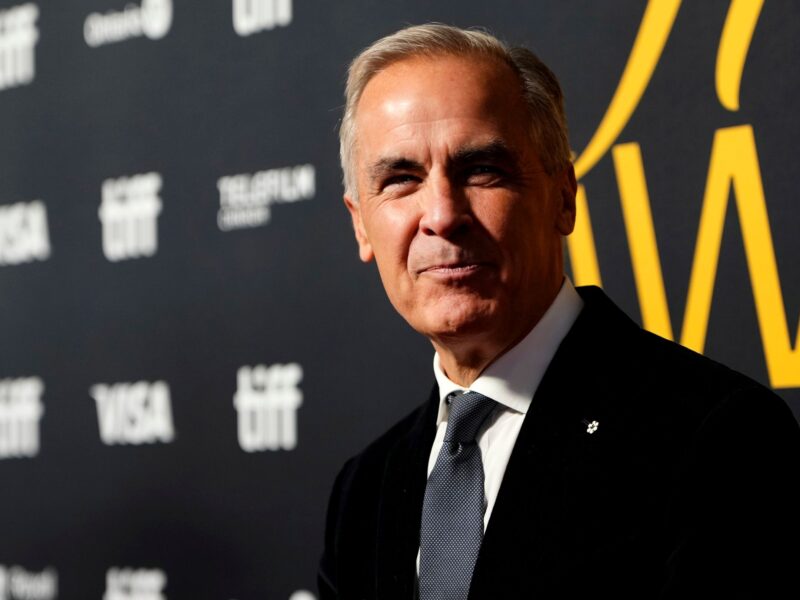
Canadian Prime Minister Mark Carney is on a mission to turn his “middle powers” strategy into a reality during a trip to Europe.(CN) — Canadian Prime Minister Mark Carney will seek to deepen economic and strategic ties with the European Union during a trip to Europe this week.His visit has been characterized as a “pivot to Europe” in response to an escalating trade war with the United States and bitter confrontation with U.S. President Donald Trump.Carney was scheduled to attend a highly anticipated State of the Union address by European Commission President Ursula von der Leyen on Wednesday and then lay out his vision for EU-Canada relations in a speech to the European Parliament the next day.Ahead of the trip, Carney said he wanted to kick start talks on building a “unique alliance” with the EU, but he stopped short of saying Canada would seek to become an “associate member” of the 27-nation EU bloc.Media reported Carney was interested in an agreement that would make it easier for Canadians to work and live in the EU while also boosting trade and investment.“We’re not looking to become a member of the European Union” but rather build a “unique alliance,” Carney said.“We share the same values, we have the same priorities, and we have very complementary strengths,” Carney said.Over the weekend, press reports cited unnamed EU and Canadian sources saying they were exploring the possibility of making Canada an associate member.Such a status does not exist under EU law, but in May German Chancellor Friedrich Merz sent a letter to top EU officials about making Ukraine and other prospective members, such as Moldova and small Balkan nations, associate members.The idea entails allowing such nations to take part in EU institutions, but without voting rights. Before the May letter, von der Leyen advanced similar ideas for fast-tracking Ukraine’s inclusion in the bloc.Such proposals face opposition from EU nations wary of expanding too quickly. Any such proposal would need the support of all EU members.Finnish President Alexander Stubb, a leading figure in EU politics, was quoted as saying: “Wouldn’t it be lovely if Canada was the 28th state of the European Union rather than the 51st state of the United States?”Stubb’s statement was a jab at Trump’s outlandish suggestion that the U.S. should annex Canada.After his speech to the European Parliament, Carney was expected to visit British Prime Minister Andy Burnham in Liverpool and then meet French President Emmanuel Macron on the French territory of Saint-Pierre and Miquelon, a remote archipelago close to the Canadian province of Newfoundland and Labrador.Carney and Macron were expected to talk about deepening cooperation on artificial intelligence, energy, defense and critical minerals, Carney’s office said. It would be the first-ever trip to the territory by a Canadian prime minister.This week’s trip was seen as Carney’s attempt to put into practice a groundbreaking speech he made in January at the World Economic Forum in Davos, Switzerland. In it, he said “middle powers” like Canada and Europe need to work together to increase their bargaining power in the face of superpower rivalry.In that speech, Carney said the “fiction” about the benefits derived from a U.S.-led international rules-based order had been laid bare by a series of crises in finance, health, energy and geopolitics in the past 20 years.The Canadian leader accused “great powers” of “using economic integration as weapons, tariffs as leverage, financial infrastructure as coercion, supply chains as vulnerabilities to be exploited.”Canada and the U.S. are in the midst of a bruising trade war that has seen each side slap reciprocal tariffs on billions of dollars worth of goods.Before the trade war, about 70% of Canadian exports went to the United States. Carney wants to build stronger ties with Europe and China to reduce Canada’s dependence on the U.S.Bilateral trade between Canada and the EU stood at about $147 billion in 2025, making Europe Canada’s second-largest trading partner.Canada and the EU have a partially applied free-trade deal and signed a defense partnership in June 2025. This year, Canada became the first non-European country to join the EU’s $173-billion SAFE defense program, giving Canadian companies access to joint procurement deals. Canada and the EU are planning a summit in Montreal in late October.Courthouse News reporter Cain Burdeau is based in the European Union.Subscribe to our free newslettersOur weekly newsletter Closing Arguments offers the latest about ongoing trials, major litigation and rulings in courthouses around the U.S. and the world, while the monthly Under the Lights dishes the legal dirt from Hollywood, sports, Big Tech and the arts.Additional Reads
Carney pursues ‘unique alliance’ with EU as Canada pivots away from US
Full Article
Original Source
Read the full article at Courthousenews →KhanList aggregates and links to publicly available news content. We do not host full articles from third-party sources. Always verify important information with original sources.