
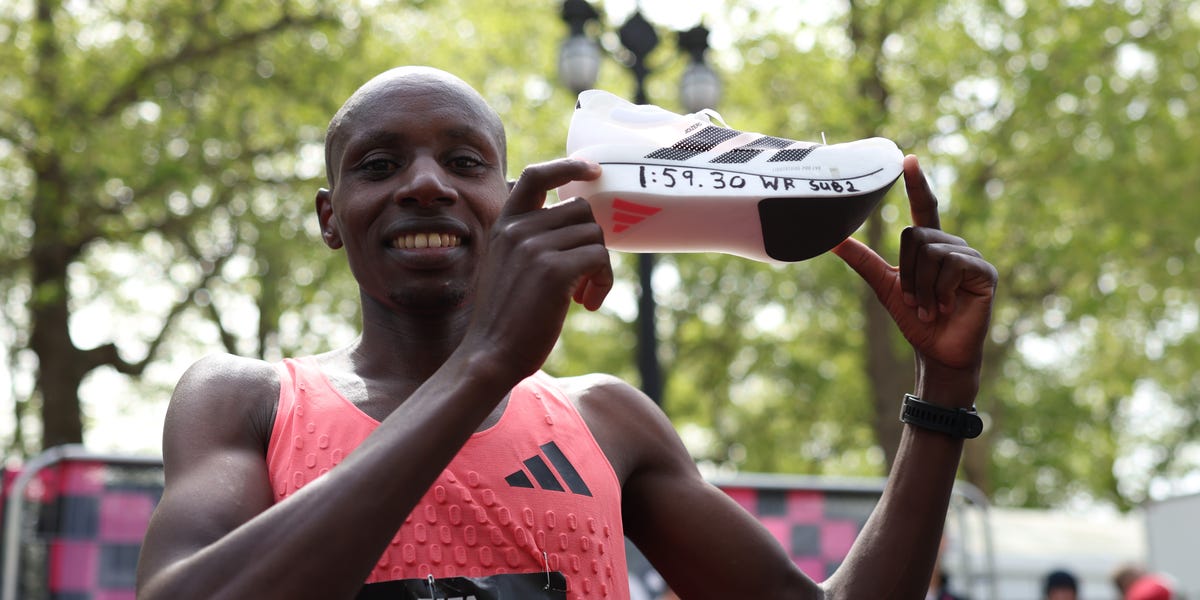
Less than 24 hours after Sabastian Sawe ran the world’s first official sub-two marathon in London, Adidas released an undisclosed, limited quantity of the shoes he made history in. The $500 Adizero Adios Pro Evo 3 sold out online in two minutes.The model—also worn by Yomif Kejelcha, who came in second in sub-2, and Tigst Assefa, who improved her women’s-only marathon world record during the same race—soon appeared on resale sites such as eBay, marked up many times from its retail price.When it launched the Pro Evo 3, Adidas presented the footwear as a shoe designed to help athletes “break through barriers” and chase new records. The marketing messaging highlights genuine, tangible advancements in running shoe technology—superlight construction, highly resilient foam, carbon-based propulsion systems that can improve running economy—but it also sells a feeling.The demand and interest bring up an under-examined part of the super-shoe era: the psychological pull of lacing up the same model as a world-record breaker. The question remains: Does it actually enhance performance?A Placebo Effect or an Actual Performance BoosterIn a randomized crossover trial published in Footwear Science journal, researchers gave female recreational runners the same two pairs of Nike ZoomX Vaporfly Next% 2 shoes but described one as a $400 super shoe worn by elite runners and the other as a $100 “knock-off.” The runners rated the supposedly performance-enhancing version as more comfortable, with 88 percent saying they perceived it as easier, more enjoyable, and more likely to improve performance. The study suggests that advantage-technology claims and association with elite athletes can alter what runners believe a shoe is capable of and, in turn, how it feels underfoot.For Nick Bester, a London-based running coach and sub-2:20 marathoner, that expectation sat alongside the practical benefits of the Pro Evo 3. Bester’s Instagram review of the shoe has generated millions of views after he called it the best he had raced in. At 97 grams, he says it felt “different to any other shoe” he had worn due to being extremely light but also highly responsive.Bester received a pair shortly before the London Marathon, and the shoe’s association with elite runners was in the background of his decision to race in it, he says. “I knew they were wearing the Pro Evo 3s and sub-two was potentially on the cards,” he says. “The thought did go through my mind when racing. The shoes mentally helped give me an edge, knowing that I needed to put in a solid performance for a solid shoe.”That association is not limited to runners who have worn the exact model used by a record breaker. Lucy Austin is a competitive amateur who runs races from 800 meters to half marathon in carbon-plated super shoes. She says the technology creates a psychological connection with the sport's leading athletes, even though she knows it cannot replicate their performances. “There’s something quite cool about knowing you’re wearing the same kind of technology that the very best runners in the world are using,” Austin says. “Obviously, I’m not suddenly running like a world-record holder, but it does make a big target feel slightly less ridiculous.”For Austin, carbon-plated shoes separate training from performing. “A normal trainer feels like, ‘I’m going for a run,’ whereas putting on a plated shoe immediately makes my brain go, ‘Right, we’re doing this,’” she says. “It feels like a switch into racing mode. I know I’ve put on my ‘fast shoes,’ so I almost feel like I need to live up to them.”Austin notices the shoes’ advantages most in 5K and 10K races, where runners are close to the limit of what they can sustain. “The biggest thing the shoes give me is confidence to commit to the pace,” she says. “If I’m uncomfortable towards the end, I’m much more likely to think, ‘The shoes are helping, my legs are fine, keep going’, rather than questioning whether I’ve gone too hard.” She estimates the effect as “70 percent physical and 30 percent psychological”; when her legs feel heavy, the bounce gives her more belief that she can hold pace.Simon Ward is a recreational runner and pacer who ran a personal best of 3:09:45 at the 2026 Seville Marathon in Adidas Adios Pro 4s, another of Adidas’s racing super shoes. For him, the influential figures weren’t world-record holders. “It was less the elites and more the friends that I look up to in the sport,” he says. “There’s definitely a mindset shift in thinking if you’re wearing fast shoes, that you’re more likely to push.”Styles Over SubstanceElite sport is not the only route to the fast-shoe-fast-time association. When Harry Styles ran 2:59:13 at the 2025 Berlin Marathon in Nike Alphafly 3s, his footwear generated intense coverage. The Alphafly became not merely a technical product but an aspirational object—a symbol of the “serious amateur” runner chasing a sub-three-hour marathon, a version of the sport many recreational runners want to join.Dylan Vas, a sport psychologist from Beaverton, Oregon, says belief is not simply a matter of being fooled by a shoe. “A successful top-level marathoner’s shoe can make one trust that product or brand and enhance belief in one’s abilities,” he says. When runners feel they have more “gas in their tank,” that confidence may make them more willing to commit to pace, take a calculated risk, or finish strong. “A choice in shoes alone is not going to make someone run a four-minute mile,” Vas adds. For him, the useful mindset is not that shoes will magically deliver performance, but that a runner has trained, prepared well, and chosen equipment they trust.Mario Soto, a sport psychology and performance consultant, draws a similar line between routine and superstition. “Can runners be overly dependent on gear? Yeah, I think so,” he says. “Great runners run regardless of what they’re wearing.”Bottom LineAlthough a shoe worn by a world-record breaker will not give an everyday runner the same fitness, training, or race-day conditions as the athlete who wore it, the belief that it can help may still have a measurable effect. In one study, runners who thought they had received a performance-enhancing substance improved their 3K time by around 1.2 percent, despite receiving only a placebo.Of course, that doesn’t mean super shoes are “all in the head.” Their foam, geometry, and plate can offer real physical advantages. But the confidence may help a runner use those advantages when the race becomes uncomfortable: committing to pace, tolerating discomfort, or finding the belief to keep pushing. As Austin puts it, “These shoes can help me do what I’ve trained to do.”They may not create confidence from nowhere, but they can give a runner another reason to trust themselves when the race gets hard.
Can Wearing the Same Super Shoes as World Record Holders Boost Your Performance?
Full Article
Original Source
Read the full article at Runnersworld →KhanList aggregates and links to publicly available news content. We do not host full articles from third-party sources. Always verify important information with original sources.