
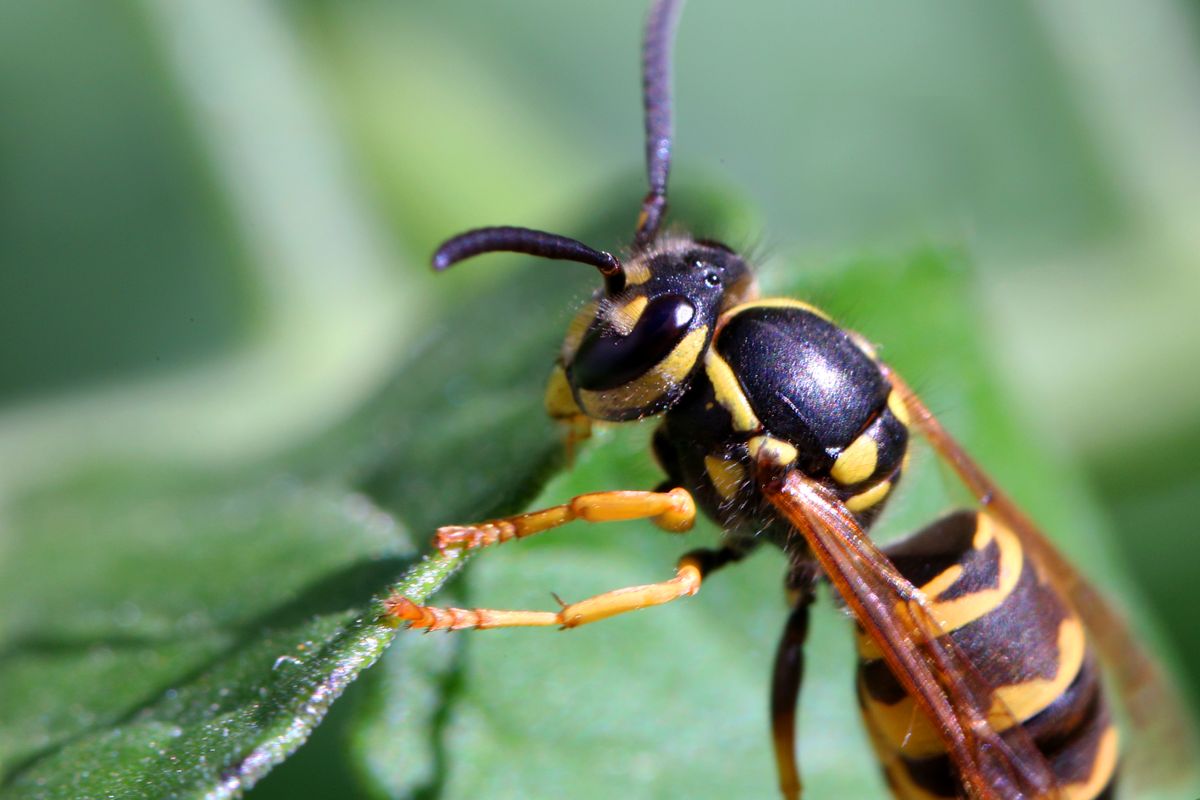
We talked to experts to determine if the long-standing rumor is just social media buzz. Published Nov. 24, 2026 Claim: Wasps can remember human faces. What's TrueOne group of scientists has successfully trained a single species of wasp to successfully recognize human faces in an artificial laboratory setting. Other researchers have conducted experiments showing that a different species of wasp has the ability to recognize the faces of other wasps. What's FalseExpert say there are around 150,000 known species of wasp. Therefore, it is improper to apply the findings of the experiments to all wasps without further research. We found no evidence that wasps will remember a human face following chance encounters. Among the animal kingdom, wasps have a pretty bad reputation. To the general public, they are often thought of as the bee's angrier, more aggressive cousin, with a more painful sting to boot. Adding to people's fear of wasps is a rumor that has spread for years, which warns that they can remember people's faces. One concerned reader even got in touch to ask, "Can wasps remember faces?" The claim seemingly alludes to the common perception that wasps are aggressive in nature. Some posts even imply they seek revenge against their enemies, including humans. To figure out whether the rumor is all buzz, no sting, Snopes spoke to experts who have researched wasps and their facial recognition capabilities. We found no evidence suggesting wasps remember human faces following chance encounters, but researchers told us about one experiment that trained a single species of wasp to successfully recognize human faces in an artificial laboratory setting. Given how many different species of wasp there are, it would be wrong to apply this finding to all wasps without further research. As a result, this claim is mostly false but with an element of truth. First, some context There are thousands of different species of wasp, according to Elizabeth Tibbetts, a professor of ecology and evolutionary biology at the University of Michigan. Princeton University Press puts that figure at roughly 150,000 known species. Despite their public perception, Tibbetts said most species don't sting at all, though yellowjackets and hornets are exceptions. A wasp's social environment also changes dramatically from species to species. While some live in large nests and have a bee-like hierarchical social structure complete with a queen (this being a feature of eusociality), many species live completely solitary lives. As a result, it would be improper to universally apply any characteristic to all wasps (one species even features wingless females). The research pool, which is small to begin with, on wasps identifying and remembering faces — human or otherwise — only focuses on a few species. The studies have found relatively solid evidence of those species' facial recognition abilities, but it would be incorrect to apply any findings to all the thousands of wasp species without more research. Can wasps remember human faces? Adrian Dyer — an associate professor of physiology at Australia's Monash University, who studies the cognitive capabilities of various animals, including bees and wasps — has trained both the western honey bee (Apis mellifera) and the common wasp (Vespula vulgaris) to recognize images of human faces, utilizing a test that is also used to check facial recognition capabilities in humans. In his 2017 experiment with common wasps, Dyer's team presented two platforms to the wasps, each featuring a different human face. One platform rewarded the wasps with a droplet of sugar, while the other punished them with a droplet of quinine hemisulfate, which tastes bitter to the insects. The wasps repeatedly trained with the rewards for several days. Then, the team removed the rewards and ran the tests again. The wasps chose the face they had learned would reward them with sugar quite consistently, even when the reward was absent, and even when they were presented with new alternative faces. The only time they tripped up was when the faces were turned upside down. Speaking via phone call, Dyer said his experiment was more of a testament to the creatures' learning abilities than anything else, though. His studies were performed in a lab setting, and recognizing human faces was not a natural ability — the bees and wasps needed to be specifically trained, instead of having an innate system for facial recognition, like humans do. (Scientists have found some facial recognition abilities in babies as young as a few hours old, he said). So, if you've ever swatted a wasp away, the research does not suggest that it can simply look at you, remember your face and track you down a few days later. "The wasps are acting in the way they evolved to act," Dyer said. "They are not trying to seek revenge." Some wasps can recognize faces of nest-mates Tibbetts' research mainly focuses on Polistes fuscatus, the northern paper wasp. It is a common species in the eastern United States that forms nests near humans and wooded areas. They do sting when threatened, but Tibbetts said the wasps are more docile than one might think. "I didn't get stung until after I completed my PhD," she said via phone call. At the beginning of her research career in the late 1990s and early 2000s, Tibbetts said she noticed something interesting about the paper wasps she was studying — they all had different facial and abdominal markings, sometimes behaved in selfish ways and had individual personalities. Their social dynamics, she added, are incredibly complex and interesting. Tibbetts wondered whether those social dynamics meant the wasps were also aware of the physical differences between individual members of their species. So, she gave some of the wasps makeovers, using paint to alter each one's facial appearance. Then, she returned the wasps to their nests and recorded their behavior. At first, nest-mates acted more aggressively toward the wasps with painted faces, by lunging and biting at them. Perhaps they thought the wasps with painted faces were impostors? No, according to Tibbetts. Studies show numerous species of wasp use chemical signals to identify their nest-mates and will quickly chase out or attack an impostor, but none of the wasps with painted faces were chased out in Tibbetts' experiment. All were accepted back into the nest. But within two hours of being reintroduced, the aggressive behavior towards the wasps with painted faces died down. The wasps had adjusted to their nest-mate's new look. Tibbetts concluded that the wasps were using the facial markings to recognize each other, and the aggressive behavior she saw represented the wasps attempting to determine where the face-painted wasp fit in the social hierarchy. In the years since Tibbetts first published her findings in 2002, she has continued to study the impressive cognitive and social abilities of the paper wasp. "Their capacity has really shocked me," she said. In one follow-up study, Tibbetts found northern paper wasps will "socially eavesdrop" on others, changing how they interact with a nest-mate after they have seen that nest-mate fight. In another, she found the wasps were better at identifying whole faces than partial faces, suggesting they could be learning faces by taking in all the information at once — the same way humans do. In a third study, Tibbetts described raising hybrid hives of three different, related paper wasp species. No matter their surroundings, P. fuscatus continued to perform well on facial recognition tasks, but remarkably, P. metricus, one of the other species, seemed to learn some basic facial recognition abilities when raised alongside P. fuscatus. It is clear these small insect brains are a lot more complex than they might initially appear. Dyer said the findings are so important because they show it does not take a large, mammalian brain to perform complex tasks. "Think of a bee as a million neurons floating in space," he said. In comparison, human brains have somewhere between 50 and 100 billion neurons. Sources "Adrian Dyer." MONASH OPINION & ANALYSIS, 14 Jan. 2026, https://lens.monash.edu/@adrian-dyer/.An Introduction to Eusociality | Learn Science at Scitable. https://www.nature.com/scitable/knowledge/library/an-introduction-to-eusociality-15788128/. Accessed 6 Nov. 2026.Avarguès-Weber, A., et al. "Recognition of Human Face Images by the Free Flying Wasp Vespula Vulgaris." Animal Behavior and Cognition, vol. 4, no. 3, Aug. 2017, pp. 314–23. DOI.org (Crossref), https://doi.org/10.26451/abc.04.03.09.2017.Baracchi, D., et al. 'Speed and Accuracy in Nest-Mate Recognition: A Hover Wasp Prioritizes Face Recognition over Colony Odour Cues to Minimize Intrusion by Outsiders'. Proceedings of the Royal Society B: Biological Sciences, vol. 282, no. 1802, Mar. 2015, p. 20142750. PubMed Central, https://doi.org/10.1098/rspb.2014.2750.Cely Ortiz, Christian, and Elizabeth A. Tibbetts. 'Visual and Chemical Signals Provide Different Information in Polistes Fuscatus Wasps'. Ethology, vol. 127, no. 3, Mar. 2021, pp. 231–37. DOI.org (Crossref), https://doi.org/10.1111/eth.13119.Dyer, Adrian G., et al. "Honeybee ( Apis Mellifera ) Vision Can Discriminate between and Recognise Images of Human Faces." Journal of Experimental Biology, vol. 208, no. 24, Dec. 2005, pp. 4709–14. DOI.org (Crossref), https://doi.org/10.1242/jeb.01929.Goriely, Alain. "Eighty-Six Billion and Counting: Do We Know the Number of Neurons in the Human Brain?" Brain, vol. 148, no. 3, Mar. 2025, pp. 689–91. DOI.org (Crossref), https://doi.org/10.1093/brain/awae390."How Wasps Recognize Faces." NOVA | PBS, https://www.pbs.org/wgbh/nova/articles/northern-paper-wasp-face/. Accessed 6 Nov. 2026.Johnson, Mark H., et al. "Newborns' Preferential Tracking of Face-like Stimuli and Its Subsequent Decline." Cognition, vol. 40, nos. 1–2, Aug. 1991, pp. 1–19. DOI.org (Crossref), https://doi.org/10.1016/0010-0277(91)90045-6.O'Grady, Cathleen. "Like Humans, Wasps Seem to Recognize Faces as More than the Sum of Their Parts." Science, 19 Jan. 2021.Osterloff, Emily. 'Velvet Ants: Flamboyant and Fuzzy with Extreme PPE'. Natural History Museum, https://www.nhm.ac.uk/discover/velvet-ants-flamboyant-and-fuzzy-with-extreme-ppe.html.Schumm, Zach. 'Ask an Expert - Do Wasps Get a Bad Rap?' Utah State University | Utah State Today, 27 Aug. 2021, https://www.usu.edu/today/story/ask-an-expert---do-wasps-get-a-bad-rap.Tibbetts, Elizabeth A., Juanita Pardo-Sanchez, et al. "Individual Recognition Is Associated with Holistic Face Processing in Polistes Paper Wasps in a Species-Specific Way." Proceedings of the Royal Society B: Biological Sciences, vol. 288, no. 1943, Jan. 2021, p. 20203010. DOI.org (Crossref), https://doi.org/10.1098/rspb.2020.3010.Tibbetts, Elizabeth A., John Den Uyl, et al. "The Development and Evolution of Specialized Face Learning in Paper Wasps." Animal Behaviour, vol. 147, Jan. 2019, pp. 1–7. DOI.org (Crossref), https://doi.org/10.1016/j.anbehav.2018.10.016.Tibbetts, Elizabeth A. "Visual Signals of Individual Identity in the Wasp Polistes Fuscatus." Proceedings of the Royal Society of London. Series B: Biological Sciences, vol. 269, no. 1499, July 2002, pp. 1423–28. DOI.org (Crossref), https://doi.org/10.1098/rspb.2002.2031.Tibbetts, Elizabeth A., Ellery Wong, et al. "Wasps Use Social Eavesdropping to Learn about Individual Rivals." Current Biology, vol. 30, no. 15, Aug. 2020, pp. 3007-3010.e2. DOI.org (Crossref), https://doi.org/10.1016/j.cub.2020.05.053.van Noort, Simon, and Gavin Broad. 'The Wonderful World of Wasps'. Princeton University Press, 20 Mar. 2024, https://press.princeton.edu/ideas/the-wonderful-world-of-wasps."Wasps | National Geographic." Animals, 9 Nov. 2010, https://www.nationalgeographic.com/animals/invertebrates/facts/wasps.Wasps That Recognize Faces Cooperate More, and May Be Smarter | Cornell Chronicle. https://news.cornell.edu/stories/2023/12/wasps-recognize-faces-cooperate-more-and-may-be-smarter. Accessed 6 Nov. 2026. By Jack Izzo Jack Izzo is a Chicago-based journalist and two-time "Jeopardy!" alumnus. Article Tags
Can wasps remember human faces?
Full Article
Original Source
Read the full article at Snopes →KhanList aggregates and links to publicly available news content. We do not host full articles from third-party sources. Always verify important information with original sources.