
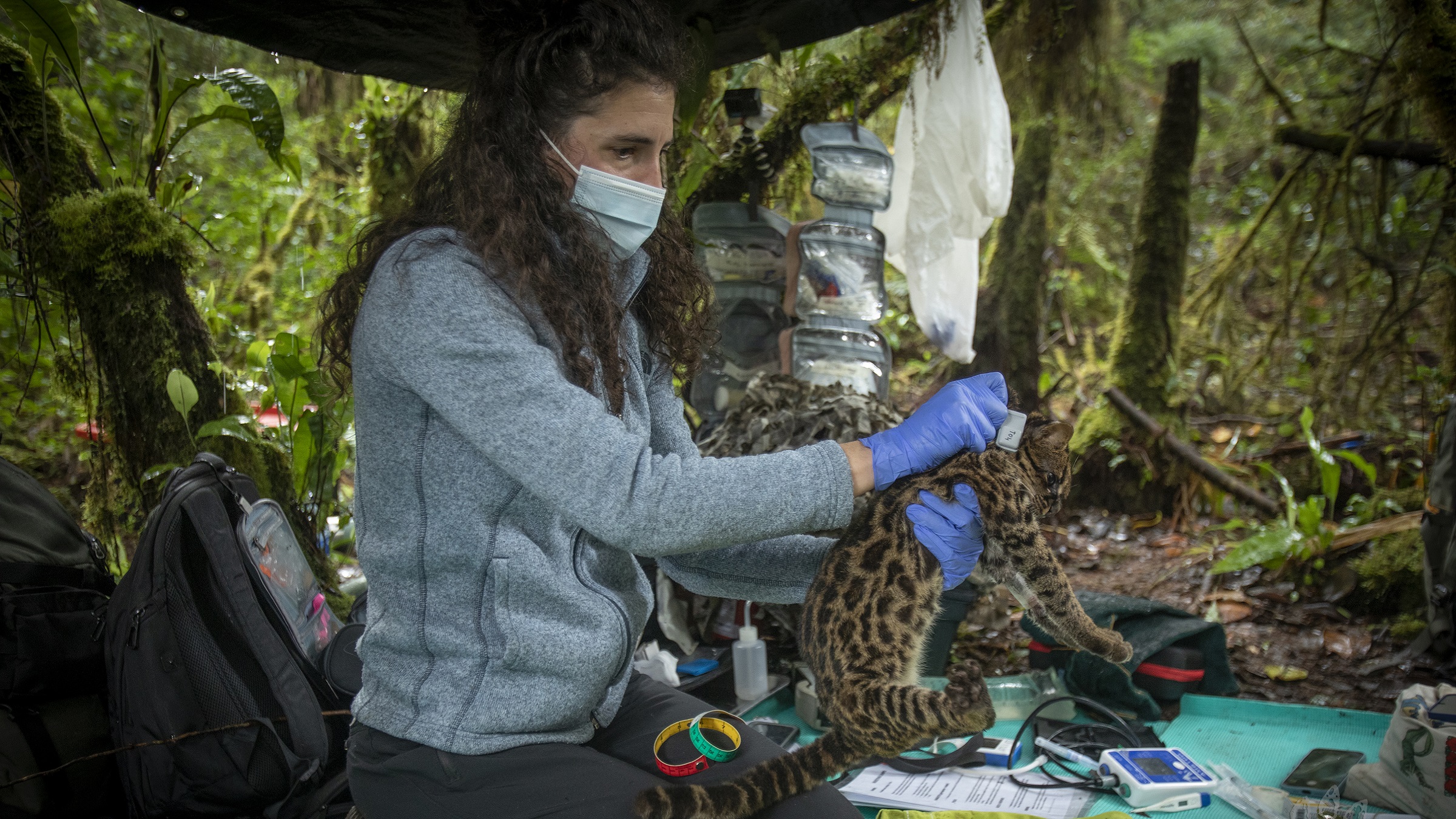
Since 2020, a small Latin American wildcat has repeatedly made science news as the tiger cat species complex (Leopardus tigrinus) underwent two major taxonomic splits, with researchers expanding it from two recognized species to four species. Then, in 2026, a new species unknown to science was identified in Bolivia.Tiger cats are notoriously elusive, and extremely hard to capture. One species, known as the clouded tiger cat or clouded oncilla (Leopardus pardinoides), a resident of rugged montane cloud forests in Central America and the Andes, has primarily been known from camera-trap images and specimens found dead.That is no longer the case thanks to the pioneering work of Amaia Autor, a young Spanish Ph.D. student who other tiger cat experts say is the first ever to capture, collar, and GPS-track L. pardinoides oncilla in the wild. This tiny wildcat’s range is limited to the cloud forests of Costa Rica and Panama.The founder of the Tiger Cats Conservation Initiative, a leading authority on Latin America’s various small cat species, confirmed the rarity of such trappings and the potential for new scientific and behavioral insights based on them. Autor is in the early stages of preparing her work for publication. Tadeu de Oliveira, founder and leader of the Tiger Cats Conservation Initiative, a group of scientists committed to studying the smallest wildcats of South and Central America, wanted to be crystal clear: “It is rare to catch a tiger cat. Period. Period!” he emphasized in a phone interview from Brazil with Mongabay. “You may ask ‘what species of tiger cat?’ because there are several. And I would say: all of them! We don’t have much information.” That’s about to change for at least one tiger cat, Leopardus pardinoides oncilla, a resident of the montane cloud forests of Central America. A young scientist, Amaia Autor, a Ph.D. student in conservation biology at the University of Montana in the U.S., has been in relentless pursuit, determined to trap the rare, elusive L. p. oncilla — also known as the clouded tiger cat or clouded oncilla — in the rugged Talamanca Mountains of Costa Rica since mid-2022, according to her Ph.D. adviser, conservation biologist Mark Hebblewhite. In what is being called a research first, Autor has managed to not just capture, evaluate, and collar one oncilla specimen, but seven different specimens since her first trapping in March 2023. She’s now analyzing her research data back in Montana for her doctorate. “Indeed, Amaia is the first person to capture free-ranging individuals of this species for research purposes and to conduct telemetry studies [GPS tracking],” Natalie Montera, a wildlife veterinarian with Cuatro Gatos Conservación (CGC), a Costa Rican initiative, confirmed for Mongabay in an email. A clouded oncilla in a cage trap just before Autor began the capture procedure of fitting the cat with a GPS collar and collecting biological samples and taking body measurements. This specimen was the only female of the seven clouded oncillas Autor captured. Image courtesy of Natalia Montero. “Her fieldwork is truly unprecedented in Costa Rica, representing a significant milestone in our understanding of [the Central American montane oncilla’s] ecology, behavior and conservation needs,” added Montera, who Autor called upon to safely anesthetize several of the tiny cats while gathering a range of data points and collaring them before their release. Montera noted that the pioneer in oncilla research is biologist José Daniel Ramirez, especially regarding genetics and camera-trap studies. Ramirez is the CGC coordinator and has collaborated with Autor. It was just two years ago that de Oliveira co-authored a major study that clearly differentiated L. pardinoides (which inhabits montane cloud forests in Central America and the Andes) from both the southern tiger cat (L. guttulus) and northern tiger cat (L. tigrinus), largely found in Brazil’s savannas and the Atlantic Forest. That research feat was accomplished in part by camera-trap images and the study of specimens found dead or in museum exhibits. With the upcoming publication of her thesis, Autor’s trapping, collaring, tracking, and study of this species in the wild will shine a bright light on this little-known mountain cat. More broadly, Latin America’s tiny wildcats are having a moment: In September 2026, researchers described the tilcayo (L. tilcayo), found in Bolivia and hailed globally as “the first discovery of a living, novel cat species in more than 100 years.” It is thought to be a close evolutionary cousin of the oncilla. This photo illustrates the dense, rugged cloud forest setting in which Amaia Autor set about capturing clouded oncillas; the image also illustrates the difficulty of the task. Here, she surveys one of the baited cages she used to successfully capture one of seven clouded oncillas over a three-year period. Image courtesy of Amaia Autor. A tiny apex predator One reason for the oncillas’ anonymity: When the sleek, stealthy cat is caught on camera traps, it is often mistaken for a small ocelot (L. pardalis), with its reddish, orangish fur, black stripes and spots; or a margay (L. wiedii), which is longer, heavier, with more angular facial features. The clouded oncilla lives in remote montane forests, at elevations above 1,500 meters (5,000 feet). No bigger than a house cat, the tiny felids usually weigh 2 kilograms (5 pounds) or less; they’re thought to be an important apex predator for their weight class, with a diet made up largely of rodents, shrews, ground-dwelling birds, and small reptiles. Oncillas are sometimes described as miniature leopards because of their spots and coloring. But de Oliveira — unfamiliar with Autor’s research until Mongabay called — said it’s believed that as many as 30% of the species are melanistic, looking like tiny black panthers. In fact, that’s what Autor gazed upon the first time she ever trapped one. A melanistic, or black, oncilla photographed by a camera trap as the small cat moved through the Costa Rican cloud forest. Experts on small wildcats estimate that about a third of oncillas are melanistic. Image courtesy of Amaia Autor and @huelladeltigrillo. ‘The most beautiful animal’ In 2022, Autor, a native of Spain, began stalking her target in the cold, rainy upper reaches of the Talamanca Mountains. Her trap was a long metal cage with a smaller cage inside containing a couple of live quails or a rooster as bait. If an oncilla entered the front part of the bigger cage, it would trip a pedal that would trap it inside. Autor confided that with so many fellow scientists, including her Ph.D. adviser, telling her that trapping an oncilla was next to impossible, she worried that she was wasting both research time and grant money. “The oncilla is kind of like a ghost,” Autor told Mongabay in a phone interview. “Most locals who live near them don’t even know they exist.” Then on March 21, 2023, Autor heard the hopeful beeping of a radio transmitter attached to one of her traps. She and her small team of research assistants scrambled out to what she described as “a dream.” “There staring back at me was the most beautiful animal I had ever seen,” Autor said of the melanistic oncilla she dubbed Calcetinas, Spanish for “socks.” She quickly reached out to Montera, the wildlife veterinarian, for help anesthetizing the feline. Autor recalled their phone exchange: “I called Natalie and I was like, ‘We have an oncilla! And it’s a melanistica!’ And she was like, ‘What?! I can die now!’” The first clouded oncilla Amaia Autor captured was melanistic (black), with gray paws. Autor, who is from Spain, named the tiny felid Calcetinas, Spanish for “socks.” Image courtesy of Amaia Autor. Valuable new details With Autor’s research not yet published, de Oliveira told Mongabay he’s eager to talk with her to learn whatever early findings she can share, especially regarding her GPS data on the small cat’s range in the Costa Rican mountains. Such information, he said, would be of immediate value to the IUCN Red List of Threatened Species. When told that Autor’s tracking collars are outfitted with double-A batteries that can only collect up to four months of GPS data, de Oliveira noted that her range findings may be limited. That’s because the longer you can GPS-track an animal, the larger its range tends to become. Then he ticked through the scientific names of the tiny wildcats to which he dedicates so much of his time as a leading expert on these species: “L. guttulus, L. tigrinus, L. emiliae, L. pardinoides. We don’t have much information on radio telemetry from any of them!” he said. But “even if [Autor’s range data] is limited, she has information that nobody else has. It’s also awesome that she managed to catch seven. That’s a really great number!” Autor explains her research and shares a photo of the first clouded oncilla she captured during an environmental workshop in La Trinidad de Dota with first-grade students. Image courtesy of Albert Bassols. Conservation is key Autor noted that she has another year or two of data collection and analysis ahead of her before she starts writing her doctoral thesis; still, she shared some general findings with Mongabay. Blood and hair samples are yielding taxonomic insights: Clouded oncillas, whose habitat is being squeezed, stick to forested locations, rarely venturing into open pastures or towns. That detail makes connectivity a conservation priority. Also, the Pan-American Highway, which cuts through Costa Rica’s mountains, poses a threat; 14 oncillas have been killed by vehicle traffic since 2021, Autor said, highlighting the importance of identifying potential wildlife crossing sites. Autor’s ongoing work in community-based conservation is seen by those who know her as just as valuable as her groundbreaking research. “Amaia has built an amazing community of landowners, ranchers, educators, government officials — a huge coalition of people who are now passionate about this species,” Hebblewhite said. “They are taking actions to restore habitat connectivity. They are advocating for corridors and crossings to mitigate the risk of the Pan-American Highway, something the Costa Rican government says it wants to do.” “Ultimately, projects like this give greater visibility to the species,” Montera added. “This helps local communities develop a sense of connection with, and pride in, the oncilla, and I believe that is one of the most important outcomes of her conservation work.” De Oliveira agrees. As he told Mongabay when it reported on his 2024 research: “Sometimes people just say, ‘Oh, it’s a new species!’ But that’s not the main issue; the main issue is the conservation, not only of Leopardus pardinoides, but of all the tiger cats.” The tiny wildcat Leopardus pardinoides oncilla, photographed here on a camera trap, is thought to be confined to a narrow, mountainous range between Costa Rica and Panama. Image courtesy of Amaia Autor. Banner image: Autor fits a small GPS collar to an anesthetized clouded oncilla, enabling her to track its movements for up to four months. Image courtesy of Elina Lagcher. Justin Catanoso, a regular contributor to Mongabay, is a professor of journalism at Wake Forest University in North Carolina. Citations: De Oliveira, T. G., Fox-Rosales, L. A., Ramírez-Fernández, J. D., Cepeda-Duque, J. C., Zug, R., Sanchez-Lalinde, C., … Rodrigues, F. H. (2024). Ecological modeling, biogeography, and phenotypic analyses setting the tiger cats’ hyperdimensional niches reveal a new species. Scientific Reports, 14(1). doi:10.1038/s41598-024-52379-8 Lescroart, J., Nogales-Ascarrunz, P., Cassatt-Johnstone, M., Bonilla-Sánchez, A., Sartor, C. C., Angulo, F., … Eizirik, E. (2026). Phylogenomics and museomics reveal five distinct species of tiger cats in South America. Current Biology, 36(19), 5027-5041.e8. doi:10.1016/j.cub.2026.08.059 FEEDBACK: Use this form to send a message to the author of this post. If you want to post a public comment, you can do that at the bottom of the page. Credits Topics
Clouded tiger cats are notoriously hard to catch. This young researcher caught seven
Full Article
Original Source
Read the full article at News →KhanList aggregates and links to publicly available news content. We do not host full articles from third-party sources. Always verify important information with original sources.