
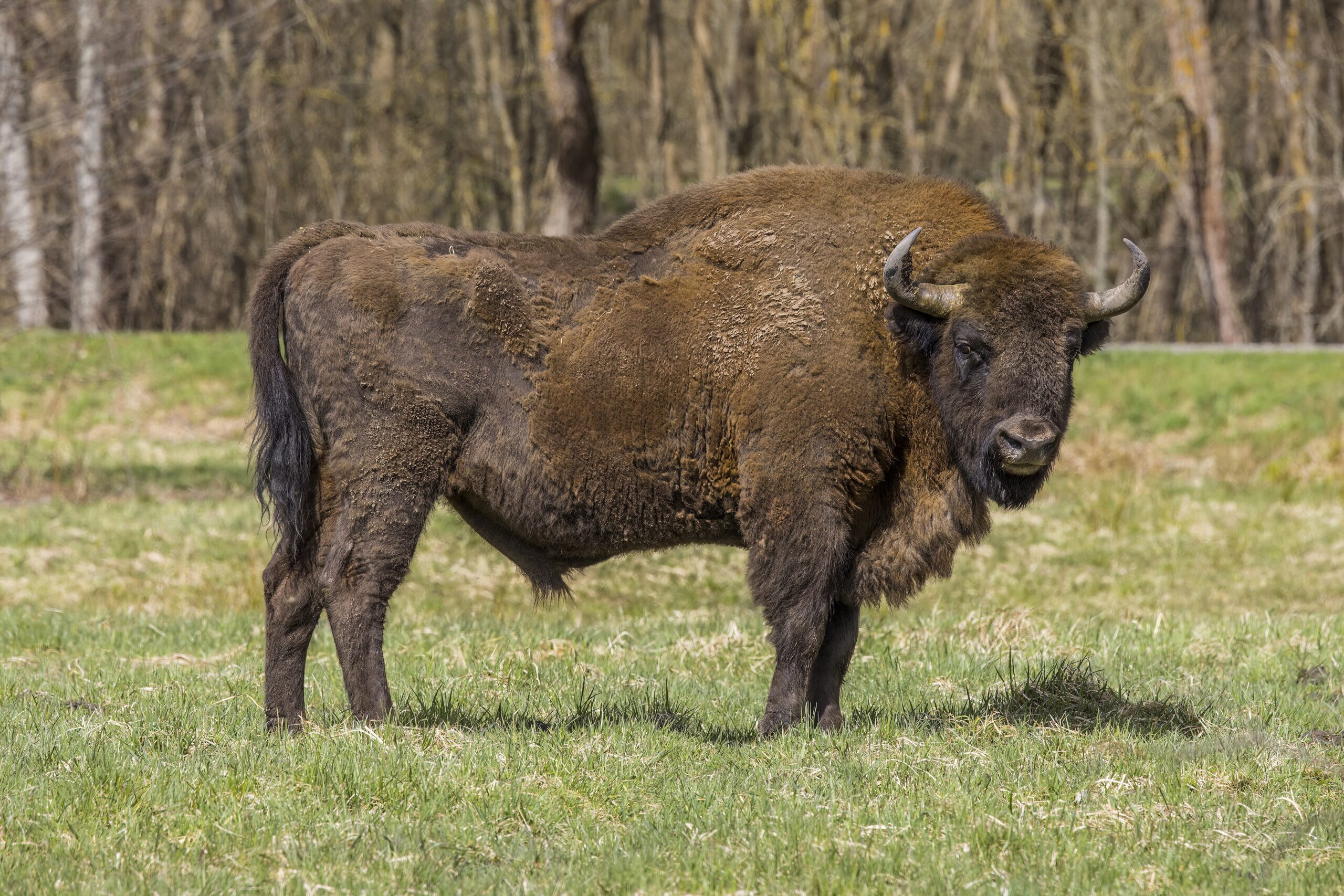
Poland’s border with Belarus runs through the Białowieża Forest, Europe’s last ancient woodland, home to lynx, wolves and European bison.To strengthen national security and deter Russian and Belarusian attacks, Poland launched the East Shield in 2024 — a 700-km (435-mi) border fortification project running along its northeastern and eastern flanks.But Polish scientists and conservationists say the East Shield would result in widespread damage to Białowieża Forest; they convinced the military to instead implement “WarWilding” techniques that forgo concrete in favor of using nature to create a defensive barrier called the Green East Shield.However, WarWilding proponents say road construction projects threaten to undermine progress on the Green East Shield and are harming the forest and its wildlife. BIAŁOWIEŻA, Poland — Michal Żmihorski, deputy director of the Institute of Environmental Protection, will never forget the morning of Aug. 1, 2023. Two Belarusian helicopters entered Polish airspace, hovering above the village of Białowieża in eastern Poland, three kilometers (1.9 miles) from the Polish-Belarusian border. The panic was palpable. “We didn’t know if the invasion had begun, if they were going to start dropping bombs,” he says during a conversation at the Białowieża-based Mammal Research Institute. The incident galvanized Żmihorski’s conviction that the borderlands should be impenetrable to enemy forces. “So that bandits on motorbikes can’t get through and start murdering people, because this is a real threat in this area,” says the longtime researcher of the UNESCO-protected Białowieża Forest straddling the Polish-Belarusian frontier. Poland shares a 420-km (261-mi) border with Belarus, 55 km (34 mi) of which runs through the Białowieża Forest, Europe’s last ancient woodland. This sprawling forest, covering an area equivalent to 200,000 football pitches, is among the continent’s top biodiversity hotspots. Consisting of impressive evergreens and broad-leaved trees, the Polish side alone is home to 900 European bison (Bison bonasus) — a species reintroduced to the forest — as well as lynx, wolves and up to 4,000 fungi species. While the specter of a military escalation by Belarus, a country that supports Russia, feels very real to some in this part of Eastern Europe, Poles throughout the country have been impacted by the war ever since Russia invaded Ukraine in 2022. To strengthen national security and deter a Russian and Belarusian attack, this key NATO state launched the East Shield in 2024 — a 700-km (435-mi) border fortification project running along its northeastern and eastern flanks. Scheduled for completion in 2028, this $2.6 billion program entails the construction of drone-detection systems and military infrastructure, such as concrete anti-vehicle obstacles, anti-tank ditches, and the preparation of minefields along the borders with Belarus and the Russian exclave of Kaliningrad Oblast. Other sections of Poland’s eastern frontier bordering on Lithuania and Ukraine are to house shelters and logistics centers. The Białowieża Forest straddling the Polish-Belarusian border covers an area equivalent to 200 thousand football pitches and is one of Europe’s last primeval woodlands. Image by alskikof via Flickr (CC BY-NC-SA 2.0). The Green East Shield When Żmihorski first saw the East Shield plans, he was flabbergasted. He says the construction of conventional fortifications in the Bialowieza Forest would require widespread logging and further drainage of an ecosystem already reeling from decades of fragmentation, drainage projects and increased militarization. Convinced that the implementation of the scheme in the ancient forest and other valuable green areas in the borderlands would spell a “disaster” for nature, he sprang into action. In July 2024, together with other Polish scientists and ecologists, he proposed an alternative: A Green East Shield that forgoes concrete in favor of using nature as a defensive barrier. Officially known as WarWilding — a term coined in the U.K. in 2022 — the concept employs the rewilding of forests and wetlands, wherever feasible, to boost national security. “Places like this are really important because a tank can’t get through,” Żmihorski says, standing on the edge of a carr forest, some 1.5 km (0.93-mi) from the Polish-Belarusian border. It’s filled with water, dead wood, tall grass and trees protruding into the sky, which makes it impenetrable to heavy machinery, according to Żmihorski. “So if we expect an attack from that side [Belarus], then we should preserve this type of environment here,” he says. An unlikely alliance To Żmihorski’s surprise, the Ministry of Defense embraced the idea, making Poland one of the first NATO states to officially fold ecological recovery into its national defense strategy in 2025. “Our position is that the construction of the East Shield and environmental protection can go hand in hand,” says Colonel Marek Pietrzak, spokesperson for the General Staff of the Polish Army. The force of nature isn’t lost on the colonel. “The landscape can put up a fight, and we would be stupid not to take advantage of it,” he says. Military strategists have been using nature in warfare for centuries, be it in ancient Rome, China, or during the Vietnam War. More recently, in 2022, Ukraine blew up a local dam on the Irpin River, flooding 13,000 hectares (32,124 acres) of wetlands drained in the 1960s and stopping Russia’s advance on the capital Kyiv. Last year, three U.S. soldiers died during military exercises in Lithuania after their transporter disappeared in a bog. Critics of the defense scheme say that contemporary warfare isn’t what it used to be. Instead of sending tanks, aggressors largely rely on missiles and drones to attack, which renders border fortifications obsolete. In 2024, the Strategic Yearbook, a University of Warsaw academic publication, said the East Shield resembles a modernized version of the Maginot Line, calling it “somewhat anachronistic.” The military begs to differ. “No matter how many drones, missiles, or artillery shells the enemy sends our way, ultimately, they will still want to put boots on the ground,” Pietrzak says. The military and scientists agree that wetlands and bogs along Poland’s eastern flank can become valuable military infrastructure and ward off an armed attack by Belarus or Russia. Image by Andy Ball. While little has changed on the ground thus far, in May 2026, the Ministry of Climate and Environment announced it will dedicate some $120 million to rewet ailing peat bogs and marshes along Poland’s borders with Russia and Belarus. The funds, the ministry said, combined national defense goals with those aimed at building resilience to climate change. Restoring water levels in forested areas, according to Paulina Hennig-Kloska, the Minister of Climate and Environment, will help woodlands respond to higher temperatures and the growing threat of wildfires. “Lack of snow cover means that water replenishment in forested areas, which a couple of years ago turned into wetlands — especially at the end of winter, beginning of spring — today requires active protection,” Hennig-Kloska said during a press conference on May 25, 2026. According to WWF, Poland drained almost 85% of its peat bogs, emitting nearly 44 million tons of CO2 into the atmosphere. In addition to bolstering resiliency to increasing temperatures and fire, rewetting its bogs would significantly reduce greenhouse gas emissions. Along with wetland restoration, the authorities banned the clearing of dead wood in borderland forests and logging within 5 km (3 mi) of the frontier. This first line of defense, known as the “no-go” zone, is meant to stop heavy military vehicles in their tracks. The second line, stretching 50 km (31 mi) into the country, is meant to slow enemy forces, giving Polish soldiers more time to respond to a threat. Overall, government officials assert, these natural defenses will help safeguard up to 60% of Poland’s eastern and northern flanks. Michal Żmihorski has been the most vocal proponent of the Green East Shield. The scientist says carr forests are a perfect defense system, since they are impenetrable to heavy military machinery like tanks. Image by Andy Ball. High stakes For Białowieża Forest, WarWilding might be its last fighting chance. Conservationists say that today, more than ever, the forest needs a break to bounce back from years of crisis after crisis. Water levels in the ancient woodland have been plummeting due to climate change and decades of drainage projects, endangering key habitats for protected and rare species. In 2017, loggers cleared an area of the forest equivalent to 980 football pitches in a state-sanctioned fight against the European spruce bark beetle (Ips typographus), drawing criticism from environmentalists. The logging only stopped after the European Union’s top court ordered a halt to the forest clearing that same year, saying it could cause “serious and irreversible damage” to the woodland, The Guardian reported. But the respite didn’t last long. In 2021, then-Prime Minister of Poland Mateusz Morawiecki, together with EU, NATO, and the U.S., accused Belarusian dictator Aleksander Lukashenko of luring vulnerable asylum seekers and migrants from the Middle East and Sub-Saharan Africa to his country, then facilitating their entry into Europe through Poland’s green border. The Lukashenko administration did not respond to Mongabay’s request for comment for this story, but denied these accusations in 2021. In 2022, Poland built a 186-km (116-mi) steel fence in response to incursions from Belarus, cutting the ancient forest in half. Conservationists say the steel barrier, coupled with increased traffic from border patrols, has pushed the forest to the brink. Dozens of animals, including the protected European bison, died in vehicle collisions, while the fence blocked animal migration routes from the Polish to the Belarusian side of the forest. In 2025, the International Union for Conservation of Nature warned that Bialowieza is in a “critical” condition. The body stated that the impacts of the border infrastructure and security operations further exacerbate the cumulative pressure on “hydrology, wildlife movement, wildlife population ecology, (and) predator-prey dynamics.” The Białowieża Forest straddling the Polish-Belarusian border covers an area equivalent to 200,000 football pitches and is one of Europe’s last primeval woodlands. Image by Andy Ball. A glimpse of what’s possible Białowieża has been grappling with deteriorating water levels for decades. A wide web of drainage ditches and artificially straightened rivers has accelerated the flow of water out of the forest. Poland’s Institute of Environmental Protection estimates that in the last 200 years, groundwater levels have dropped by 40 centimeters (16 inches). Białowieża’s wetlands have remained dry since 2023, even in springtime when melting snow cover would typically rewet them, the institute says. Most recent water retention initiatives in the forest have been small-scale and spearheaded by NGOs and, to a lesser extent, by local authorities and the Polish State Forests. “We know that the soil is dry everywhere, which is why we’ll be working even on the smallest drainage ditches,” says Edyta Kapowicz, the director of the Polish Association for Bird Protection (PTOP). Kapowicz is working on the biggest water-retention project currently underway in the forest, together with German conservation NGO Frankfurt Zoological Society, Białowieża National Park and local authorities. While not officially a WarWilding project, the initiative offers a glimpse of what Green East Shield rewetting interventions could look like in the Białowieża Forest and, more broadly, in Poland’s eastern frontier. Throughout April and May, Kapowicz’s colleagues and volunteers had been filling in drainage ditches with soil and dead wood — the quickest and cheapest way to rewet the ancient forest. The expectation is that blocking drainage ditches should restore water retention across 3,500 hectares (8,649 acres) of the woodland. “This way, we can keep at least some water in these habitats, which are drying out,” says Kapowicz as she walks through an unnaturally crispy carr forest. This particular project also aims to reconnect rivers and streams to their floodplains along 25 km (16 mi) of the Lutownia and Narewka rivers, bringing back old oxbow lakes and re‑meandering river sections. Both rivers were artificially straightened in the past. Kapowicz says it will also restore a further 8,500 hectares (21,000 acres) of surrounding mire and wetland landscapes. The forest has been grappling with drought for years. Bialowieża’s wetlands have remained dry since 2023, even in springtime when melting snow cover would typically rewet them. Image by Andy Ball. A veteran conservationist, Kapowicz cut her teeth on water retention projects in the forest. Twelve years ago, her organization successfully renaturalized sections of the local Narewka River by recreating the original river meanders and building small dikes. The wetlands, which were restored in the process, are a key habitat of the strictly protected lesser spotted eagle (Clanga pomarina). “We know that nature doesn’t always come first, but here we have such a valuable UNESCO site, we should take care of it,” she says. All roads lead … to the border While scientists and the military agree that the forest’s most strategic value lies in being wet and forested, Bialowieza has another problem. “For these two effects to work, we can’t have a dense network of roads,” says Żmihorski, the Green Shield proponent. There are around 2,000 km (1,243 mi) of roads cutting through the woodland, according to Żmihorski. The roads slicing Europe’s last primeval forest have been a subject of debate and conflict for years between authorities, residents, scientists and environmentalists. Local authorities and residents in this remote, sparsely populated part of Poland say they need roads to reach hospitals quickly. They assert that they improve safety and connectivity with the outside world — the northeast of the country has been suffering from transportation exclusion. But the dense web of roads isn’t only fragmenting habitats; it also significantly affects groundwater levels by disrupting natural hydrological connectivity within catchments, according to a 2022 hydrological assessment of the Bialowieza Forest by PTOP. The assessment found that while many roads are equipped with culverts, their density needs to be increased along certain sections in order to maintain connections between water sources. This is particularly critical in areas where roads intersect surface and groundwater flow paths, the report says. Although ecological preservation is now part of Poland’s military doctrine, there seems to be a disconnect between what the central government says and what local authorities do, according to Żmihorski. “This borders on sabotage,” he says, referring specifically to a recent widening of regional road 687, which connects the Polish-Belarusian border to the interior. When he arrives at a construction site along 687, Żmihorski whips out his phone and takes photos of the excavators widening the road and trees destroyed in the process, gasping in disbelief. “We hear that the Green East Shield is something we should be investing in, and simultaneously, we have this road construction project. Quite incredible,” he says. There are around 2,000 km of roads of various types cutting through the Białowieża Forest. This fragmentation, scientists and environmentalists say, significantly affects groundwater levels by disrupting natural hydrological connectivity within catchments. Image by Andy Ball. The project has triggered a barrage of criticism from ecologists and environmentalists, raising questions about its compliance with domestic and international laws and regulations. Poland’s top environmental watchdog, Workshop for All Beings, alleges that construction took place during the bird breeding season, despite a regional environmental authority ban on such projects between March and August. The ban applies to tree felling, excavation work, and the destruction of the habitats of protected species. The group filed a complaint with the General Director of Environmental Protection, questioning the validity of the project’s environmental impact assessment. It’s also seeking to stop the flow of EU funds that is supporting it. The Regional Road Construction Authority refuted Workshop for All Beings’ allegations in an email to Mongabay, and stated that the project had obtained all necessary permits. Krzysztof Barbachowski, the director of the Regional Road Construction Authority, said his team paused road works when it learnt the area is a habitat for protected bird species, pending further authorization. Barbachowski pointed out that the regional authorities aren’t building a new road from scratch. Rather, they are modernizing a route that’s been in use for years. “Preparations for the investment began long before the inception of the ‘East Shield’ program: Work started in 2014, consultations were held in 2015, and the environmental decision was issued in 2016 — at a time when the geopolitical situation beyond the eastern border was completely different,” Barbachowski said. A representative for the Regional Directorate for Environmental Protection in Białystok told Mongabay in an email that the previous management approved the project a decade ago — a decision the current administration is at odds with. “The project could have been implemented in a less invasive manner by scaling back the scope of works and limiting the extent of tree felling within the Białowieża Forest,” it wrote, adding that the directorate has since introduced several mitigating measures. Regarding the construction’s impact on the Green East Shield and national security, the directorate’s representative advised Mongabay to speak to the Ministry of Defense, which referred Mongabay to the Ministry of Climate and Environment, which referred Mongabay back to the Ministry of Defense. This dispute comes at a historic time for the Bialowieza Forest; in June, Poland approved a new Bialowieza Forest Management plan, which is slated to come into effect in 2027. The document envisages, among other things, leaving 96% of the Polish portion of the Białowieża Forest to natural processes. Currently, that number stands at 37%. A collared flycatcher (Ficedula albicollis) in Białowieża Forest. Image by Frank Vassen via Wikimedia Commons (CC BY 2.0). Meanwhile, Poland has been put on high alert by indications that Russia may launch an attack or a provocation in the country. For Żmihorski, who has been advocating for sweeping WarWilding projects since 2024, the question is no longer whether nature can defend Poland’s border, but whether there’s enough time and will to do so. “We need drastic action,” he says. “It’s not like we can ponder another five years, because the political situation is very uncertain, very unstable.” Banner image: The Polish side of the Bialowieża Forest is home to 900 Bison, brought back from the brink of extinction. Image by Charles J. Sharp via Wikimedia Commons (CC BY-SA 4.0). FEEDBACK: Use this form to send a message to the editor of this post. If you want to post a public comment, you can do that at the bottom of the page. Could biodiversity be a key to better forest carbon storage in Europe? Last chance to save Europe’s greatest old-growth forest? (commentary) Credits Topics
Can WarWilding defend Poland’s borders and save Europe’s last ancient forest?
Full Article
Original Source
Read the full article at News →KhanList aggregates and links to publicly available news content. We do not host full articles from third-party sources. Always verify important information with original sources.