
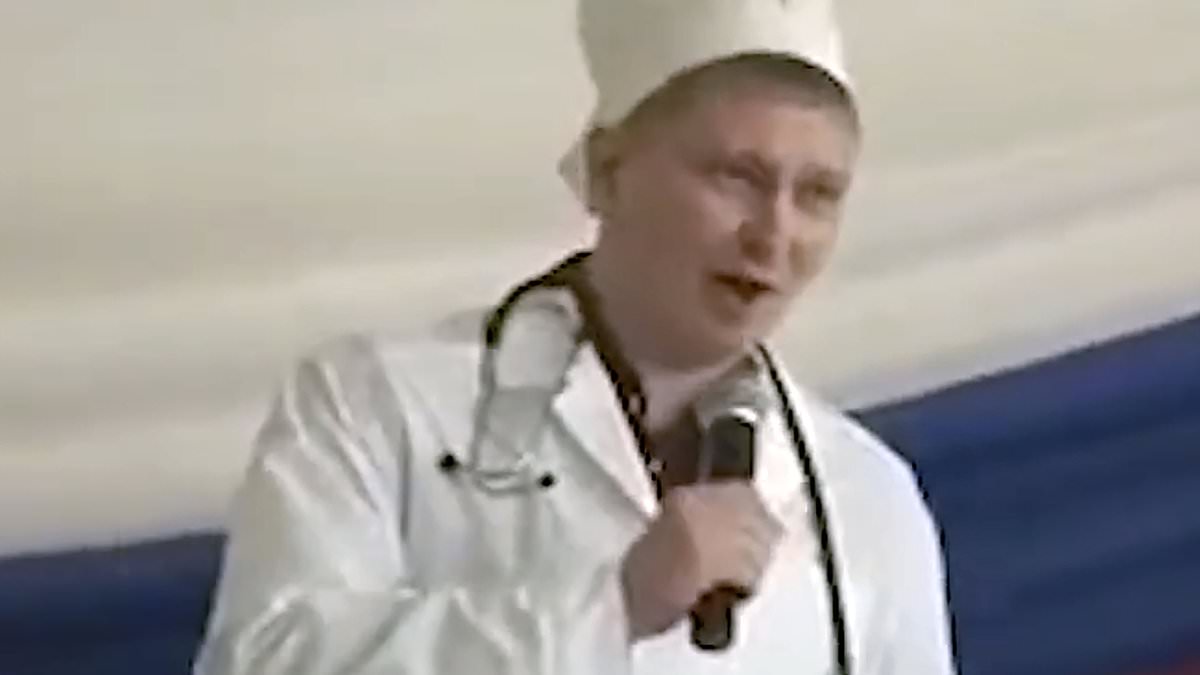
Russian prison guards play a sick and twisted game with fresh Ukrainian prisoners of war. Known as 'admission', guards at penal colonies and camps across Russia and Russian-occupied Ukraine will line up and beat up recent arrivals with anything at their disposal. In a maelstrom of terror and pain, stun guns, batons, hardened boots and closed fists fly at those who were captured in the line of duty. The aim of this sick ritual is to break Ukrainian prisoners, both physically and psychologically, to get them to spill their guts about military secrets and keep them compliant. Overseeing the guards are an army of 'maniac' medical professionals, tasked with keeping detainees alive. What's more, these men and women, who swore the Hippocratic Oath to do no harm, take part and relish in the near constant torture of prisoners. Testimonies from Ukrainian prisoners of war, as well as civilians illegally detained by Russian forces, paint a harrowing picture of medical professionals overseeing systemic physical, psychological and sexual abuse in detention centres run by Vladimir Putin's army.Among the worst of these medics, according to a report published by Centre for Civil Liberties – which was awarded the Nobel Peace Prize in 2022 and is run by human rights activist Oleksandra Matviichuk – is Ilya Sorokin, a man known by the nickname 'Doctor Evil'.Based in Penal Facility No10 (IK-10) in the Republic of Mordovia, Russia, Mr Sorokin was given the moniker by prisoners, who were left petrified by his total lack of humanity. Ilya Sorokin (pictured), also known as Doctor Evil, was given his nickame for his lack of humanity A Ukrainian prisoner of war who was returned to his home nation in May 2024He was known, according to one prisoner, as an 'individual who tortured more than other prison staff... [and] aimed to cause the greatest harm'.An inmate recalled that after a fellow prisoner lost many of his teeth following an 'admission' ritual, Doctor Evil was called to tend to his wounds. He said: 'The cell door opens, and he asks, "So whose tooth is aching? Okay, come out".'The guy came out, and they began beating him. The doctor then shocked him with a taser so strongly that he lost consciousness. They didn't administer ammonia; instead, they simply woke him up by resuming beating him with a taser. And that's it. 'Then, he crawled into the cell, and Doctor Evil asked, "Well, who else has a toothache?"' Another prisoner spoke of a fellow detainee, an officer, who was unable to stand due to a hip problem. The officer would be made to attend a daily medical check-up, where staff would 'apply the taser to the same joint that was hurting, helping him 'forget' the pain quickly,' they said. Another person said of Mr Sorokin: 'He would hit the person addressing him and the person on duty in the cell. And he would say: "Patient, what's wrong with you? Patient, come here, give me your hand". A jail cell in the border town Kozacha Lopan which is believed to have been used by Russian soldiers as a torture chamber An emaciated Ukrainian soldier who was returned during a prisoner exchange in 2024 'Your eyes are closed, your head is tilted down, and you can't see anything. You give him your hand, and he hits you in the hand with a taser. First, he hits you with a taser, and then he gives you a pill.' According to the UN, 95 per cent of Ukrainian prisoners of war interviewed reported being tortured or ill-treated in Russian captivity.More than half also reported sexual violence, including 'rape, gang rape, beating while nude, beatings to the genitals, electric shocks to the genitals and nipples, and degrading treatment of a sexualized nature'. In pre-trial detention centre No2 (SIZO-2) in Staryi Oskol, which sits in Russia's Belgorod region, former prisoners spoke of a female medical professional who routinely physically and sexually abused prisoners of war.Nicknamed the 'Aunt in Pink' for her bright and colourful outfits, she would regularly task prison guards to carry out her bidding, which included using tasers to administer painful electric shocks. One victim said she masked her torture orders with the veneer of scientific language, wrongly using the term 'electrophoresis' to mean an electric shock given to an already painful area. The victim said: 'She said [to prison guards], "Give a shock to this one, do electrophoresis on his knee for the other, so it heals faster".' Plastic ties for torture and a broken chair are seen inside a basement of an office building, where prosecutors say 30 people were held two months during a Russian occupation, amid Russia's attack on Ukraine, in Kherson, Ukraine, December 10, 2022 A basement of the regional police headquarters of Kherson in January 2023, allegedly used as a torture site of pro-Ukrainian citizens during the Russian occupation'If you had a headache, they would beat you on the buttocks or genitals because it hurts more there. In the next cell, a guy was complaining that his teeth hurt and that he was being hit in the neck with a taser.'Another person said that they were sexually abused by prison guards at the 'Aunt's' behest, after daring to ask for medical attention to treat a fever. They said: 'She was very surprised and asked, "Do you have a fever thermometer? Where did you hide it? Let's look for it".'The medical worker pointed with her finger where to look - at the buttocks and genitals. And the guards looked there. They used a taser to search, targeting the nerve endings in the lower back and buttocks. 'It is very painful. And for her, it was just a funny joke.'Several people spoke of the medical neglect they faced while detained by Russian forces. One person, who was held at the infamous Olenivka Corrective Colony No120 in the Russian-occupied Ukrainian region of Donetsk, spoke of being ignored by medical professionals charged with taking care of them. They said of their time in the colony: 'It was very difficult in Olenivka with the medical care. The doctor asks, "What is hurting?" I answer her. She just turns around and walks away. This was all the help I got.' Beyond the neglect, many former prisoners said they believed all the staff at their prison were 'evil'.One former detainee said: 'They hated us and said various negative things. Healthcare professionals should not behave in that manner.' A Ukrainian soldier who was previously held captive by Russian forces is examined by staff while undergoing rehabilitation on June 6, 2024 in Ukraine An office chair stands in the corridor of a basement in a building used, according to a war crime prosecutor, by Russian forces as a place of torture in Kherson, Ukraine, Thursday, December 8, 2022Last month, a former Ukrainian prisoner of war gave a horrific account of the abuse he endured during 1,183 days in Russian captivity.Khuan Alberto Levya Garsiya said he suffered 'every imaginable form of torture', including daily beatings, electric shocks and sexual abuse.Two of his friends were beaten to death in detention centres in the Donetsk region, while other prisoners were left starving and riddled with disease, he said.'Yes … I was tortured,' Mr Garsiya told reporters after a UN meeting.'Anything you can think of that can be done hurtful, humiliating to a man, unwillingly. Anything that comes to your mind, not only verbal, physical abuse, daily beatings, electrocution, excessive, excessive exercises in freezing cold when it's minus degrees… sexual abuse.'Everything that can be applied to a person into making a person break mentally. It was all applied to me and most of my comrades.'Mr Garsiya told the UN meeting that prisoners were crammed into 'overcrowded barracks without adequate conditions', where 'almost all POWs were ill with dysentery'. Crimean Tatar activist Leniie Umerova, released in a prisoner exchange in 2024, said she was detained while trying to visit her seriously ill father in Crimea.She described being moved through 'seven detention facilities' in what she called 'a carousel of repression' and accused Russia of using torture against Ukrainians in captivity.Oleg Gushin of the Ukrainian government's Coordination Headquarters for the Treatment of Prisoners of War said Ukrainian prisoners were 'killed and tortured' in detention.He said Kyiv had identified 'more than 300 places of detention' in Russia and occupied Ukrainian territory and that while more than 9,000 Ukrainians had been returned through exchanges, 'thousands' remained in Russian captivity.
Inside 'complete horror' Russian jails where sadistic 'Dr Evil' and 'Aunt in Pink' torturers punish Ukrainian PoWs with electric shocks and beatings
Full Article
Original Source
Read the full article at Dailymail →KhanList aggregates and links to publicly available news content. We do not host full articles from third-party sources. Always verify important information with original sources.