
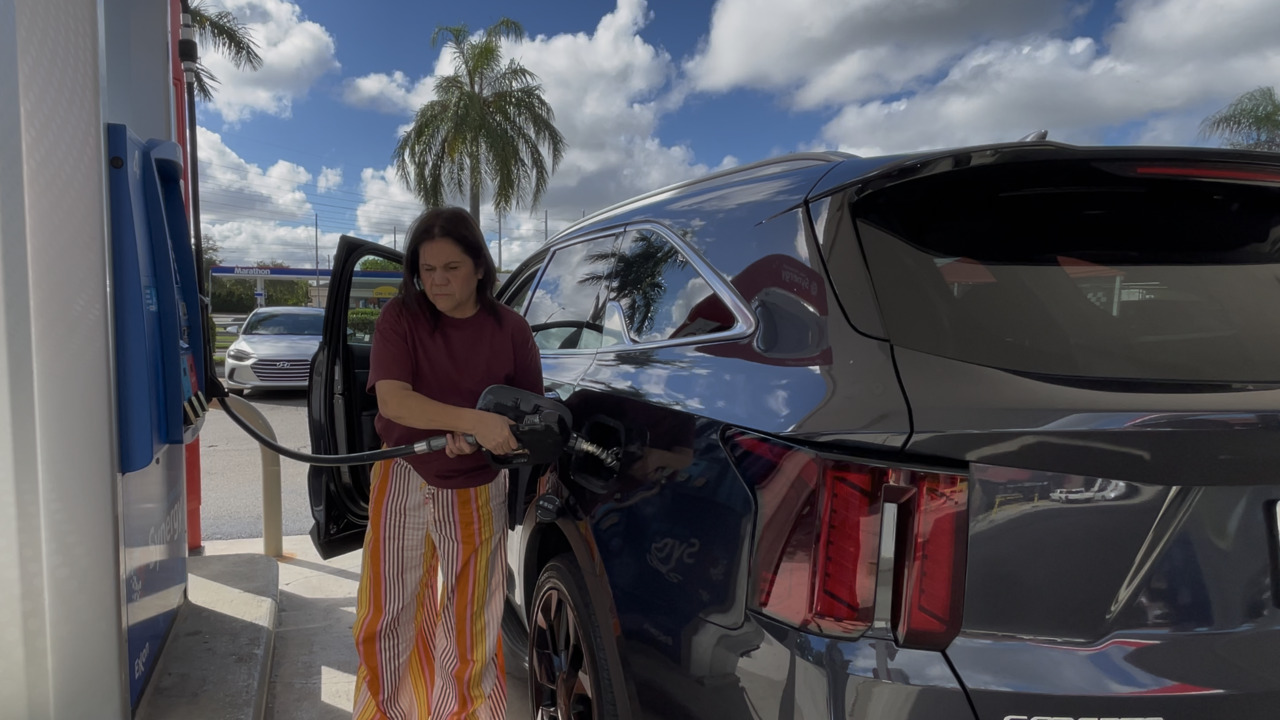
Rising petrol prices and anger over immigration raids are testing Latino support for Republicans in Florida. Ahead of Tuesday’s midterm elections, Democrats see an opening in a state that has swung firmly to the right, but economic frustration may not be enough to overturn years of Republican dominance. Outside his car-service station in Doral, a predominantly Latino city west of Miami, the owner has his employees polish his pride and joy: a majestic 1960s Rolls-Royce Silver Ghost II, coated in silver from top to tail. He does not speak english, and when asked about the general economic situation in Florida, he grins and gives a thumbs up. But Celeste, a Latin American immigrant who stopped at his service station to buy petrol, is worried. “Today I paid $45 because I didn’t fill it up as it’s getting very, very expensive each day,” she says. "I'm very surprised because when I first got to the United States it wasn't that price, it was $2 and something [per gallon]". That's less than half of today's price. Despite the price hikes, driving less is not an option. "I have to use the car,” she says. Celeste declines to say who she will vote for next week. "That's private," she says, but admits the situation presents "a problem for our pocket". Silver Rolls Royce Silver Ghost II belonging to the owner of a car service station in Doral, Florida, 30 October 2026. © RFI/Jan van der Made Cost of living concerns The squeeze on households budgets is a key issue in Florida’s 3 November midterm elections, when voters will choose their next governor and decide key races for the US Senate and House of Representatives. In a state that has moved decisively to the right, Democrats hope concerns about living costs and immigration enforcement will reopen the political contest. Two years ago, Donald Trump's economic message appealed to many Latinos says Liz Rebecca Alarcón, founder of Latino media organisation Pulso. “The idea that he was a businessman was appealing to many people who were struggling after the pandemic,” she says. “There was a lot of hope that there would be some relief for families after that hard time.” Instead, she argues, households have seen costs rise. Liz Alarcón, founder of Pulso, a nonprofit media outlet reaching more than 1 million Latinos, based in Doral, Florida. 30 October 2026. © RFI/Jan van der Made “The cost of living matters," notes Eduardo Gamarra, a political scientist and Director of the Latino Public Opinion Forum, pointing to the gap between campaign promises and what voters have experienced. The pressure is particularly acute for Latino households "dependent on wages or fixed incomes," he notes. Trump's immigration policy is another source of frustration. Many Latinos want an orderly border and a pathway to citizenship, but object to the treatment of people caught up in deportation operations, Gamarra says. Alarcón sees the two issues as inseparable, arguing that “if people are scared to come to work, they can’t make a living for their families.” Businesses also suffer when customers fear raids, she says, describing the recent arrest by US Immigration and Customs Enforcement (ICE) of the owner of a well-known Venezuelan restaurant. "If you are the person who brings in the salary to your family and ICE takes you, how do you pay the bills?" she asks. She also describes how an aquaintance who owns a business "is driving the car of a US citizen to prevent ICE being able to track her license plate and take her". Contrasting platforms On 3 November, Republican Senator Ashley Moody faces Democratic state representative Angie Nixon in a special election to complete Marco Rubio’s term following his appointment as secretary of state. Democratic candidate for U.S. Senate Angie Nixon speaks on stage during a fireside chat hosted by Rep. Frederica Wilson at Florida Memorial University, Thursday, Oct. 8, 2026, in Miami Gardens, Fla. AP Photo/Lynne Sladky - Lynne Sladky Florida’s other senator, Republican Rick Scott, was re-elected in 2024 and is not on the ballot this year. Moody is focusing on Trump’s agenda and immigration enforcement, while Nixon, who is endorsed by the Democratic Socialists of America, is campaigning on living costs, healthcare and stronger social provision. “She’s run primarily on affordability,” Gamarra says of Nixon. He believes her grassroots campaign is mobilising black voters and could help Democrats elsewhere on the ballot, even if she falls short. But some Latino voters have reservations about Nixon’s position on Latin America. “For some time people weren’t sure where she stood,” Alarcón says. But she welcomes Nixon’s recent denunciation of Cuba’s dictatorship and support for Venezuelans seeking freedom. “I’m hopeful, I'm going to vote for her.” Meanwhile, Republican congressman Byron Donalds faces Democrat David Jolly, a former Republican congressman, in the race to succeed Ron DeSantis as governor. Property insurance, housing and healthcare dominate the contest. Donalds is offering a lower-tax, less regulated approach while Jolly has promised insurance reform and expanded Medicaid, the government health insurance programme for people on low incomes and some other groups. A Miami battleground The heavily Latino 27th Congressional District, where Republican María Elvira Salazar faces Democrat Eliott Rodriguez, is another "important race to watch", notes Alarcon. Both candidates are Cuban-American former television journalists. Rodriguez has challenged Salazar over the protection of local communities during immigration raids, she says. Gamarra calls the race “probably the most interesting contest" in Miami-Dade County. But he stresses that Latino voters "are not completely committed to any party for the long term". Political scientist Edouardo Gamarra, Prof Green School of International and Public Affairs and Director the Latino Public Opinion Forum, 30 October 2026. © RFI/Jan van der Made Florida was once a symbol of electoral uncertainty. In 2000, Republican George W. Bush’s certified lead over his Democratic rival Al Gore was just 537 votes. The Supreme Court ended the recount, handing Bush Florida’s 25 electoral votes and the presidency. In 2008 and 2012, however, Florida backed Democrat Barack Obama before conservative gains among Latino voters helped turn it solidly Republican. Trump carried Florida by about 13 percentage points in 2024. Alarcón now predicts a “blue wave”. But Gamarra says Republicans retain major structural advantages, including a voter registration lead of 1.5 million. Despite the Democrats' "infectious optimism", he believes turning Florida blue will remain "very difficult".
Can Latino discontent loosen Republican grip on Florida?
Full Article
Original Source
Read the full article at Rfi →KhanList aggregates and links to publicly available news content. We do not host full articles from third-party sources. Always verify important information with original sources.