
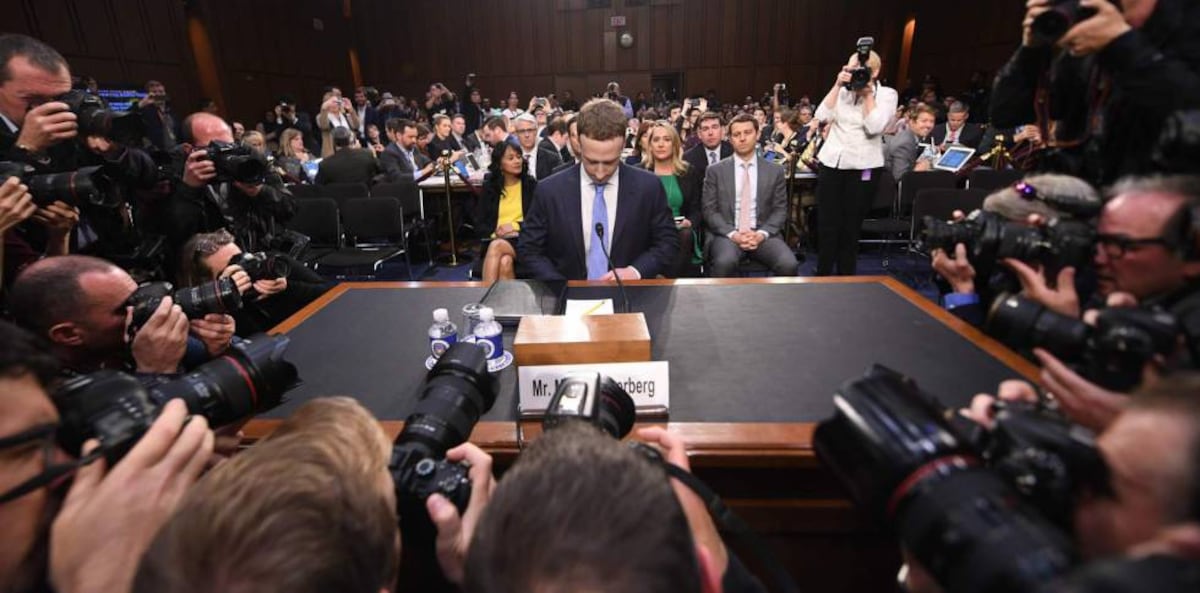
2016 was a pivotal year in the 21st century. In June, Britons voted in a referendum to leave the European Union. In November, U.S. voters elected Donald Trump as president, a figure widely regarded as a bad joke by both Democrats and establishment Republicans. Both events marked the beginning of a far-right wave that, a decade later, continues to sweep across much of the world. And both were aided, perhaps decisively, by a small London-based political consultancy: Cambridge Analytica. The company collected data from 87 million Facebook users without their consent and used it to create personalized political propaganda to boost the campaigns for Trump and Brexit, among others.It was the first warning that the vast amount of information platforms collect about users through their likes, interactions and browsing histories can be used not only to sell them products, but also to manipulate them psychologically and try to influence how they vote.A decade later, the shadow of Facebook and Cambridge Analytica still looms large. The issue returned to the spotlight last week, fueled both by the record fine imposed on Meta and the elections taking place around the world.In Brazil, the Superior Electoral Court spent last week sparring with Mark Zuckerberg’s company in an effort to make it demonstrate that the algorithms of Instagram and Facebook treat equally the two candidates competing in Sunday’s presidential runoff: Luiz Inácio Lula da Silva, of the left-wing Workers’ Party (PT), and Flávio Bolsonaro, of the right-wing Liberal Party. In recent weeks, the Brazilian government has accused Meta’s platforms of giving preferential treatment to the Bolsonaro campaign.Brasília complains that Lula’s account was temporarily suspended, that his rival’s content was being promoted and distributed more widely than his own, and even that images generated by Meta’s artificial-intelligence tool appear less sharp when depicting Lula than when depicting Bolsonaro. Similar biases were also reported in WhatsApp searches. Meta, for its part, has blamed technical errors, although a group of employees allegedly acknowledged that the problems in every case were detrimental to Lula’s campaign.The shadow of Cambridge AnalyticaAs it happened, while Brasília was locked in that dispute with the technology giant, a court in New Mexico on Wednesday ordered Meta to pay a record fine of around $25 billion for violating privacy laws, on top of the $5 billion it had already paid to the Federal Trade Commission (FTC).This year, Meta has also suffered a string of legal setbacks on another major front: the impact of social media on minors. These have included additional fines and a settlement with 52 state attorneys general, under which the company agreed to pay up to $18 billion in exchange for the withdrawal of their lawsuit.That issue — the mental health of young people exposed to social media platforms — has dominated the debate about the societal influence of Big Tech. But in an election year for countries such as the United States, which will hold its midterm elections in November, Spain and Israel, it is worth remembering what Cambridge Analytica revealed about how social networks can be used to influence elections.“We used Facebook to harvest data from millions of people and build models that appealed to their preferences and private demons,” Christopher Wylie, an analyst at Cambridge Analytica and the whistleblower who exposed the scandal to the world, told EL PAÍS. Wylie was one of the main architects of the digital machinery that propelled the early far right of the 21st century in both the United Kingdom and the United States.“We played with a nation’s psychology,” said the young Canadian engineer. How did they extract so much value from Facebook data? Users’ likes, posts and comments were used to build psychological profiles. Cambridge Analytica did so using five traits: openness, extroversion, conscientiousness, agreeableness and neuroticism. From there, the consultancy grouped those profiles into categories. The next step was to use that information on each individual to allow political parties to send different ads to different potential voters, tailoring the message, whether more emotional, inflammatory, or informative, according to what was known about them. In this way, the impact could be far greater than that of a generic advertisement.The scandal led to inquiries in both the British Parliament and the U.S. Senate. “The Electoral Commission described the pernicious nature of micro-targeted political adverts: ‘Only the voter, the campaigner and the platform know who has been targeted with which messages. Only the company and the campaigner know why a voter was targeted and how much was spent on a particular campaign,’” stated a 2019 House of Commons report on disinformation and fake news. The report concluded that Zuckerberg’s company had acted in “bad faith” and described social media platforms as “digital gangsters.”Backlash and rollbackThe Facebook–Cambridge Analytica scandal was huge. The British consultancy collapsed; Mark Zuckerberg faced his first hearings before investigative committees. And social networks responded. “Platforms took action,” explains Carmela Ríos, a journalist who specializes in social networks and disinformation. “I think we won in that sense, because we gained transparency and that also forced social networks to act. It was after that that Facebook decided to open its political ad library, for example, and launched CrowdTangle [the free tool to detect the spread of hate speech].” That period did not last long. When Elon Musk bought Twitter in 2022, the rollback began. The billionaire fired content moderators at the newly rebranded X, which shifted toward community moderation, a model that Meta later adopted on its own platforms. Algorithms became more influential, and researchers and journalists were no longer given access to information about how the platforms operate.“Now social networks act with great opacity,” says Ríos. “What little we know about them does not come from their willingness to disclose but from legal obligation.”In recent years, new methods have been developed to exploit people’s digital footprints for political ends. In the U.S., Trump advisers used geofencing (a marketing practice that exploits cellphone location data) to detect people attending Catholic or evangelical churches on Sundays in key states for the 2020 presidential election. Just as retailers track customers’ phones in stores to offer personalized ads, the organization CatholicVote identified 200,000 Catholics in Wisconsin who had attended Mass at least three times in the previous 90 days and, by cross-referencing IP addresses with other databases, found they had not registered to vote.The legacy of Facebook and Cambridge Analytica is still with us. Brad Parscale, the digital strategist who designed Trump’s micro-targeted advertising campaign in 2016, joined the team of advisers to Israeli Prime Minister Benjamin Netanyahu last year. He was tasked with winning over Generation Z across all platforms and ensuring that ChatGPT returns information favorable to Netanyahu’s cause. A decade later, Cambridge Analytica’s influence can still be felt.Sign up for our weekly newsletter to get more English-language news coverage from EL PAÍS USA Editio
Cambridge Analytica, 10 years on: Meta still struggles to shake off the specter of political interference
Full Article
Original Source
Read the full article at English →KhanList aggregates and links to publicly available news content. We do not host full articles from third-party sources. Always verify important information with original sources.