
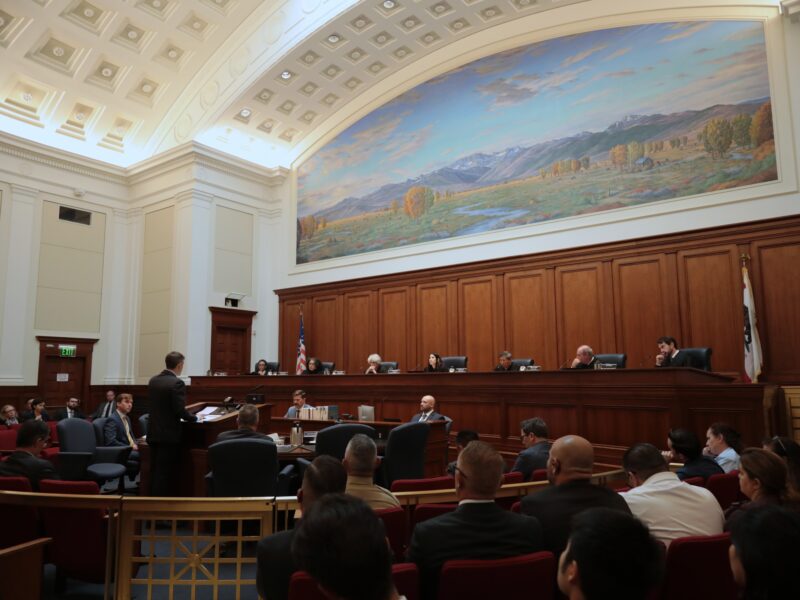
SAN FRANCISCO (CN) — The argument over whether Riverside County Sheriff Chad Bianco should have to return roughly 650,000 ballots cast in last year’s special election to the appropriate election officials went before the California Supreme Court on Monday.Bianco, who was running for governor at the time, seized the ballots as part of a criminal investigation into a purported discrepancy between the number of ballots cast and the number counted in the November election on California’s Prop 50 redistricting proposal intended to give five more seats to Democrats in the U.S. House of Representatives.The sheriff obtained search warrants and seized the ballots from the custody of the Riverside County Registrar of Voters after a citizens group claimed its audit discovered 46,000 more ballots had been counted than were cast in the Southern California county.Bianco claimed his office would conduct a manual recount and only intended to count the ballots and compare that total with the number of votes reported.California Attorney General Rob Bonta sued to stop the sheriff from conducting the recount, calling Bianco’s investigation a “fishing expedition meant to sow distrust and undermine public confidence in our elections.”Bonta directed Bianco to pause all work and provide his office with a copy of the case file and related documents. The attorney general later claimed Bianco violated the directive and continued to abuse the criminal process. Bonta filed a petition March 23 with the Fourth Appellate District, seeking to stop the investigation.The appellate court denied Bonta’s petition on procedural grounds, which led him to the California Supreme Court. The UCLA Voting Rights Project separately petitioned the high court on behalf of four Riverside voters, asking it to return the seized ballots to the proper election officials.On April 8, the California Supreme Court ordered Bianco to stop his investigation into the November special election and preserve all items seized, pending a review. The court heard both cases Monday.Chad Dunn of the UCLA Voting Rights Project, representing the petitioners, told the justices the state’s Elections Code lays out a process for requesting a recount of ballots, including avenues through a grand jury, the district attorney, the board of supervisors, the secretary of state and the attorney general.Instead, Dunn said Bianco flouted the law when he obtained a warrant to seize the ballots, beginning to recount the ballots with sheriff’s department staff under the supervision of a special master appointed by a Superior Court judge, with no election officials, neutral observers or political parties present.“My clients have had their ballots handled in a way the legislature said they shouldn’t,” Dunn told the justices.Kevin Calia of Illovsky Gates & Calia LLP, representing the California Secretary of State’s Office, told the court that under no circumstances should the ballot packages have been taken from the Riverside County Registrar of Voters, citing a section of California Elections Code that states “in no event shall the package or its contents be taken from the custody of the election officials.”However, Bradley W. Hertz, an attorney for Bianco, argued the sheriff had a duty to investigate the claims of election fraud, and Bianco followed the Penal Code in his investigation, including getting sworn declarations to go to a neutral magistrate judge for a warrant.The justices were skeptical of Hertz’s position that the language “in no event” didn’t mean ballots should never be taken from election officials; rather, the phrasing should be read in context, and in some events, it would be allowed.“It says in no event shall the package be taken from the custody of the election official. So I’m just not following your argument,” Associate Justice Kelli M. Evans said.Associate Justice Joshua P. Groban asked if the sheriff could seize ballots before, or even during, an election. Hertz argued the Elections Code would outweigh warrant power preelection but not after an election was certified.“Why give precedence to the Elections Code in preelection context but not post-election context?” Evans asked.Hertz additionally speculated it would be unlikely a judge would sign off on a search warrant in an ongoing election, as it would “wreak havoc.”“This is different?” Associate Justice Goodwin H. Liu asked.As for the second case, the justices grilled both parties on the extent of the attorney general’s power.California Solicitor General Samuel Harbourt argued the attorney general works in the public interest and has power that is “very expansive” by design.“If the attorney general only decides what is public interest … That sounds almost unlimited,” Groban said.Hertz argued the attorney general did not have the power to overtake the sheriff’s authority but rather serves a supervisory, “advise and consent” role with local law enforcement.“The sheriff is not an employee of the attorney general. … The attorney general is limited in what he can do,” he said.However, Associate Justice Leondra R. Kruger cited a section of California law that states the attorney general has “direct supervision over” all sheriffs.“‘Shall direct’ is very broad,” Liu said. “It’s a wide open thing.”The petitioners are also represented by VRP senior voting rights adviser and former California Attorney General Xavier Becerra, who is the Democratic nominee for California governor.After oral arguments, Bianco told a gaggle of press he is not accusing the registrar of a crime but is concerned about potential corruption within the office.“It’s interesting that the entire argument is to give the evidence back to the people that may be responsible for the crime,” he said. “… And at this point, we really don’t know who that may be or what it may be. Is it a person? Is it a machine? Is it an accident? Was it on purpose? We really don’t know, and we were prevented from finding out because of the attorney general.”Bianco additionally drew a connection with what he believed happened in Riverside County to additional claims of voter fraud across the country.“There’s a massive part of this election fraud investigation across the country that the machines count something different than the ballots you have. How strange that now we have evidence that the machines counted something different than the ballots that we have, and an attorney general runs in to stop that investigation, so we’ll never know,” he said.However, Bianco said he would return the ballots if the court directed him to.In contrast, Bonta said Bianco broke the law multiple times in his ballot seizure and investigation, creating a “constitutional crisis in the process.”“This is a law enforcement officer sworn to uphold the law, who broke the law, and then abused his criminal investigative authority, and then failed to comply with my constitutional authority, my statutory authority, to follow my directions. So unfortunately, he broke the law multiple times. He acted rogue.”When asked if he would pursue criminal charges against Bianco, Bonta said his office would assess the sheriff’s actions in a “fair and objective way” and “make sure that we protect the integrity of our election system from any interference or attacks from him or anyone else.”Subscribe to our free newslettersOur weekly newsletter Closing Arguments offers the latest about ongoing trials, major litigation and rulings in courthouses around the U.S. and the world, while the monthly Under the Lights dishes the legal dirt from Hollywood, sports, Big Tech and the arts.Additional Reads
California high court questions Riverside County sheriff’s ballot investigation
Full Article
Original Source
Read the full article at Courthousenews →KhanList aggregates and links to publicly available news content. We do not host full articles from third-party sources. Always verify important information with original sources.