
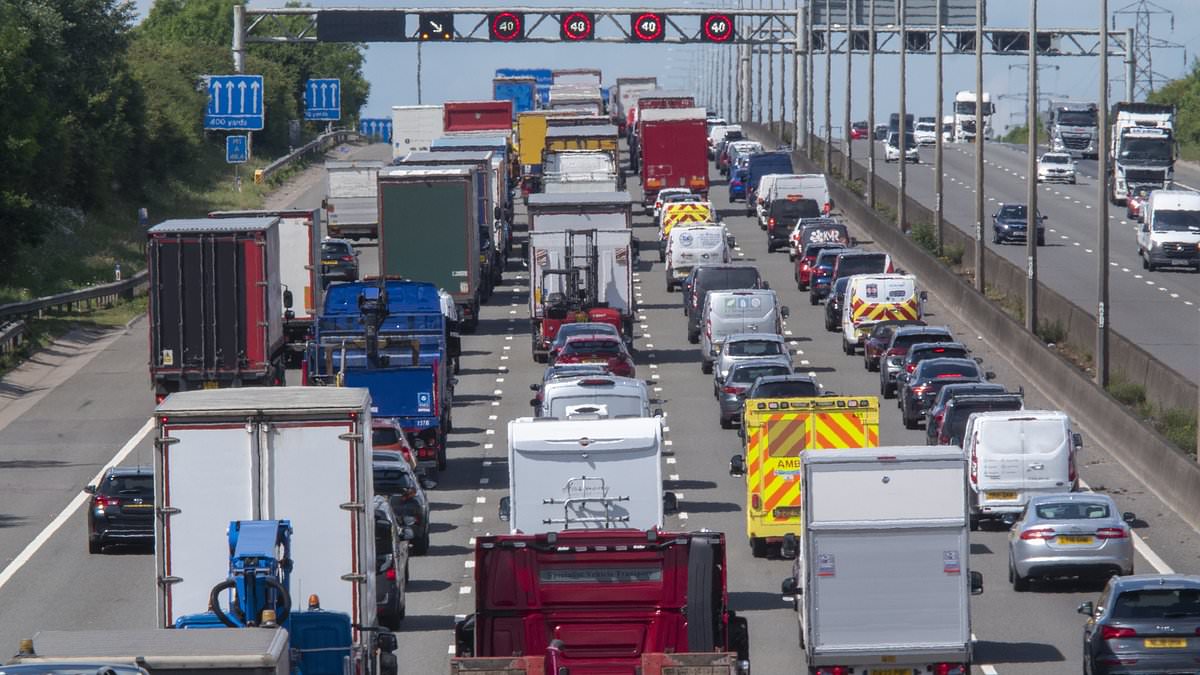
Britain's most infamous motorway turns 40 today.The M25 has become synonymous with endless tailbacks, roadworks, variable speed limits and degrading condition, earning its reputation as the nation's most hated stretch of road.And four decades after it officially opened, drivers are still complaining about the same problems.On October 29, 1986, Margaret Thatcher snipped a white ribbon and swept aside traffic cones to declare the final section of the orbital motorway open at South Mimms in Hertfordshire.Yet even before she handed over the ceremonial scissors, critics were branding the £1billion project 'obsolete on opening'.Built using traffic forecasts drawn up decades earlier, many experts warned its three lanes in each direction would be overwhelmed almost immediately.They were right. Rather than relieving congestion around London, the motorway quickly attracted even more traffic, becoming a victim of so-called induced demand.Forty years later, little has changed...Margaret Thatcher pictured on 29 October 1968 at the opening of the M25 motorway. Critics at the time branded the £1billion project 'obsolete' and sentiments hasn't shifted in 40 yearsJoin the discussionWhat¿s your worst experience on the M25, and how would you fix its chronic problems?What's your view?Drivers consistently rank the M25 among the country's most frustrating roads, citing congestion, delayed journey times and poorly surfaced stretches as major grievances.Transport Focus, which surveys motorists annually about the best and worst motorways and 'A' roads in England, consistently ranks the M25 as the lowest performers.In its latest report for 2025-26, it was 28th out of 32 major trunk roads, with motorists slamming its delay times and poor condition. Among motorists who said they were 'very dissatisfied' with the orbital motorway in the last 12 months, one told Transport Focus: 'As usual, the M25 was a disaster with stop go traffic. A journey that I allowed 45 minutes for took me 90 minutes. The M25 is not fit for purpose.'Others took aim at the motorway's lengthy stretches of so-called smart motorway, including 'all-lane running' sections with no hard shoulder.'No hard shoulder for part of the journey. Other drivers having absolutely no idea what the lanes are for. Drivers going slower in the outside lanes. Drivers travelling far too close to the back of my vehicle. All the usual stuff,' said another irate user.Many others lambasted the poor driving standards often encountered on the nation's busiest motorway, with road users becoming increasingly frustrated by slow-moving traffic.One male driver said: 'People pulling out in front of you especially lorries, people tailgating which should be made illegal. Very sadly, it is what we all have to put up with now in the UK.'Another told Transport Focus: 'There are a lot of bumps and potholes on the M25. Also the surface is uneven and I had to do dangerous maneuvers at high speeds to avoid damage to my car.'But despite its terrible reputation, the 117-mile motorway remains one of the most important pieces of infrastructure in Britain, keeping businesses moving and proving a transport lifeline for the UK economy. The latest Transport Focus Strategic Roads User Survey ranked the M25 as the fifth worst trunk road in England A backbone for the economyDespite attracting regular criticism, the M25 provides is the backbone for many British companies.It generates an estimated £1billion annually in direct economic benefits by bolstering regional connectivity and cutting journey times... when it runs freely. Around 250,000 vehicles use the orbital motorway every day and roughly one in four of these are HGVs and vans.Research commissioned by telematics giant Geotab found that 97 per cent of van drivers in South East England who regularly use the motorway say it is 'important' to the day-to-day running of their business. More than four in five said their company could not operate as effectively without it.Yet dependence does not equal affection.Over 80 per cent of van drivers said the M25 causes delays for the services they provide and has become less reliable than it was five years ago.The consequences can be costly, too: late deliveries, higher fuel bills and missed business opportunities. Some firms even admit turning away work because journey times on the motorway have become too unpredictable.It has been estimated that it costs £2billion annually in lost productivity, creating a complex economic net trade-off. Despite attracting regular criticism, the M25 is an economic powerhouse and a vital transport lifeline for UK businesses On average, the M25 suffers eight major disruptions per day - and over a third of these cause delays lasting two hours or moreWhere the M25 typically grinds to a haltA recent study found that congestion is not spread evenly around the motorway but instead suffers due to sections that are 'chronic bottlenecks'.Geotab's analysis found 46 of the motorway's 58 interchanges operate at more than 80 per cent of their posted speed limit on average.However, the worst congestion is concentrated between Junctions 10 and 20 in west London, where the motorway intersects with the M3, M4 and M40.The most congested stretch is the anticlockwise section between Junctions 12 and 11, where average traffic speeds fall to just 68 per cent of the speed limit on average.The Heathrow corridor is another major headache; between Junctions 14 and 15 clockwise, average speeds fall to just 44.6mph, making it the slowest section of the entire M25.But what really infuriates drivers is not necessarily how slow the M25 can be – it's how wildly journey times can swing depending on the time of day.A stretch that is free-flowing one hour can be an arduous crawl the next.Take the clockwise section between Junctions 14 and 15, from Heathrow Airport towards the M4. At 4pm, the journey takes more than nine minutes. By 7pm, it can be completed in just three, Geotab found.The difference is even more dramatic on the anticlockwise stretch between Junctions 17 and 16, from Mill End towards Denham. A journey that takes 15-and-a-half minutes during the morning rush can be done in less than half that time – just six-and-a-half minutes – in the evening.And when things go wrong, they often trap drivers for hours in jams. Research has showed that 6am is the busiest hour on the M25 - earlier than the conventional commuter rush - with traffic moving at an average speed of 57.7mphOn average, the M25 suffers eight major disruptions per day – and over a third of these cause delays lasting two hours or more.The anticlockwise sections between Junctions 20 and 19 and Junctions 13 and 12 are among the least reliable sections. During the worst 5 per cent of working-day hours, journey times on these stretches double compared with normal conditions.Between Junctions 13 and 12 alone, almost a third of working hours see traffic moving at least 30 per cent slower than usual.Aaron Jarvis, vice president for EMEA at Geotab, said: 'The M25 is easy to complain about, but the research shows how much businesses across the South East depend on it. For many operators, there simply isn't a practical alternative.'Some congestion is inevitable on a motorway this busy, so the aim is to manage it better.'The data shows where and when the pressure points are, so fleets can adjust departure times and plan around the weekday peaks.'Drivers themselves put faster incident detection and clearance among their top priorities, and quicker responses when something goes wrong could make a real difference to the businesses that rely on this road every day.'The survey also asked van drivers to identify the stretches of the M25 that give them the biggest headaches.Clockwise, the most commonly cited trouble spots were Junctions 3 to 4, 2 to 3 and 4 to 5. Anticlockwise, drivers most frequently pointed to Junctions 28 to 27, 29 to 28 and 27 to 26 as the motorway's most problematic sections. M25 HISTORY & FACTSHISTORY● The idea of an orbital road around London far precedes its opening on 29 October 1986. In fact, it dates back more than a century, with proposals made for a ring road for the capital in the early 1900s.● The modern M25 emerged from a series of separate orbital road schemes, brought together as one project in the 1970s.● The first section of the M25 opened to traffic between South Mimms and Potters Bar in September 1975.● After the first Dartford tunnel opened in 1963, the second tunnel was completed in 1980 followed by the Queen Elizabeth II Bridge in October 1991. Technically, the M25 is not a complete motorway circle because the Dartford Crossing section is the A282.● Smart stretches with variable speed limits were introduced in the 2010s, with the nation's first permanent all-lane-running smart motorway section (with no hard shoulder) opened in April 2014 between junctions 23 and 25 in Hertfordshire, and junctions 5 and 6/7 on the Kent/Surrey border.● The M25 is 117 miles long.BUSIEST PERIODS● 6am is the busiest hour - earlier than the conventional commuter rush - with traffic moving at an average speed of 57.7mph.● Speeds dip at 7am, recover during the middle of the day, then reach their lowest average levels between 4pm and 5pm.DISRUPTIONS● Based on a 12-week sample, the M25 suffers an average of eight major disruptions per day (659 recorded in total).● Over a third of disruptions last for two hours or longer. CARS & MOTORING: ON TEST
Britain's most hated road turns 40: The M25 is despised for its delays, variable limits and poor condition... but Britain couldn't function without it
Full Article
Original Source
Read the full article at Dailymail →KhanList aggregates and links to publicly available news content. We do not host full articles from third-party sources. Always verify important information with original sources.