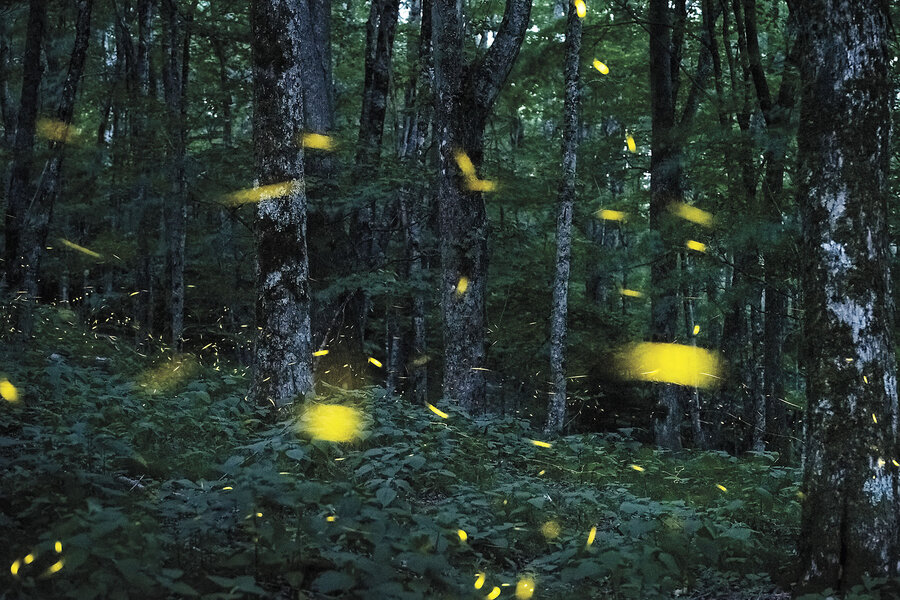
I grew up in a large New Jersey city in an era predating environmental awareness. I recall factories standing shoulder to shoulder, their smokestacks belching who-knows-what into the air in an age when children spent most of their time outdoors. The result was something I didn’t know enough to lament back then: There were few stars in the nighttime sky because the pollution obscured their light.When I say that I didn’t lament it “back then,” I’m being mindful of the truism that we don’t miss the things we never knew. (In other words, who grieves for the dodo?) But it was my father who gave me and my friends a gentle reminder of the sky he had known as a boy. Looking up one summer evening as we sat with him on the front porch, he remarked that a solitary star had managed to shine through. Then he added, in his abbreviated way, “There used to be more.”That’s when it struck me that, at the age of 11, I had never seen a starry sky. Then I leveled my gaze at the neighborhood and noted the winking of fireflies – stars come to Earth. They were flitting everywhere. I had always taken them for granted because, throughout my childhood, they had been part of the landscape. But my dad’s wistful comment had me regarding them with new eyes. Why We Wrote This Catching fireflies and then releasing them into the summer sky results in an exuberant display of light. In quick order, five or six of my friends and I each had an old jelly jar in hand. Then, we set out and ran the length of the street, scooping up fireflies on the wing, whooping and hollering with every capture of their pure, cold light. After indulging our joy for about an hour, and tuckered out from our exertions, we gathered on my front porch and squatted in a circle around the jars. It’s hard to describe the otherworldly scene of like-aged boys staring in silence at the collection of fireflies, our faces awash in their glow. My father looked on but didn’t say anything for the longest time. Finally, he must have felt that we had had the fill of firefly light to which we were entitled, because the only thing he said was, “Stars belong in the sky.”We knew what to do. Picking up our jars, we assembled on the stoop. “One, two, three!” I counted, and in synchrony we lifted the lids and released the fireflies. They instinctively flew upward, gradually spreading out in a display of what I can only call exuberance. I sensed, with the perception of a philosopher, that this was a moment I would carry into the life that lay ahead of me. Eleven years old is a springboard into adolescence, and by the following summer, I had lost interest in catching fireflies. Life somehow became a tad more challenging, relationships grew more complicated, and the prospect of high school began to be discussed in whispers.And yet, it’s childhood memories that have the most staying power, perhaps because childhood is the only time that others are responsible for our happiness. I think that’s why my father stayed mum as I hunted down those fireflies. He was bearing witness to my joy, and he was the only one who could have denied me that moment, which he chose not to do. Instead, he had counseled, “Stars belong in the sky.” I know he was right about that, and now I find myself wondering if I had filled the sky with stars for him – reinforcing his own childhood memory of New Jersey skies so clear that you could see the Milky Way. That’s how good the view used to be.Fireflies and lanterns: Twilight across cultures From twinkling insects to golden-hour glow, the themes of light, beauty, and innocence carry through distand lands and centuries of artworks.Robert Klose’s essay in this issue prompted me not only to reminisce, but also to search for art on the subject of fireflies. Turns out it was a significant theme in Japanese woodblock prints between the 17th and 19th centuries. Landscapes with tiny lights at dusk and images of graceful figures often bore names referring to fireflies. In “Catching Fireflies,” a late-1700s print by Kitagawa Utamaro, women and children collect the whimsical insects in paper lanterns. Kitagawa Utamaro (Japanese, Circa 1754–1806), “Catching Fireflies” (“Hotaru Gari”), Circa 1796-97, Metropolitan Museum The print reminded me of one of my favorite paintings by American artist John Singer Sargent, which depicts Japanese lanterns and children. Was he inspired by this or a similar print? We’ll never know, but we do know that newly opened trade in the 1850s created a fascination among Europeans with Japanese art and design. The French even had a name for it: Japonisme. This interest fostered new developments in Western art, particularly among the French impressionists.Living in Paris at the time, Sargent felt this influence. Much has been written about Japanese art’s flattened depth, botanical patterns, open space, and asymmetrical compositions. But what I find alluring are the qualities in both the woodblock print and Sargent’s painting – elegance, childlike beauty, and an appreciation for nature at twilight – that go beyond these formal considerations. John Singer Sargent (American, 1856-1925), “Carnation, Lily, Lily, Rose,” 1885-1886, Tate Britain Sargent spent two summers creating the masterful oil painting. Soon after a move to England in 1886, it was related by a friend accompanying him that Sargent caught sight of hanging “Chinese” lanterns one evening, inspiring him to create the painting. Staying true to the impressionists’ aim of capturing a specific light, he painted the child models and glowing Japanese lanterns outdoors for just 25 minutes each evening. He chose children whose fair hair would reflect the enchanted golden-hour light. The lilies, another popular motif in traditional Japanese art, recede into the background with an ephemeral, cooler shade of white that sets off the warm glow from the lanterns reflected on the girls’ faces. The painting hangs in Tate Britain.– Julia Miner / Editor, The Home Forum
Bringing the stars to Earth – and back
Full Article
Original Source
Read the full article at Csmonitor →KhanList aggregates and links to publicly available news content. We do not host full articles from third-party sources. Always verify important information with original sources.