
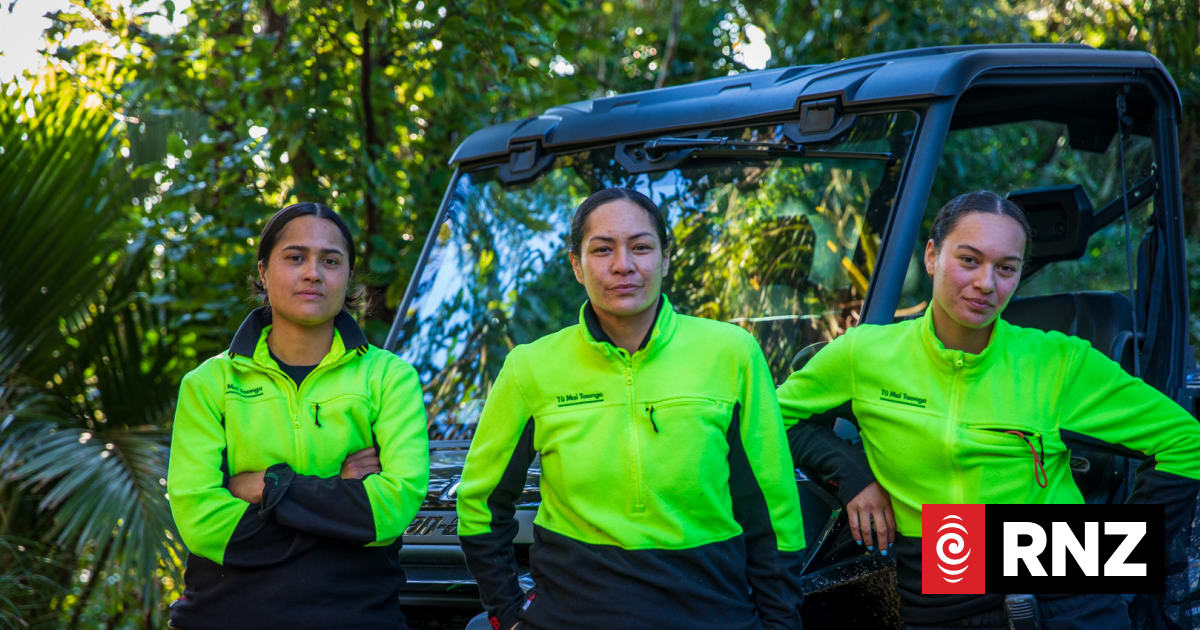
Ko au te taiao, ko te taiao ko au.I am the nature, and nature is me.For the people behind an iwi-led conservation project on Aotea Great Barrier Island, that relationship sits at the heart of the mahi.Tū Mai Taonga is a Ngāti Rehua Ngātiwai ki Aotea-led conservation project working to remove introduced predators and restore balance to the whenua.They are undertaking one of the largest feral cat eradication operations in the world.Project lead Makere Jenner told RNZ the kaupapa was about protecting native species and healing whānau."While we're doing a feral cat eradication to restore the whenua, we also are restoring and healing ourselves. That's a holistic te ao Māori way to do things."Jenner said being able to bring people home was an important part of restoring the whenua.Trappers Lyric Murray (team lead), Phoebe Ngawaka and her younger sister Reneeah Ngawaka.RNZ / Layla Bailey-McDowell"The Tū Mai Taonga project has provided jobs that allow whānau to be able to return home to Aotea who have had to live on the mainland for work and other reasons."To be able to come home, reconnect with the marae, reconnect with whānau, reconnect with culture, te reo Māori, and also gives them the opportunity to heal the land with their own hands, is really magical."For trapper and team lead Lyric Murray, the mahi had also provided a way to reconnect with a part of her identity."For me personally, I didn't grow up with that, Māori, like our culture was beaten out of our family literally, you know, so to work for like an iwi led project and reconnect with that kind of mahi is pretty important."Tū Mai Taonga team lead Lyric Murray didn't grow up in te ao Māori, and says reconnecting with that part of herself is pretty special.RNZ / Nick MonroNew Zealand added feral cats to the official Predator Free 2050 target species list for national eradication in 2025.Tū Mai Taonga was currently working from north to south of the island, setting up hundreds of cage traps and cameras across the ngahere.The first phase of the kaupapa involved cutting around 90 kilometres of tracks through Te Paparahi, a 3414-hectare rugged forest block located at the northern end of Aotea.Once the number of feral cats was brought down in one zone, the trapping network moved into the next.The island was estimated to have around 2500 feral cats, while data from the northern area suggested that now, fewer than 15 remained.A feral cat roams Aotea, captured on one of Tū Mai Taonga's trail cameras.Supplied / Tū Mai TaongaJenner said the decision to remove the introduced predators came from an understanding that people were part of the environment too."We see ourselves as part of te taiao, as part of the environment, we are protecting, restoring and sustaining the natural environment, so that the environment is able to sustain us."And that meant taking responsibility for the damage humans had caused."It's not the cat's fault that it's here causing damage in an environment, it's our fault. We brought cats here, people brought cats here and so from a te ao Māori perspective, we are a part of the environment and so sometimes we cause damage but we also need to take every opportunity we can to be able to make things right."Aotea has specialised ecosystems and is home to many native species.RNZ / Nick MonroAotea had specialised ecosystems and was home to native species including takoketai, or black petrel, niho taniwha, the chevron skink, and the kākā.Jenner said those taonga species could not withstand the pressure of feral cats."It's important for us to be able to try to make a way to restore balance for them and to make a way for our taonga species to survive."The human side of eradicationRestoring that balance also meant confronting the difficult reality of killing the animals that threatened it.For some of the project's trappers, that could be confronting.Trapper Phoebe Ngawaka remembered her first kill."I went and dug a hole and then asked for [my team lead] to bring the feral over, so she did and then I buried it and planted a little tree on top, had me a little karakia ... but it was traumatic, I wasn't happy about it and it's still the only feral that I've caught."Trapper Phoebe Ngawaka says her mahi restoring te taiao is closely connected to her mahi with rongoā.RNZ / Layla Bailey-McDowellBut Ngawaka said the reason behind the mahi was to create a future where native species could safely return to the ngahere."It'd be really cool to have our area set up so that it's safe for those natives to come back, like the kōkako, maybe one day the kiwi, and until then, until all the cats are out of the ngahere, then we can't really have them back."Jenner said the project's trappers were trained to approach the animals with respect."We teach our crew when they're onboarded to be respectful of the fact that that is a living thing. We humanely kill, we don't cause undue distress."Some people have questioned why the feral cats could not be rehomed, but Jenner said that was not feasible given the numbers involved and the difficulty of domesticating feral cats.Tū Mai Taonga project lead Makere Jenner says pet cats will always be part of life in Aotearoa, but the project's goal is to make responsible cat ownership possible.RNZ / Nick MonroKeeping Aotea's pets safe through manaakitangaWhile the project targets feral cats, it also recognises the importance of companion cats to Aotea whānau.Aotearoa New Zealand is one of the world's biggest domestic cat owners, with around 40 percent of homes owning at least one cat.Unwanted pets made their way into becoming what's referred to as stray cats - the cats which lived close to humans often surviving on scraps.Feral cats were the truly wild cats, generations removed from their domestic roots and having had no human interaction. It's these cats even the SPCA accepts should be killed due to the risk they pose to wildlife.As part of the Safe Cat programme, pet cats could be collected by the Cat Taxi and taken to the vet for desexing.RNZ / Nick MonroThrough the project's de-sex drive and Safe Cat programme, free microchipping and desexing was available on Aotea, while pet owners could register their cats in the island's "Cat-alogue".Collars and ear-tipping could help identify pets, while a "cat taxi" took animals to the vet and brought them home.Auckland Council conservation advisor Annamarie Clough said keeping pets safe was an important part of the programme."Feral cat control is important, but on the other hand, we recognise the importance that companion cats play in households, so we really want to keep them safe while we're undertaking feral cat control."Seventh-generation Aotea resident Judy Hale.RNZ / Nick MonroSeventh-generation Aotea resident Judy Hale has four cats. She used the free desexing service, saying she could not have otherwise afforded the procedure and travel costs.Petrol and diesel at the time of RNZ's visit was over $4.44 a litre."I was very lucky that we had this available for us, you know, because there's no way as a pensioner that I could have afforded to have had my cat spayed, so it would have been more kittens."And gone are the days you could get rid of them yourselves."This intitative was an example of how the island's approach was looking after the people and pets who called Aotea home, while protecting the wider taiao, she said.Tū Mai Taonga project lead Makere Jenner says while they're doing a feral cat eradication to restore the whenua, they are also restoring and healing themselves as a people.RNZ / Nick MonroFor future generationsTe toto o te tangata he kai, te oranga o te tangata he whenua.While food provides the blood in our veins, our health and wellbeing are drawn from the land.Jenner said success would not only be measured by how many cats were removed, but by whether future generations grew up knowing abundance as normal."My generation has grown up, with the northern bush on Aotea particularly, being absolutely silent, ghostly silent, sadly silent," she said emotionally."Particularly sad for the generation before me, who got to experience the remnants of abundance up there. And that generation, my mum's generation, witnessed that peter away at almost nothing."Our ambition is for our tamariki, for our future generations, for their normal to be that abundance that two generations ago had."With the work now well underway in the north, the next phase of Tū Mai Taonga will see the trapping network expand further south.
Bringing Aotea back to life through a te ao Māori lens
Full Article
Original Source
Read the full article at Rnz →KhanList aggregates and links to publicly available news content. We do not host full articles from third-party sources. Always verify important information with original sources.