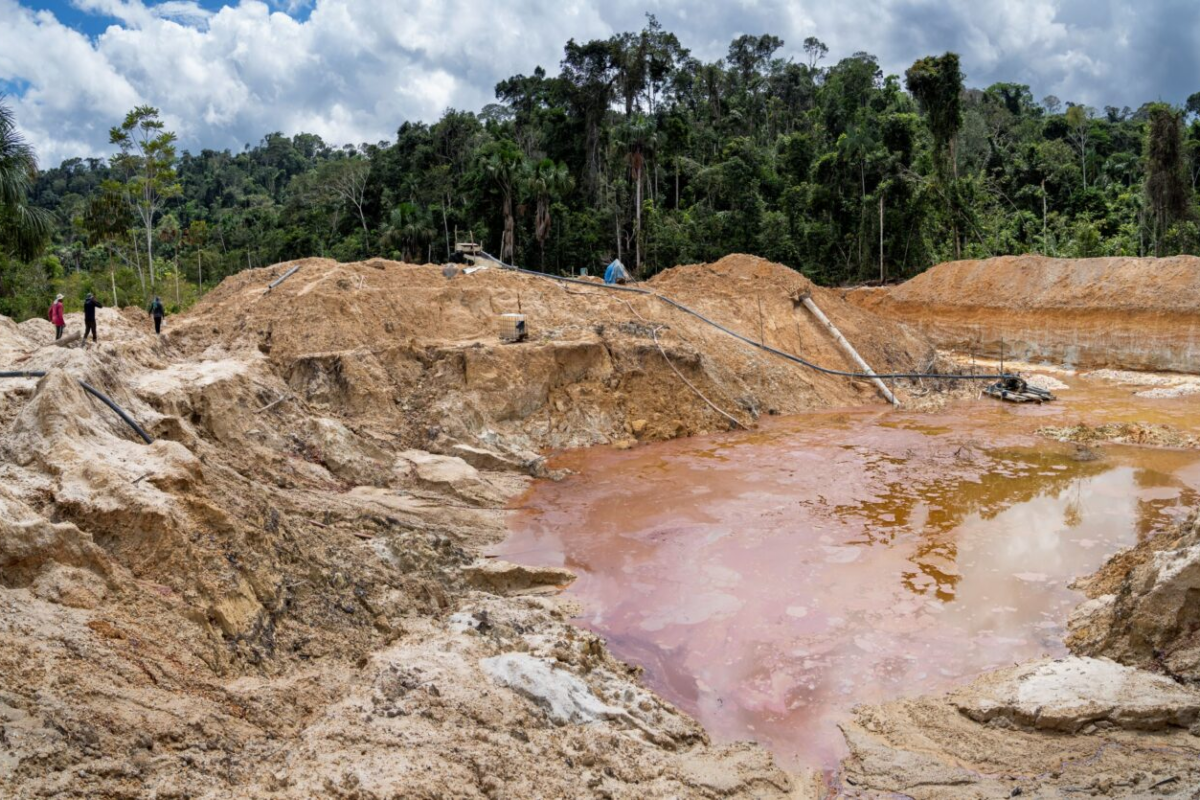
Federal prosecutors are suing the Brazilian mining agency for failing to monitor wildcat gold mines in the Brazilian Amazon.Illegal miners take advantage of the agency’s lack of oversight and name small areas as the origins of tons of gold that have actually been taken from protected areas.Measures implemented in the past few years have contributed to a sharp decrease in gold laundering in Brazil, but illegal metal is now being smuggled out of the country.ANM’s top officials are also under investigation for receiving bribes to favor mining companies. Federal prosecutors in Amazonas state are suing the Brazilian government’s mining agency (ANM) for an alleged failure to monitor gold mining exploration in the Amazon. The lawsuit was filed in early July. A few days later, on July 21, the federal justice ordered ANM to increase oversight over wildcat mine permissions, small-scale mines known as garimpos in Brazil, following a similar lawsuit filed in 2021 by federal prosecutors in neighboring Pará state. The legal push also follows corruption probes into the agency’s top executives, who are accused of favoring mining companies in Brazil’s largest industrial mining state, Minas Gerais. ANM is responsible for authorizing and monitoring mining activities in Brazil, including wildcat mining permissions (PLGs), which aren’t subject to the same rigorous environmental requirements as large-scale mines. According to the federal prosecutors, poor monitoring and unclear rules have turned PLGs into mechanisms to launder gold taken from Indigenous lands and strictly protected conservation areas, where the activity is forbidden. The case is based on irregularities found in reports from Greenpeace and the Federal Court of Auditors. “Mining permits no longer serve the interests of small-scale miners and, in many cases, have become a front for gold laundering carried out by criminal organizations,” the federal prosecutor André Porreca stated on the Amazonas Federal Public Ministry’s website. The municipality of Itaituba, in Pará state, is known as the capital of illegal gold mining in the Brazilian Amazon. Image by Fernando Martinho for Mongabay. ANM doesn’t require permit applicants to provide prior mineral research to estimate the amount of gold available in each area. Therefore, the permission of a single mine can be used to launder tons of illegal gold taken from elsewhere. One PLG, the size of a soccer field (1.08 hectares or 2.67 acres) and with no signs of mining activity, cited in the lawsuit, was declared as the source of 776 kilograms of gold (1,710 pounds). “If the permit holder claims to have extracted ten kilograms from a given permit area, there is insufficient evidence to accurately assess whether the metal might have come from another source, likely an illegal one,” the federal prosecutor André Luiz Cunha wrote in the case. The exemption of preliminary mineral survey is one of ANM’s main shortcomings, according to Gregor Daflon, the spokesperson for the Indigenous Peoples’ Front of Greenpeace Brazil. “Once the permit is issued, there is little or no on-site inspection or monitoring to verify whether the declared production volume is consistent with the potential and actual conditions of the area being mined,” Daflon told Mongabay. According to the NGO, granting several permits to a single holder also allows industrial-scale mining operations to benefit from PLGs’ simplified rules. Another lawsuit, filed in 2021 by Pará state’s prosecutors, addressed similar flaws in permissions located in the southwestern municipalities of Jacareacanga, Novo Progresso and Itaituba — the epicenter of illegal gold mining in the Brazilian Amazon. On July 21, a federal judge ruled in favor of the prosecutors and ordered ANM to conclude a revision of the PLGs rules and to review all the permissions in the region. The agency should also implement a tracking system for the gold supply chain in Brazil, the ruling said. “This decision could deal yet another blow to the illegal gold mining industry in Brazil,” Daflon said. In an email to Mongabay, ANM stated that the agency is already addressing a significant portion of the issues raised by the prosecutors, including oversight of possible permit misuse. ANM also said the “work involves document analysis, cross-checking production and revenue data with geospatial information, investigating production reports lacking evidence of mining operations, and verifying permits that are incompatible with the activity actually being carried out.” No money or personnel Since 2023, Brazilian authorities have addressed many of the gold laundering issues involving PLGs, said Larissa Rodrigues, research director at the sustainable development think tank Escolhas Institute, in an interview with Mongabay. Steps taken include implementing electronic invoices for gold trading and a Supreme Court decision to end the “good faith” concept, which had previously exempted DTVMs, the financial companies authorized to trade gold in Brazil, from verifying the origin of the metal. As a result, gold production officially declared by garimpos dropped by 80% in 2025 compared to 2022, according to official data analyzed by the Escolhas Institute. Brazil’s general gold exports also dropped by 24% in the same period. Raids from federal forces have also expelled illegal miners from many Amazon Indigenous territories, including the lands of the Yanomami, Munduruku and Kayapó peoples. “What we’ve accomplished since 2023 is no small feat,” Rodrigues said. But record gold prices and gold miners’ resistance to abandoning the activity mean many of them keep illegally operating in the Amazon, even if at a smaller scale. Brazilian Federal forces raided illegal miners and land grabbers in eleven Indigenous territories recently. Image courtesy of IBAMA. Now, however, illegal gold no longer leaves Brazil by the front door. It is smuggled out of the country, mainly through the Venezuela border. As a symptom of this shift, gold seizures on federal roads increased 830% in the first quarter of 2026 compared to the same period last year, according to a report by the G1 news outlet. “The problem has shifted elsewhere,” Rodrigues said, adding that now smuggled gold faces greater difficulties in entering the global supply chain. “It is a positive shift.” President Luiz Inácio Lula da Silva current administration has not, however, addressed chronic underfunding and understaffing at ANM. In May, the agency had almost 20% of its budget blocked by the Ministry of Finance. According to Brazilian magazine Veja, the agency had to suspend inspections of tailings dams, structures used to hold mining byproducts, owing to a lack of travel budget. “It is the ANM that handles day-to-day operations in these mining areas — including oversight, licensing, and everything else — and it has never been properly structured,” Rodrigues said. A lack of personnel is another chronic problem. In February 2026, the agency had 607 employees, a third of the staff required for an adequate workforce (1,866), according to the union that represents Brazil’s national regulatory agencies. “For the agency to be able to monitor thousands of securities and track the source of high-value funds, it is essential that it have the technical capacity, independence, and oversight mechanisms necessary to minimize the likelihood of decisions based on private interests,” Daflon said. ANM’s president is under investigation for allegedly favoring mining companies illegally operating in Serra do Curral, in Minas Gerais state. Image courtesy of Lyiz Santana/ALMG. Extra troubles hit the agency in June 2026 when the federal police indicted its president, Mauro Henrique Moreira Sousa, as part of an investigation into illegal iron ore mining in the Serra do Curral protected area in Minas Gerais. According to the investigation, public employees forged environmental recovery plans to allow the mining company Empabra to continue operating in the area illegally. When contacted by the Brazilian newspaper Folha de São Paulo in late June, Sousa said he wouldn’t comment on the allegations until he had access to the full Federal Police report. In another investigation, initiated in 2025, the federal police arrested one of ANM’s directors, Caio Mário Trivellato Seabra Filho. He was arrested on suspicion of being part of a criminal organization that forged environmental licensing documents for mining projects in Minas Gerais. In the court case, which Mongabay had access to, Seabra Filho’s lawyers stated that the federal police had no evidence that he favored or received bribes from mining companies. Both cases are ongoing. “That is a clear sign of what happens when you let an agency be deteriorated,” Rodrigues said. “It becomes more vulnerable to capture [by private interests] and to corruption.” In an email to Mongabay, ANM stated it does not comment on ongoing investigations, disciplinary proceedings or legal actions. Banner image: Illegal gold mines contaminate the Amazon rivers with mercury and affect the health of local communities. Image by Fernando Martinho for Mongabay. Artisanal mines in Brazil a front for gold laundering, investigation shows FEEDBACK: Use this form to send a message to the author of this post. If you want to post a public comment, you can do that at the bottom of the page. Cite this articleFernanda Wenzel (2026). Brazil’s mining agency under fire over corruption and omission probes. Mongabay Conservation news. DOI: https://doi.org/10.66709/news-325250 Credits Topics
Brazil’s mining agency under fire over corruption and omission probes
Full Article
Original Source
Read the full article at News →KhanList aggregates and links to publicly available news content. We do not host full articles from third-party sources. Always verify important information with original sources.