
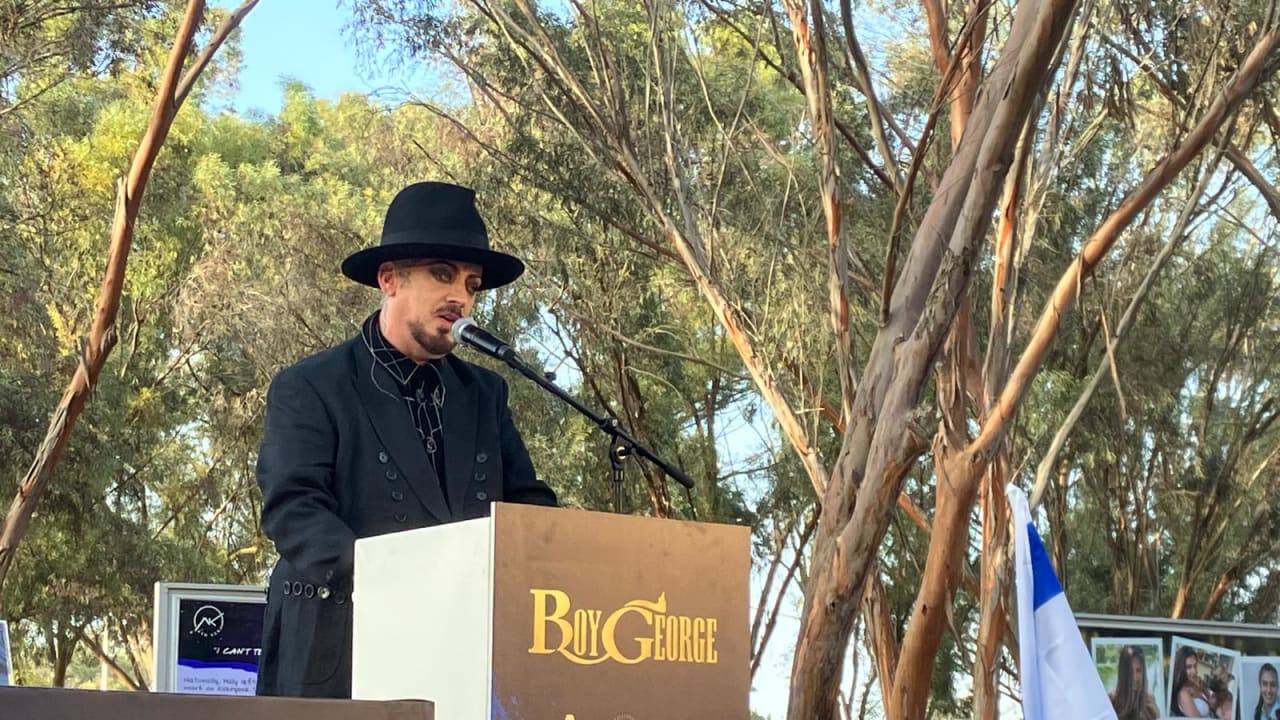
NOVEMBER 3, 2026 21:25Updated: NOVEMBER 3, 2026 21:30“I feel odd being thanked for doing what’s just normal,” iconic singer and Culture Club frontman Boy George said at a press conference on Tuesday, at the site of the Nova music festival massacre in Re’im, speaking about the reception he had received in Israel.Boy George, who arrived on Saturday, will perform on Wednesday and next Saturday in Tel Aviv, and said that they would feature his recently released song, “We Will Dance Again,” a phrase which had become the motto of Nova survivors. Over 360 festivalgoers were killed at the Nova music festival on October 7, 2023, and dozens more were taken hostage.“I’m afraid with ‘We Will Dance Again,’ there was no secrecy or subtext whatsoever,” he said. The deliberately provocative song opens with the lines, “You say genocide, I say war,” and the singer has spoken out in solidarity with Jews and Israelis frequently in the years following the October 7 massacre.Sylvan Adams, president of the World Jewish Congress Israel, arranged the concerts and the press conference.He thanked Boy George for his solidarity and said that his decision to come to Israel was particularly meaningful at a time when other international artists had chosen to boycott the country.British singer-songwriter Boy George delivers remarks during a ceremony honoring him for his public support of Israel and the Jewish people, attended by Israeli President Isaac Herzog at the President’s Residence in Jerusalem, November 2, 2026. (credit: YONATAN SINDEL/FLASH90)1500 tickets to concert made available to survivors and familiesAdams announced that 1,500 tickets to the November 7 concert, dedicated to the Nova community and featuring a special appearance by DJ Ofer Nissim, had been made available to survivors and their families through a collaboration with the Museum of Tolerance Jerusalem.The Tribe of Nova Foundation, which was represented at the press conference by Nova survivor Ofir Amir, and the Foreign Ministry also supported the concerts and Boy George’s visit.Adams paid tribute to the Nova community’s resilience. “The music will not stop, our spirit will not be broken, and yes, we will dance again,” he said.Omer Shem Tov, who was kidnapped by Hamas from the Nova festival and spent 505 days in captivity, was the master of ceremonies at the press conference, and he also expressed his appreciation for Boy George’s presence.“I think that in today’s world, it takes real courage to openly stand with Israel and the Jewish people around the world. And it takes even more courage to hop on a flight and come here to Israel... You could have chosen to stay away, but you chose to come. And I think that says a lot about who you are,” he said.Noting that this was his second visit to the Nova site since he was freed, Shem Tov added, “There is this feeling and this energy that somehow is dark and sad. But on the other hand, I can feel so much light here. I look at those photos over there, and I see so many, I’m going to say, friends of mine. Maybe we don’t know each other, but we’re all friends here. We’re all family.”When Boy George stood up to speak at the press conference, he said that visiting the Nova massacre site was deeply moving, particularly after meeting survivors and hearing their stories during his visit to the Nova exhibition in London.“I think it’s very powerful, from a kind of spiritual perspective,” he said. “Obviously, you can see there’s a lot of healing that’s gone on, and that’s really important because an outsider never knows what they’re supposed to feel.”'We Will Dance Again' partly response to anti-Israel commentsHe described writing “We Will Dance Again” partly as a response to anti-Israel comments made by other musicians, many of whom he knew personally.“Some of that was quite shocking to me, you know, and also a little bit predictable,” he said.Boy George recalled watching news of the massacre in real time as it unfolded on television.“I saw what happened on October 7. I saw it on TV. I was up very early, and I saw it. And it just horrified me… What horrified me more, I think, was hearing people that have no connection to what happened, telling me it wasn’t true, that it was made up, you know, and I shouldn’t believe it.”He said he had heard the word “genocide” repeated so often as an accusation against Israel that he decided to address it directly in the song.But the line that he said mattered most to him comes later: “If you’re ever confused/I stand with the Jews.”He said he was looking forward to singing the song in Israel after performing it in venues around the world, including synagogues, where it had received a warm response.“Particularly here in Israel, you know, it feels like it’s the right song to make the highlight of the show, and that’s what I’m gonna do… That’s what music should do. It should make people feel safe, celebrated, and make them feel like they belong. And that’s the music I want to make.”Asked by The Jerusalem Post whether he could have imagined, when he first became famous wearing a T-shirt with Hebrew lettering in the video for Culture Club’s “Karma Chameleon” in the 1980s, that he would one day be celebrated for his support of Israel, Boy George said he had no idea back then where his career would lead.“No, because I think at that time, I was so culturally naive,” he said.But the question prompted him to recall growing up in southeast London in the 1970s, when racism was widespread, and the far-right National Front had a headquarters near his home. He remembered being handed National Front leaflets when he was a young punk rocker and wondering why the people distributing them thought he might be interested.As a gay teenager who often felt like an outsider, he said, he developed a lasting identification with marginalized people.“I guess as a gay man and as an outsider, I always feel connected to anyone that’s kind of pushed out. You know, I’ve never been a big fan of bullies, and I experienced a lot of that as a kid.”He recalled that in his early years, he was primarily interested in attracting attention through his appearance rather than making political statements.“I only wanted attention, at any cost,” he said, laughing.His experience of being treated as an outsider has remained important to him, and it informs his response to the hostility Jewish people have faced since October 7. He described receiving messages from Jewish friends in London who were frightened by the atmosphere around them.“I kept getting WhatsApp messages from friends that I hadn’t spoken to in a while saying, ‘What’s going on? I don’t feel safe in London.’” He also heard from Israeli friends who wondered why he had not spoken out sooner but said he had wanted to find a meaningful way to respond rather than simply posting something on social media.When asked whether he intended to speak to artists who have remained silent or expressed hostility toward Israel, he joked: “You mean the ones that haven’t already blocked me?”“If somebody is posting stuff that I disagree with, I will call them out, and I have called them out, and I’ve been very public about that, and mostly they don’t respond,” he added. “I have fallen out with some quite big musicians that I absolutely used to love. I still like the records – I’m not 10,” he said, adding, though, that the music no longer “felt quite right.”Asked why hostility toward Israel had become so prevalent, he answered, “I think that things become kind of trendy, and it becomes easier to go along with what other people are saying… Suddenly you’re the odd one out if you’re not actually in agreement with them.”He emphasized that disagreeing with a government should not mean condemning an entire people: “I disagree with this government, all right? ... But I don’t attack the entire race of people based on something that I’ve seen on CNN or on TikTok.”Although his current visit has attracted a huge amount of attention, Boy George emphasized that his affection for Israel goes back decades.“I’ve been here many, many times, and I’ve never had a bad experience in Israel. I felt very comfortable here. I felt accepted. I didn’t feel judged like I do in a lot of places in the world,” he said. “Pretty much every time I’ve come here, I’ve been told by people I shouldn’t come. I got the classic letter from [Pink Floyd co-founder and radical antisemite] Roger Waters, which I put in the bin.”Despite the seriousness of the occasion, Boy George frequently displayed the playful sense of humor that has been part of his public persona for more than four decades. During a meeting with President Isaac Herzog earlier this week, he said that his life was becoming increasingly Jewish, and at the press conference, he was asked whether he was considering converting to Judaism.“I’m far too lazy. I’ve heard it’s very difficult,” he said and laughed, although he joked that having a Jewish boyfriend might change his mind.When Adams suggested that the singer, who has matured considerably since his days as a flamboyant young pop star, might want to change his name to “Man George,” he had a quick response: “I’m gonna stay Boy George, just to annoy people.”Follow us on Google
Boy George at the Nova festival memorial: ‘If you’re ever confused, I stand with the Jews’
Full Article
Original Source
Read the full article at Jpost →KhanList aggregates and links to publicly available news content. We do not host full articles from third-party sources. Always verify important information with original sources.