
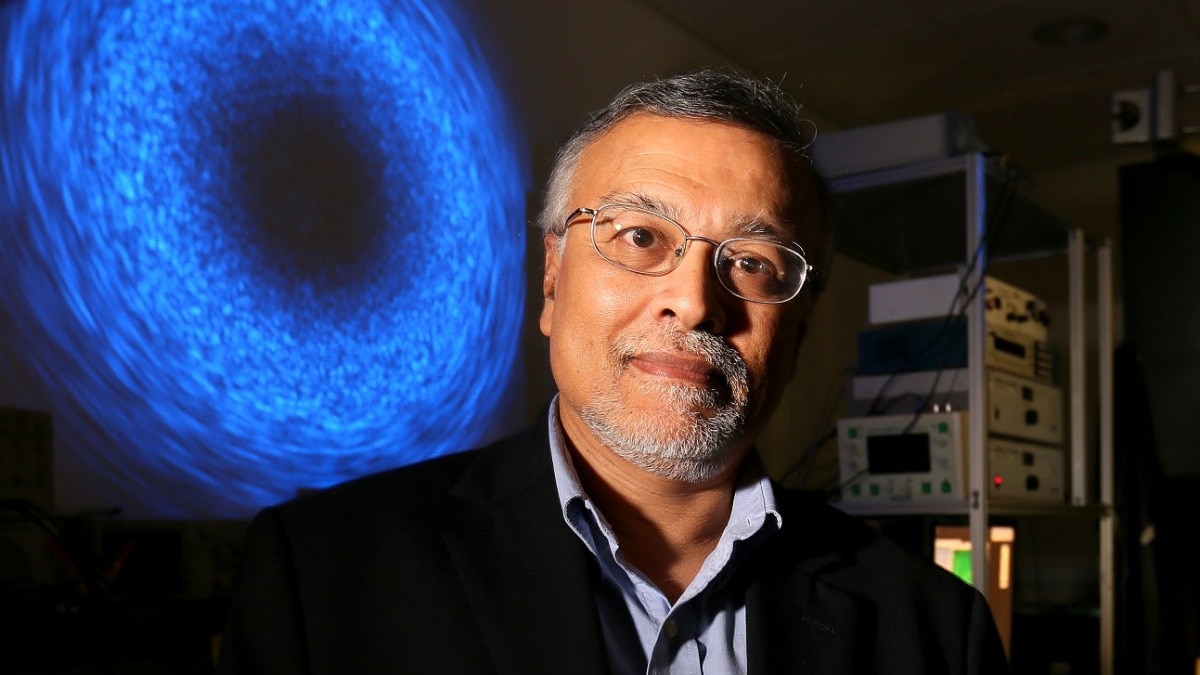
Five decades ago, Professor Mriganka Sur graduated from IIT Kanpur and went on to explore neuroscience at Yale and MIT. His work on brain wiring, association with IIT Madras and honours from institutions such as the Royal Society mark a distinguished academic journey.Dr. Mriganka Sur is photographed in a laboratory at Massachusetts Institute of Technology in Cambridge, Massachusetts where he does research on the brain's adaptivity to various inputs and stimuli.New Delhi,Nov 23, 2026 14:28 ISTHow challenging is it to move from electrical engineering to neuroscience? Today, the growing intersection of AI and different academic disciplines is making such transitions easier to imagine. But nearly five decades ago, one Indian student had already taken a path that brought these seemingly distant fields together.Professor Mriganka Sur, who graduated in Electrical Engineering from IIT Kanpur in 1974, went on to pursue higher studies in the United States before making neuroscience the focus of his academic career.Professor Sur's journey took him through Vanderbilt University, Stony Brook University and Yale University before he joined the Massachusetts Institute of Technology (MIT).His work would eventually centre on a question that has occupied scientists for generations: how does the brain develop, organise information and change through experience? For his contributions to research, Professor Sur received prestigious recognition, including a Fellowship of the Royal Society and the NR Narayana Murthy Distinguished Chair at IIT Madras.FROM IIT KANPUR TO VANDERBILT UNIVERSITYAccording to IIT Kanpur's official alumni profile, Sur completed his BTech in Electrical Engineering in 1974. He then moved to Vanderbilt University in Nashville, where he earned his Master's degree in 1975 and PhD in Electrical Engineering in 1978. His early academic training was firmly rooted in engineering.However, his subsequent research career took him towards the study of the brain, where he applied experimental and theoretical approaches to understand how neural circuits develop and function.After completing his doctoral studies, Sur continued at Vanderbilt as a postdoctoral associate from 1978 to 1980.He then joined the State University of New York at Stony Brook, where he worked in the Department of Neurobiology and Behavior.FROM ENGINEERING RESEARCH TO THE STUDY OF BRAINSur's professional journey took a significant turn when he moved towards neuroscience. Rather than abandoning his engineering background, he brought its principles into the study of the brain.His research examined how the cerebral cortex develops and how its neural connections change in response to experience.One of the major questions in his work was how much of the brain's organisation is determined by genes and how much is shaped by sensory experiences such as touch, vision and hearing.The laboratory where Sur spent hours and days studied this relationship through experimental and theoretical methods. In one notable experiment, researchers rerouted the optic nerve of newborn ferrets to the auditory cortex.The cells in that region subsequently developed characteristics associated with visual processing and responded to visual information.The findings offered evidence of the brain's capacity for plasticity, or its ability to reorganise neural connections. MIT's Simons Center for the Social Brain identifies cortical development and plasticity as central areas of Sur's research.FROM YALE TO MITSur joined Yale University School of Medicine as an Assistant Professor in 1983. Three years later, in 1986, he moved to MIT's Department of Brain and Cognitive Sciences.Sur's association with MIT continued over the following decades. He served as head of the department for 15 years and later established the Simons Center for the Social Brain, where he serves as director.He is currently the Paul E. and Lilah Newton Professor of Neuroscience at MIT and an investigator at the Picower Institute for Learning and Memory.His academic journey also includes an association with IIT Madras, where he serves as visiting faculty in the Department of Computer Science and Engineering and holds the NR Narayana Murthy Distinguished Chair in Computational Brain Research.Sur's educational record offers an account of how his academic interests developed across disciplines.He completed his undergraduate education at IIT Kanpur, followed by postgraduate and doctoral studies in electrical engineering at Vanderbilt University.His subsequent appointments at Stony Brook and Yale preceded his move to MIT. The multidisciplinary approach he adopted proved highly successful. Today, as AI is transforming various fields, it is also encouraging us to explore possibilities that humans have never experienced before, potentially giving rise to new endeavours.Decades ago, Sur set an example. Today, more students and professionals can draw inspiration from his journey and consider exploring paths beyond their chosen disciplines.The engineering education he received at IIT Kanpur and Vanderbilt remained relevant to his later work on neural circuits, brain organisation and information processing.- Ends
Born in Kolkata, educated at IIT Kanpur: The journey of neuroscientist Mriganka Sur
Full Article
Original Source
Read the full article at Indiatoday →KhanList aggregates and links to publicly available news content. We do not host full articles from third-party sources. Always verify important information with original sources.