
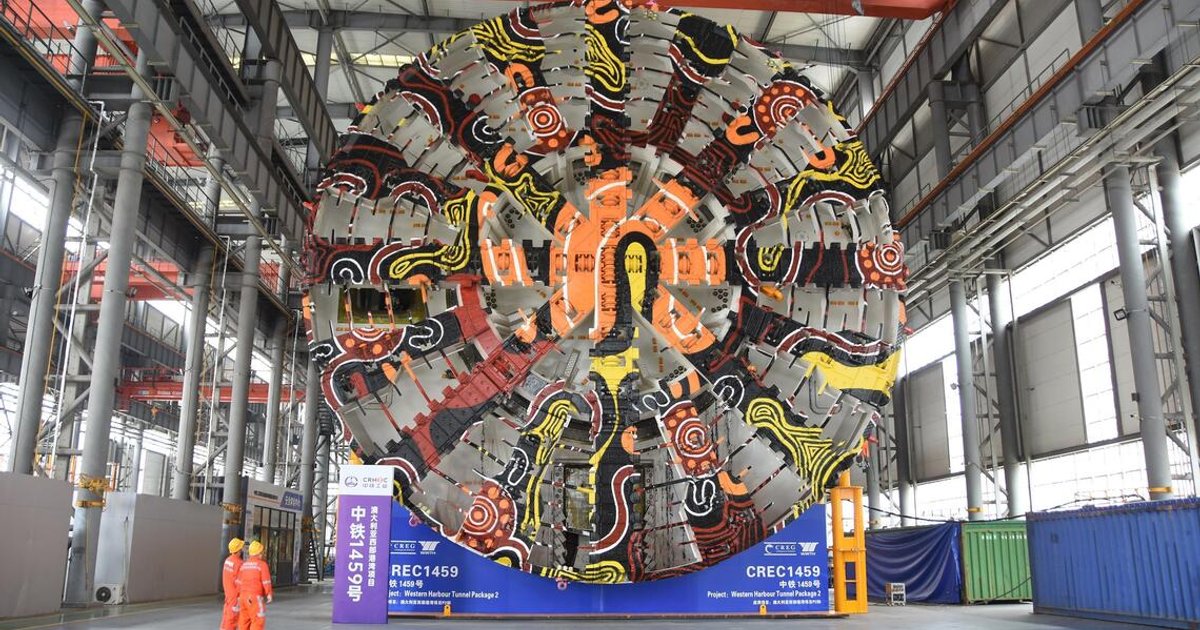
NEW DELHI – Across India, tunnel boring machines (TBMs) – giant, powerful, mechanical earthworms that can be longer than a jumbo jet with circular cutting faces over 10m in diameter – are powering the country’s infrastructure building drive, churning deep beneath the ground to create tunnels for roads, railways, power projects and more.Many of the TBMs at work here are from China, the world’s top producer of these advanced machines. But in a fresh trade salvo, Beijing will begin restricting the export of these machines and other advanced construction equipment from Nov 18.The equipment on the control list also includes critical TBM components and other machines such as crawling excavators and high-altitude concrete spraying systems.Scholars say the move – first announced on Oct 19 – may be aimed at slowing down India’s strategic infrastructure development along the Himalayan border with China.In India, where the move has cast a shadow on warming bilateral ties with China, the government has reacted defiantly, redoubling its efforts to build TBMs in India.Minister for Commerce and Industry Piyush Goyal told a public audience on Nov 3 that the country was not going to “kneel down”. He said: “If they (China) don’t give us tunnel boring machines, we will develop it in India.”China’s security imperativeAccording to the new regulations, the export of these goods to “sensitive countries” with which China has territorial disputes must be now licensed by the Chinese Ministry of Commerce.India and China have a longstanding border dispute that led to a war between the two in 1962 and, more recently, a limited but fatal clash in 2020.Exports to other destinations are subject to a simpler registration and information reporting process.A spokesperson for China’s Ministry of Commerce said that the items covered by these measures are “clearly dual-use” in nature, implying these machines could be used not just for civilian infrastructure projects but also military or strategic defence operations.The spokesperson added that Beijing’s latest export control measures “could better safeguard national security and interests, and better fulfill international obligations such as non-proliferation”.Commentaries in Chinese media highlight that the export of TBMs and other equipment could help India build military infrastructure along its border with China.Li Guangman, a senior researcher at the Kunlunce Research Institute, a pro-government Chinese think tank, wrote: “If China were to freely export complete tunnel boring machines, cutterheads, main drives and other core components, it would be tantamount to supplying weapons for India’s militarised border infrastructure, assisting it in rapidly enhancing its military deployments against China and significantly exacerbating the pressure on China’s land border defences.”The extent of the restrictions are such that even foreign firms which manufacture these products in China are prohibited from selling them to “sensitive countries” without Beijing’s approval.Importers and other entities in non-sensitive locations are also prohibited from transferring such goods originating in China to “sensitive countries” without Beijing’s authorisation.Targeting IndiaIn India, the move is being seen as yet another instance of China weaponising its industrial technologies and strengths by restricting their overseas supply, including not just TBMs but, in the past, also rare earth materials and engineering talent.“It does reflect a sense of fear among the Chinese that why should their products be used against them and why should things made in China be used to build strategic ecosystems elsewhere?” said Mr Pranay Kotasthane, who chairs the High Tech Geopolitics Programme at the Takshashila Institution, a Bengaluru-based think tank.Specific restrictions on high-altitude wet sprayers intended for use at altitudes of 3,000m or higher, and other high-elevation machines, have strengthened suspicions that the new restrictions target India.“If you look at the intersection of the countries which are doing things above 3,000m and have a dispute with China, there’s only one country (India),” Kotasthane told The Straits Times. “Maybe this is their (China’s) way to signal that they have leverage and this can be negotiated at a future point of time.”Silver lining: Self-relianceBilateral trade and investment exchanges between India and China often fall hostage to political tensions.In June 2020, a fortnight after the fatal border clash with China, New Delhi banned 59 Chinese apps, including TikTok, citing threats to national security, sovereignty, and public order. This was followed by a second wave of bans in August 2020.The latest Chinese restriction, says experts, could delay some Indian projects but add that this trade salvo is a blessing in disguise for India in the long term, pushing it to develop indigenous capabilities to manufacture and maintain these machines.In August 2026, Reuters reported India was preparing to approve a US$1.2-billion incentive scheme aimed at strengthening domestic manufacturing of high-value and technologically advanced construction and infrastructure equipment to reduce reliance on foreign imports.These attempts at becoming self-reliant were strengthened by signs of a squeeze in the supply of Chinese TBMs in 2024 when at least three such machines meant for use in India – including for the development of a high-speed rail corridor between Mumbai and Ahmedabad – were held up in China, leading to several months of delay. The machines were manufactured in China by Herrenknecht, a German company.Since then, Herrenknecht, a market leader in the area of mechanised tunnelling systems, has increasingly been building TBMs at its plant in Chennai in South India, including the two largest such machines ever ordered in India for a road link project in Mumbai.While questions remain on how far India can truly break out of the Chinese TBM supply chain, the country has increasingly diversified away from China-imported TBMs. The value of tunnelling machinery imports from China fell from US$18 million in 2022-23 to US$800,000 in 2025-26, according to Reuters.China’s global market share of TBMs stands at about 70%, according to Chinese state media, while other TBMs come from suppliers in Germany, the United States, Japan and beyond.Mr Vinayak Chatterjee, Co-Founder and Managing Trustee of The Infravision Foundation, an independent think tank focused on infrastructure-led economic development, estimates around 40% of the 100-odd TBMs operational in India are Chinese, adding that the new export restrictions could slow down acquisition of spare parts and potentially delay some projects.“The current concern is about the existing (Chinese) stock, whether stores or spares will come… we will have to see how the Chinese react to it because they haven’t announced an outright ban yet,” he said.But Chatterjee also noted that TBMs are increasingly being built in India by foreign and Indian players, including machines of large 15m diameters. “We were already exploiting the opportunity. These latest restrictions just give (these efforts) a sense of heightened urgency,” he told ST.In 2024, Afcons Infrastructure, a major Indian engineering and construction company, saw its operations on a high-speed rail project impacted because of a delay in the import of TBMs from China. The company currently has 20-odd TBMs of its own and has diversified its vendor base since then.Naresh Sharma, the head of corporate communications at Afcons Infrastructure, told ST that there would be “no impact of this (Oct 19) decision” on the firm’s operations, noting that the firm now had options to source TBMs from manufacturers in India and beyond.Indeed, Indian firms such as BEML Limited and Larsen & Toubro are making efforts to produce TBMs in India. R. Shankar Raman, president of Larsen & Toubro, a Mumbai-based engineering giant, told Bloomberg in October 2026 the firm is developing a prototype tunnel-borer and that “if our experiment proves successful” the firm might be able to source its own machinery and sell to others.Kotasthane noted that the latest restrictions are a window of opportunity for India to draw foreign firms that manufacture TBMs and other advanced construction equipment out of China to India.“The only other big economy (other than China) that will serve as a huge demand sink for these machines will still be India,” he said. Together with Chinese restrictions on export of such equipment, this would serve as an incentive to “push” foreign firms out of China to India, he noted.However, he cautioned that India would also have to work to “pull” foreign manufacturers to set up base here by carrying out necessary reforms to ease predictable bottlenecks related to complex tax regulation, land acquisition hurdles and customs clearance delays, among other issues. Kotasthane added: “The push from China exists, but can we pull companies on our side?”With additional reporting from Ingrid Yu in Beijing
Boring war: China cuts tunneling machine exports, India digs in
Full Article
Original Source
Read the full article at Straitstimes →KhanList aggregates and links to publicly available news content. We do not host full articles from third-party sources. Always verify important information with original sources.