
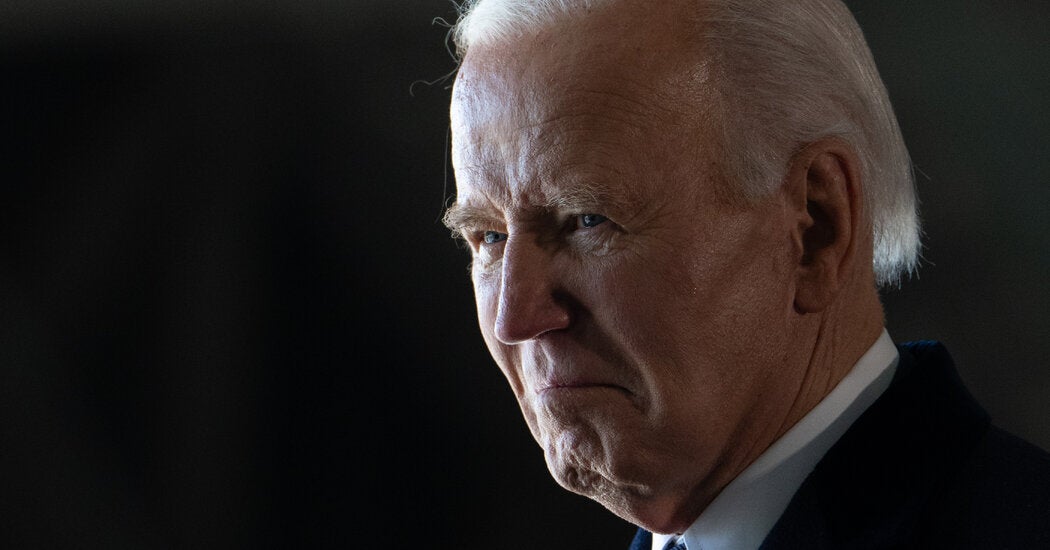
AdvertisementSKIP ADVERTISEMENTNonfictionReflecting on 2024, Joe Biden Finds No Faults of His OwnThe former president’s new memoir trumpets his achievements while justifying his decision to run for a second term and his embrace of Israel’s war in Gaza.Joe Biden’s memoir runs on two tracks: steady pragmatism and accelerating grandiosity. Credit...Erin Schaff/The New York TimesNov. 13, 2026, 12:56 p.m. ETWhen you purchase an independently reviewed book through our site, we earn an affiliate commission.PROMISE ME, AMERICA, by Joe BidenJoe Biden wants you to know that he is proud of himself — and if his new memoir is any indication, he thinks everyone else should be proud of him, too. “Promise Me, America” begins with soaring declarations about the “long sweep of history” and the “fundamental goodness” of the United States, before turning into a minutely detailed account of his presidential accomplishments. The result reads like a mix of cover letter and campaign speech — one that’s more than 400 pages long.It didn’t have to be this way. The post-presidential memoir is an uneven genre; to engage in sustained reflection requires some humility, a quality for which former presidents aren’t typically known. And Biden, who turns 84 this week, can legitimately lay claim to a raft of domestic policy feats at an extraordinarily difficult time. Pandemic relief, infrastructure, clean energy, semiconductor manufacturing: He understandably wants to chronicle the hard work behind these achievements, and more.But enumerating the wins is easy. The true test of a book like this is whether its author will own his losses, too. Biden, for his part, does not. He is so preoccupied with burnishing his legacy that he gets awkward and defensive when addressing the two issues many readers will be most curious about: his handling of the war in Gaza, and his decision to run for a second term.From the first chapter, “History Comes Knocking,” the book runs on two tracks: steady pragmatism and accelerating grandiosity. Biden takes pains to show how, as a 78-year-old commander in chief, he assembled a “great team,” and he is plenty willing to give credit where credit is due. He makes sure to name-check his staffers, dedicating entire paragraphs to simply listing the people who traveled with him or attended a meeting. Such compilations are generous, if narratively fatal. It’s hard to sustain momentum amid a blizzard of names.Not that the book’s trajectory is ever in doubt. It begins on Jan. 6, 2021, when Trump supporters stormed the Capitol. (Biden unhesitatingly calls the event an “insurrection” that “should follow” Donald Trump “to his grave.”) It ends with Trump back in power. When announcing his run for a second term, Biden says, he chose to emphasize that his opponent was a threat to democracy: “He said he’d be a dictator on Day 1. He was planning to invoke the Insurrection Act, which would allow him to deploy troops on the streets of America. He was calling those who opposed him ‘vermin.’ He talked about the ‘blood' of America as being ‘poisoned,’ echoing the language used in Nazi Germany.”Why, then, did Trump win?Biden has his ideas. His own policies, he argues, couldn’t have had anything to do with it. (Regarding Kamala Harris, he “was proud of her and the campaign she ran.”) “We had accomplished so much,” he says. He decided to run again because he “wanted to finish the job.” In addition to describing his legislative victories, the book includes an appendix to hammer this point home. “Laws Signed by President Joseph R. Biden Jr.” lists a “selection” of the “more than 600 bills” he signed into law.As for his age and his health, he repeatedly contends that these weren’t a problem either. He believes that Americans supported him, casting a primary win in New Hampshire as “a resounding vote of confidence.” Instead, he blames “the press and pundits” for pushing a “narrative” and “salivating” at the prospect of his humiliation. “Yes, people could point to moments when I mixed up names or lost my train of thought or had a weak voice or walked slowly,” he writes, grudgingly. “But they could never point to something presidential that I failed to do.”Reminiscing about his victory in 2020, Biden complains about increased scrutiny: “Now it was four years later, and the noise about my age had grown louder” — as if he hadn’t also grown four years older. Even he cannot wholly disavow his abysmal debate performance against Trump in 2024, and so he shrugs it off as no big deal.“Lots of presidents had bad debates,” he says, pointing to Barack Obama’s first debate against Mitt Romney. “The difference was that every other president was given the chance to redeem themselves in a second debate. As it turned out, that chance would not be available to me.”The sulking at the end of that quote is telling. Biden’s voice gets passive; he portrays himself as the helpless victim of events. He gets similarly defensive when recounting the war in Gaza. “I repeatedly sought to restrain the Israelis,” he says, citing multiple instances when he gave Prime Minister Benjamin Netanyahu a stern talking-to amid the escalating Palestinian death toll. Reassessing America’s unconditional military aid to Israel was apparently out of the question. Biden offers no explanation why, other than to say that he had “always felt an affinity” for the country.“Too many innocent Palestinians were killed,” Biden allows. “Too much pain was inflicted on people with no connection to Hamas. Too little food and water and medicine and fuel got into Gaza for too long.” Again, note the passive voice. In the same chapter, titled “October 7,” he writes with moving specificity about the suffering of Israeli civilians, referring to several by name. When writing about Palestinian civilians, however, he includes no names, and depicts their suffering in only the most general terms, calling their plight “a tragedy.”Biden maintains he would have “prevailed” at the 2024 Democratic National Convention. He says he eventually relented to pressure and bowed out of the race for the sake of “party unity.”In May 2025, he learned he had Stage 4 prostate cancer. He mentions this in his epilogue, though he says nothing about how such a development could have affected him and presumably the country had he gotten his way and been granted another go as president. You have to marvel at such formidable powers of compartmentalization: Biden still wants us to know that he could have won.PROMISE ME, AMERICA | By Joe Biden | Little, Brown | 465 pp. | $42Jennifer Szalai is the nonfiction book critic for The Times.Related ContentAdvertisementSKIP ADVERTISEMENT
Book Review: ‘Promise Me, America,’ by Joe Biden
Full Article
Original Source
Read the full article at Nytimes →KhanList aggregates and links to publicly available news content. We do not host full articles from third-party sources. Always verify important information with original sources.