
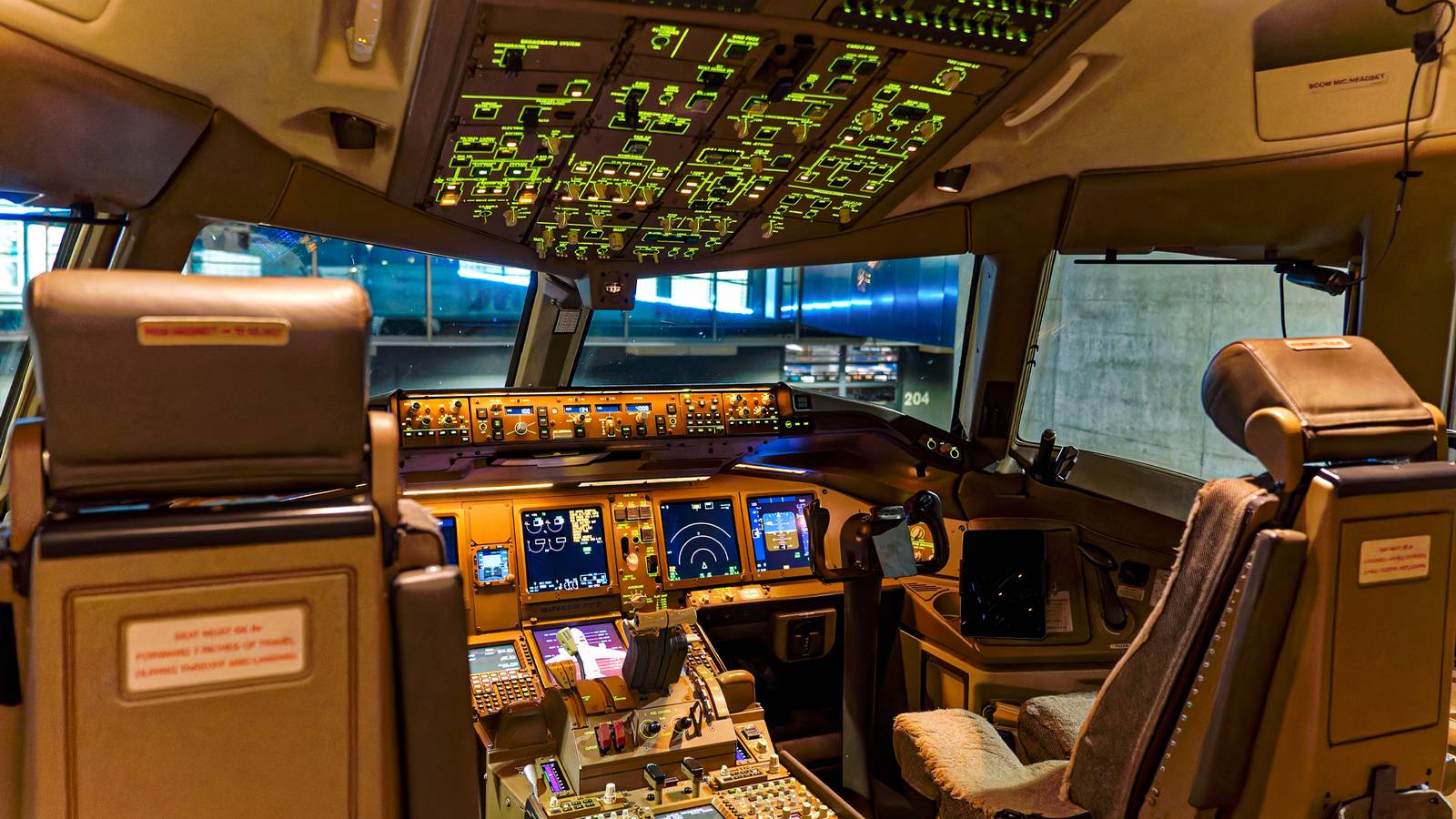
Credit: Michael Derrer Fuchs | Shutterstock, Simple Flying Published Nov 19, 2026, 11:00 AM EST Brandon's passion for aviation started at a young age. He became involved in the flight simulator and VATSIM communities, which sparked his interest in aviation and eventually led him to earn his private pilot license. Outside of work, he continues to build flight hours, explore new airports, and stay involved in the aviation community. Airbus and Boeing had the same technology available and reached opposite conclusions about what to do with it. The A320 introduced a digital fly-by-wire system to a commercial airliner for the first time, and with the mechanical linkage removed, a control column was no longer technically necessary. Airbus took that option and fitted a sidestick. Boeing arrived at fly-by-wire later with the 777 and 787, had no mechanical requirement for a yoke either, but kept one. The difference most people notice is the shape of the control. The differences that matter to the pilots flying them sit elsewhere. Boeing yokes are linked, so each pilot can see and feel the other’s inputs. No fly-by-wire Airbus has linked sidesticks. Boeing’s yokes and thrust levers move with the autopilot engaged, while an Airbus leaves both stationary and puts the information on the displays instead. The same split runs through general aviation and business jets, where Cirrus built a control that looks like a stick and works like a yoke, and Dassault put the first sidestick in a business jet in 2001. The A320 Made The Yoke Optional Credit: Thomas Roell | Shutterstock Airbus did not start with sidesticks. Up until the A320, Airbus aircraft were designed with conventional control columns, the same arrangement found in Boeing cockpits. What changed was the A320, which introduced a digital fly-by-wire system, a first on a commercial airliner. With that system in place, a control column was no longer technically necessary. Airbus removed it. Boeing reached fly-by-wire later and made the opposite decision, keeping the yoke on the 777 and the 787 despite neither aircraft requiring one for mechanical reasons any more than the A320 did. What separates them is intent rather than capability. Simple Flying puts it directly: Boeing’s fly-by-wire software aims to replicate the feel of flying an aircraft with mechanical flight controls, which is not the case for Airbus aircraft. The Boeing cockpit delivers a more traditional flying experience that many pilots find engaging, at the cost of a yoke that is large and sits directly in front of the pilot. Airbus treated fly-by-wire as a reason to redesign the interface rather than to reproduce the previous one in software, and the sidestick followed from that decision rather than driving it. Linked Versus Unlinked Is The Real Difference The visible difference is the shape of the control. The consequential one is whether the two controls are connected to each other. The yokes in a Boeing cockpit are linked, and no fly-by-wire Airbus aircraft features linked sidesticks. On a linked system, when the captain moves their yoke, the first officer’s yoke moves with it. Each pilot can see what the other is doing and feel it through their own control without looking across the cockpit. The arrangement is not unique to airliners. AOPA notes that in typical light aircraft with dual yokes, the controls are directly connected, with a sprocket behind each tube and a chain driving both simultaneously. A student pilot learning in a Cessna is flying a control linked to the instructor’s in essentially the same way a 787 captain’s is linked to the first officer’s, which is part of why the arrangement feels conventional to most pilots arriving at a Boeing flight deck. On an Airbus, each sidestick is an independent input to the flight control computers, and moving one does nothing to the other. A pilot watching the other side of the flight deck sees a control that is small, mounted outboard, and largely out of view. That difference has shaped the debate around Airbus flight deck design for decades, and it is the reason active sidesticks were later developed. Whether unlinked controls represent a meaningful safety distinction or simply a different convention remains contested among pilots, and the two manufacturers have not converged on an answer. What Moves & What Does Not The second difference appears the moment the autopilot engages. On a Boeing, the yoke continues to move as the autopilot flies and the thrust levers advance and retard with the autothrottle. In a modern Airbus cockpit, neither the sidestick nor the thrust levers move when the autopilot and autothrust systems are engaged. This is a design philosophy rather than a technical limitation. Backdriving a control is achievable engineering, and Boeing does it on aircraft that have no mechanical connection to the control surfaces either. Airbus concluded the information belongs on the displays. If a pilot wants to know what thrust the engines are producing, the answer is on the screen in numerical form rather than inferred from a lever position. Which approach suits a given pilot depends on what they want from monitoring. Boeing’s design provides a continuous peripheral sense of the aircraft’s state without requiring anything to be read. Airbus’ design requires an active instrument scan but removes moving hardware from the flight deck and presents the data in the form the aircraft is using. This is among the first things pilots notice when switching between the two, ahead of the shape of the control itself, because a cockpit where nothing moves under automation feels substantially different from one where the hardware tracks the aircraft. The thrust levers are the clearer example of the two. On an Airbus, they sit in a detent through the entire cruise, giving no indication of what the engines are doing, while a Boeing’s advance and retard continuously as the autothrottle works. Why Airbus Never Linked Them, And Who Did Credit: Aerospace Trek | Shutterstock The explanation for unlinked sidesticks is more mundane than the debate around them suggests. Such a system was not economically feasible in the 1980s when the A320 was being designed. Airbus built what the technology and the budget of the period allowed, and the arrangement has carried forward through every fly-by-wire aircraft the manufacturer has produced since. Active sidesticks addressed the problem later. Rather than a mechanical connection, they use electric servos to link the two sticks electronically so that both move together, and the same servos can supply tactile feedback during manual flight. The Gulfstream G500 and G600 were among the first aircraft to fly them. The capability has implications beyond linking the two controls, since a stick that can push back against the pilot can also signal the edge of the flight envelope through the control itself rather than only through the displays, which is closer to what a yoke does naturally. The most interesting case sits inside Airbus itself. Many newer aircraft, including the Airbus A220 and many business jets, include linked sidesticks. The A220 was designed by Bombardier as the CSeries and acquired by Airbus in 2018, which means its flight control system was built by a different company with a different philosophy. The result is an Airbus aircraft doing something no Airbus-designed fly-by-wire aircraft does. The technology to link sidesticks has existed for years, and Airbus has elected not to adopt it on its own designs rather than been unable to. Outside The Airliner Cockpit Credit: GingChen | Shutterstock The same divide runs through general aviation and business jets, with some arrangements that fit neither category cleanly. AOPA traces the yoke back to at least the Curtiss 1 in 1909, and it remains the standard control in light aircraft, where most installations are mechanically interconnected between the two seats. Early aircraft used something approximating a car steering wheel, while most of today’s designs use half a wheel, and the yoke can be panel-mounted or floor-mounted in either a U shape or the less common M arrangement. Cirrus built the notable exception. AOPA describes the side yoke as a control that looks like a stick but functions like a yoke, with distinct pushing, pulling, and turning motions, and credits Cirrus with popularizing it in general aviation. The arrangement is not an Airbus-style sidestick. It commands conventional control surfaces through mechanical linkages rather than a computer. Cirrus itself moved away from the design when it built a jet. AOPA reported that the Vision Jet replaced the SR series’ unusual side yoke with a more conventional sidestick, while the handling characteristics remained close enough that transitioning pilots found the two aircraft eerily similar. Business jets split along manufacturer lines much as airliners do. Dassault announced the Falcon 7X at the 2001 Paris Air Show, and Aviation Week describes it as the world’s first fly-by-wire business jet, drawing on four decades of Dassault military fly-by-wire development, and the first business jet with sidestick controls. Gulfstream followed with sidesticks on the G500 and G600. Embraer went the other way, fitting conventional yokes to the E-Jet series despite the aircraft’s electronic systems.
Boeing Vs. Airbus Cockpits: How Yokes & Sidesticks Change The Way Pilots Fly
Full Article
Original Source
Read the full article at Simpleflying →KhanList aggregates and links to publicly available news content. We do not host full articles from third-party sources. Always verify important information with original sources.