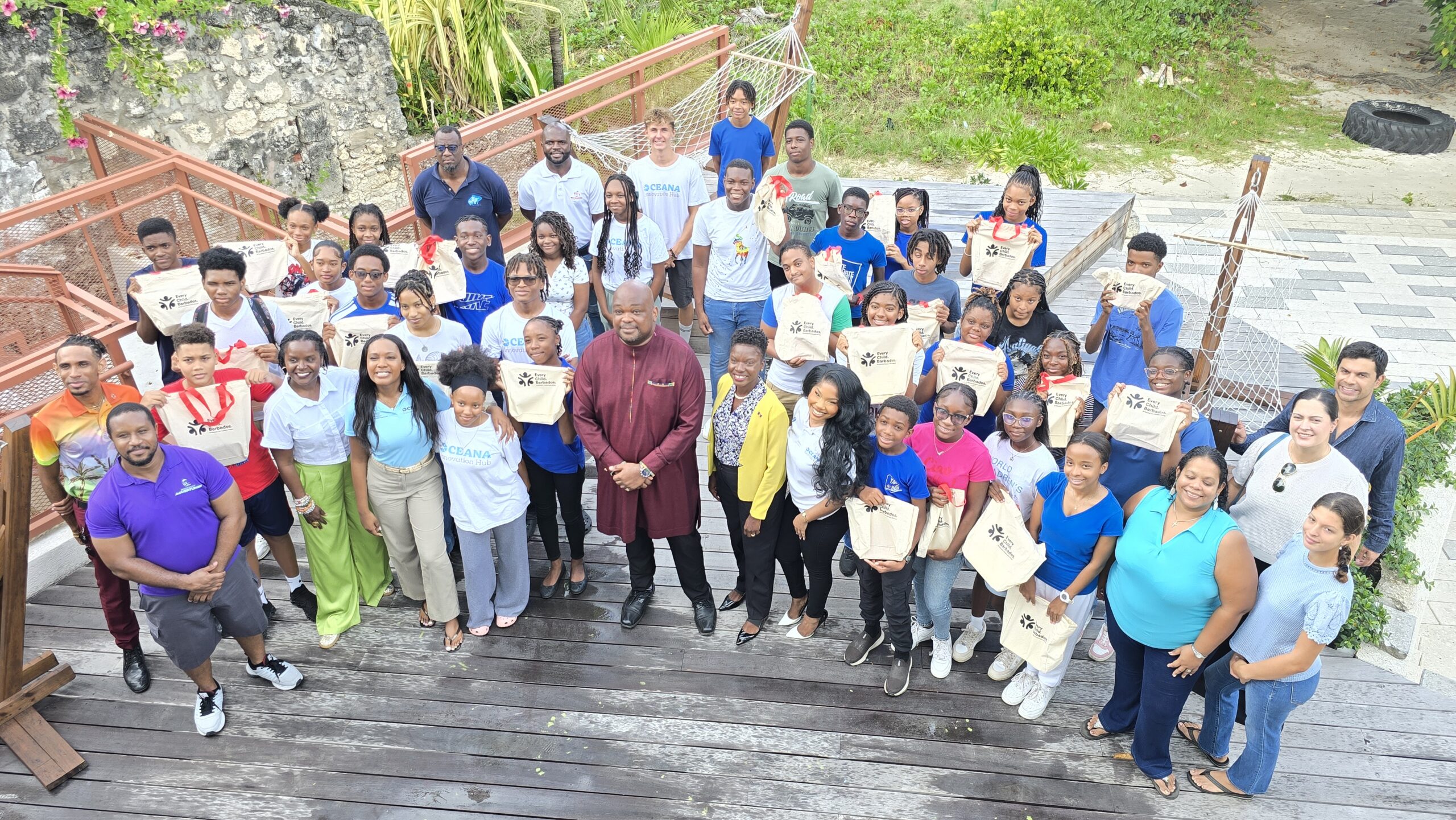
Campers, Oceana Hub Staff, parents and Ministry of Education Officials at the Launch of Blue X Accelerator Camp 2.0. (Photo Credit: Lourianne Graham) The Ministry of Education Transformation is developing a globally recognised high school certificate from its new ocean and climate schools, entering partnership discussions with international organisations to offer the certificate, Minister Chad Blackman has announced. With the Barbados Climate School under construction, its marine and coastal counterpart, the Oceania Innovation Hub, on Tuesday launched its second Blue X Accelerator programme, Blackman described the certification plan as part of the government’s wider push to prepare students for emerging opportunities in the blue economy and climate resilience. He said: “This is a very bold and deliberate strategy of the Government of Barbados, as I said, to be able to help young people to be able to lead the world that they must inherit, and part of that leadership also must be to give them the tools to understand climate and ocean diplomacy.” Blackman explained that many global decisions, including international protocols and treaties governing the ocean and business activities, will require young people to develop skills such as negotiation. “Part of what the ministry has already started to do is to partner not just with local and regional organizations, but other organizations within the United Nations system so as to ensure that even when they come through Oceania or the Barbados Climate School that they will be getting a globally certified level of certification that they can go any corner of the earth and to be able to say, hey, yes, I did my programming and studies in Barbados, but it is globally recognized and here is the skill set that I bring to you. “All of this we’re doing for them prior to them leaving secondary school in Barbados, and as I said, it’s a very deliberate strategy to ensure that we’ve now repositioned Barbados’ education system as a leading education system over time so as to ensure that we can maximise on our skill sets.” You Might Be Interested In The four-week Blue X Accelerator programme, which involves students from 14 schools, will expose participants to marine technology, robotics, blue tourism, aquaponics, sargassum, advocacy and innovation, culminating in a Blue X Innovation Challenge. Blackman told students the four-week programme reflects the ministry’s education transformation agenda: “If we are to prepare our students for the world that not only exists but that will exist in the future, we have to give them the skills and exposure necessary to be able to not just navigate that space but to dominate it and to lead it, and that’s really the story of what we’re doing in education in Barbados.” Blackman encouraged students to learn how to maximise opportunities in the marine space. “Barbados is a large ocean state; it means that we must now be able to navigate that space just out there and all around us with respect to the ocean. So from simple things like swimming, but also how do you tap into the opportunities of what is beneath the ocean.” He added: “The idea is that Oceania as a school and also through this camp, is to give these students the ability to tap into that.” Barbados must become a knowledge-based economy by identifying global challenges and creating solutions rooted in ocean knowledge, he said. “Spotting challenges around the world and being able to create solutions to those challenges, we have the ability, therefore, through this school and all the other programs that we do.” Blackman also outlined how the Barbados Climate School and the Oceana Innovation Hub will bring together students from different schools to collaborate on projects, describing it as a new approach to learning. “Part of the programming here at Oceana and part of the programming that will happen also at the Barbados Climate School is not just to help students understand issues of the climate crisis or what the climate crisis is about but it’s also getting them to focus on what are the solutions, how do they work with students from other schools when they’re coming here and working in terms of course of a project-based learning approach.” The minister also encouraged students to use technology and social media to share what they learn and become ambassadors for climate and ocean education. “See even beyond the accelerator 2.0, how do you now take what you’ve learned here and put it into a fun way for others to learn, so with podcasts and Instagram posts, you name it, you now live in a world where, the technology serves as a basis that you can amplify not just your voices, but your thoughts and ideas, not just your peers at school or in Barbados, but around the region and the world.” Blackman disclosed that next week he intends to raise the programme at the CARICOM Council for Human and Social Development (COHSOD) meeting in Guyana with hopes to create opportunities for students across the Caribbean to collaborate on ocean and climate issues. “One of the things that I intend to do is…for us to set up a framework that young students in Barbados and across the region can also start to share their experiences with respect to ocean and climate, because the truth is, as a region collectively we all face a singular threat but equally it means that there’s a singular opportunity for all of us, and we cannot simply focus on us alone in Barbados. “If this region is to be viable and continues to be viable and competitive, these young people must now be given tools to be able to think. Also like how we do at the policy level and policy formulation level, even though they’re at school, they start to see a global picture as they go forward and therefore prepare our future.” In welcome remarks, the director of the Oceana Innovation Hub, Ché Greenidge, said this year’s Blue X Accelerator forms part of the hub’s wider curriculum, focusing on the blue economy and how Barbados can generate sustainable value from its ocean resources while protecting marine ecosystems. “Examining how Barbados can generate sustainable value from its ocean space while protecting the ecological systems on which that value also depends, and this work supports the goals of Mission Barbados by linking education directly to climate resilience, to food and water security and digital transformation that all blends with the workforce development and sustainable economic growth for Barbados.” The Barbados Climate School, also known as the Chelston Academy located at Chelston Park in Collymore Rock, is being developed in partnership with the US-based XQ Institute, with a focus on climate resilience, sustainability, and 21st-century learning. It is expected to cater to senior secondary and lower/upper sixth-form students (fourth form through sixth form) with hands-on learning in climate science, environmental protection, and green technology to prepare youth for future ecological challenges and opportunities. (LG)
Blackman unveils global certification plan
Full Article
Original Source
Read the full article at Barbadostoday →KhanList aggregates and links to publicly available news content. We do not host full articles from third-party sources. Always verify important information with original sources.