
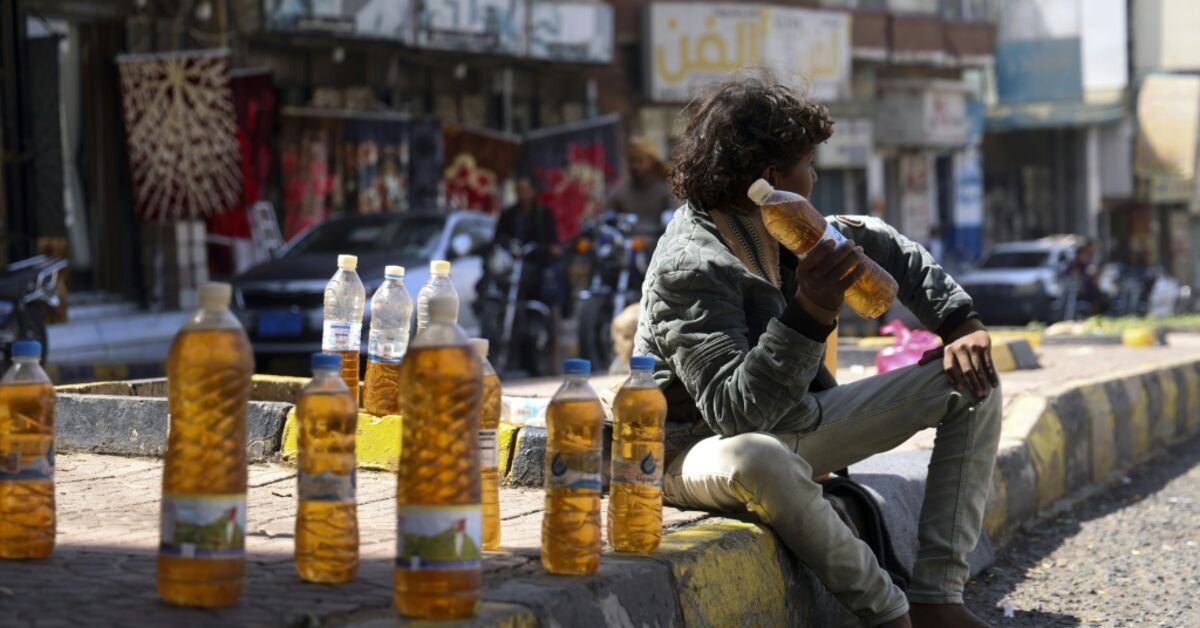
In Yemen's western city of Taiz, men and children line the streets, selling rows of bottles filled with orange liquid, the only petrol available in the city besieged for weeks. Since October, the Iran-backed Houthis have tightened their grip on Taiz, cutting it off from the interim seat of the internationally recognised government in Aden. Although the Houthis deny preventing food and medical supplies from reaching Taiz, residents complain of shortages and skyrocketing prices, especially of fuel. Taiz resident Hamoud Bajash likened the city to a prison. "We are besieged, three million people inside a prison," he said. "Our lives have become dependent on the black market, from tomatoes and onions to gas and fuel." Open-air petrol markets have sprung up across Taiz, Yemen's third-largest city by population, according to AFP footage, while petrol stations have closed. Mazen Abdulaziz, a bus driver, complained that "the price of a dabbah (20 litres) of petrol has reached 55,000 Yemeni riyals", the equivalent of about $35 at the unofficial dollar exchange rate in government-held areas -- equal to a monthly salary for some workers in Taiz. A 20-litre jerrycan of petrol is now sold for around 37,000 Yemeni riyals (about $24) in Aden, according to an AFP correspondent there. "If only the petrol were good... it's all tainted," the driver said, noting that black-market fuel caused his bus to break down. Before the siege, 20 litres cost "27,000 riyals from the legitimate (authorities), and the petrol was excellent". Yemen's currency is effectively split. In government-held areas, a dollar is worth about 1,550 riyals, compared with around 530 riyals in Houthi-controlled areas, according to August data from the Studies and Economic Media Center. - 'It's a risk' - Amin Ahmed, a petrol seller, confirmed that the black market has become the only source of petrol. Traders are forced to go to areas under Houthi control outside the city to buy it, he said, pointing to "dangers on the road, from shelling and sniping to clashes". "Every trader sells at whatever price he wants. There is no fixed price," he said. It is not just petrol being sold; gas cylinders also line the streets. Gas seller Mukhtar Assaj said "the price of gas used to be 9,000 riyals... now we buy it for 20,000 from Al-Nashma", an area under Houthi control. "We bring it in with difficulty amid gunfire," he added, recounting that "two drivers were killed on the road near a driver who works with me. It's a risk". - 'A necessary evil' - Abdulwudoud Abdou, deputy director of the industry and trade office in Taiz, described the black market as "a necessary evil... since having goods available is better than not having anything". Committees from his office, which is responsible for regulating prices, "go down into the field to control costs and ensure selling at reasonable prices", he told AFP. He pointed to "newly set up checkpoints to collect levies, obstruct people and prevent them from reaching the city". The Houthis deny preventing essential goods from entering Taiz or imposing tariffs on them. Mohammed al-Bukhaiti, a member of the Houthis' political bureau, told AFP: "We do not obstruct civilian movement to and from Taiz and do not impose any levies." He said the group only imposes a blockade on weapons, accusing Al-Qaeda and the Islamic State group of "looting, robbery and imposing levies on the entry of foodstuffs and especially petroleum products". Bukhaiti maintained that medicines and foodstuffs "enter smoothly", adding: "We welcome humanitarian organisations that want to bring food and medicine into Taiz, and we will provide them with all facilities." About two weeks ago, the International Committee of the Red Cross announced that it had delivered essential medical aid to Taiz, the first such delivery since the end of September, when fighting intensified in western Yemen. The ICRC told AFP these were the only shipments it had been able to deliver since. After years of relative calm, fighting between the Houthis and government forces resumed in July, forcing at least 340,000 people to flee, more than half of them from Taiz province, according to the International Organization for Migration. At the beginning of November, the United Nations warned that the humanitarian crisis in Taiz was "worsening" as the Houthis encircle it. In the city, Shihab Ali lamented that people could afford very little with their meagre salaries. "A sack of flour has reached 47,000 riyals, while an employee's monthly salary is 50,000 riyals." He urged officials in the Yemeni government to put an end to their suffering. "Pay attention to Taiz," he said, adding bitterly: "They live in Riyadh while people here are dying of hunger." ml/rd/jsa/amj
Black market thrives as a result of siege on Yemen's Taiz
Full Article
Original Source
Read the full article at Al-monitor →KhanList aggregates and links to publicly available news content. We do not host full articles from third-party sources. Always verify important information with original sources.