
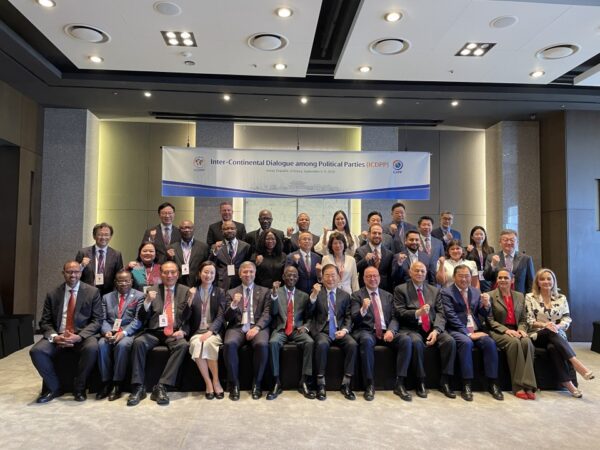
In September 2026, political leaders and party representatives from Asia, Africa, the Americas, and Europe gathered in Seoul to launch a new forum: the Inter-Continental Dialogue among Political Parties (ICDPP). Your correspondent attended the inaugural meeting as part of the CDP delegation and spoke with Chung Eui-yong about how the ICDPP emerged and the principle behind it. The inaugural meeting brought together 23 political parties from 23 countries, including 19 governing and four opposition parties. Participants included Chung Eui-yong, chair of the Standing Committee of the International Conference of Asian Political Parties (ICAPP) and former South Korean foreign minister; Mushahid Hussain Sayed of the Pakistan Muslim League, a former information and broadcasting minister; Adem Farah Ibrahim, Ethiopia’s deputy prime minister and vice president of the ruling Prosperity Party; Milton Morrison of the Dominican Republic, vice president of the Permanent Conference of Political Parties of Latin America and the Caribbean (COPPPAL) and leader of the País Posible party; Zsolt Németh of Hungary, chair of the European Conservatives, Patriots and Affiliates group in the Parliamentary Assembly of the Council of Europe; and Maiko Tajima, director of the International Department of Japan’s Constitutional Democratic Party. The variety of political traditions represented in Seoul is central to understanding the ICDPP. This is not a forum limited to ideologically like-minded parties. Its purpose is to provide a forum in which parties with different political orientations – including governing and opposition parties – can remain in dialogue. That principle was formally incorporated into the Seoul Declaration, unanimously adopted on September 7. The declaration describes the ICDPP as a voluntary platform for consultation, cooperation, and confidence-building among political parties, open “irrespective of ideological orientation, governing status, or level of development.” It also stresses that the ICDPP is intended to complement, rather than replace, existing regional and international organizations. The declaration addresses a broad range of challenges, including geopolitical tensions, armed conflicts, climate change, economic uncertainty, technological transformation, and inequality. Participants reaffirmed their commitment to the purposes and principles of the United Nations Charter, international law, human rights, the rule of law, sustainable development, and multilateral cooperation. They also agreed to continue ICDPP meetings and develop institutional arrangements and future work programs. Its concluding phrase summarized the aspiration behind the new forum: “dialogue over dispute, cooperation over confrontation, and partnership over polarization.” From ICAPP to ICDPP The ICDPP did not emerge suddenly. It builds on more than two decades of political party dialogue developed through the ICAPP and its regional partners. The ICAPP was founded in 2000 at the initiative of former Philippine House Speaker Jose de Venecia Jr. Chung, who became involved after entering South Korean politics in 2004, later played an important role in its institutional development, including drafting the ICAPP Charter and helping establish its Standing Committee and regular meetings. In addition to this institutional development, the ICAPP gradually expanded its dialogue beyond Asia. It established regular exchanges with the Permanent Conference of Political Parties of Latin America and the Caribbean (COPPPAL), developed the Asia-Europe Political Forum with European political groups, and promoted contacts with African political parties. The establishment in Ghana in 2025 of the African Political Parties Initiative (APPI) added a new institutional partner in Africa. With ties established across the Americas, Europe, and Africa, Chung explained: “I thought it’s about time” to hold a meeting involving the four regions. He proposed the name “Inter-Continental Dialogue among Political Parties,” and the idea received support from the regional partners. The ICDPP can therefore be understood as the culmination of a gradual process: regional political party dialogue in Asia expanding into cross-regional dialogue and, eventually, an intercontinental framework. Why Talk Across Ideological Divides? The principle inherited from the ICAPP is as important as the network itself. The ICAPP developed as a forum open to political parties from different ideological traditions, rather than one organized around a single political family. Chung incorporated that principle into the ICAPP Charter when the organization was being institutionalized. Asked why, Chung replied: “I tell you my conviction. Why should we be divided by ideological orientation? And why can’t we talk to each other?” He explained that he had held the same view in domestic politics. When Chung entered politics in 2004, some in his own Democratic Party were skeptical of bipartisan diplomacy, while persuading the conservative opposition to cooperate was not easy. Today, however, South Korea’s major rival parties cooperate in ICAPP activities. The same thinking is visible in the Seoul Declaration. It describes differences in political traditions and cultures not simply as obstacles, but as possible sources of “strength and mutual learning.” This does not mean that the ICDPP expects political disagreements to disappear. On the contrary, disagreement is built into the design of the forum. At the welcome dinner on the eve of the inaugural meeting, Chung told delegates that they should not expect everyone around the table to think alike. “Our political traditions, experiences, and perspectives are different,” he said. Those differences, he continued, should be acknowledged and respected. The aim was to create a space in which they could be discussed openly and constructively, while keeping channels of communication open – especially “when circumstances become difficult and dialogue is needed most.” That may be the clearest expression of what distinguishes the ICDPP. Its purpose is not to create ideological unity, but to sustain political communication despite ideological difference. From Dialogue to Action The challenge now is whether that dialogue can produce results. A forum encompassing parties with widely different political traditions and geopolitical interests may find it relatively easy to meet, but much harder to reach common positions or act collectively. Chung himself raised precisely this issue in his opening remarks. “The significance of this initiative,” he said, should not be measured simply by the number or diversity of participants around the table, but by the ability to “build sustained dialogue and turn our conversations into meaningful action.” The Seoul Declaration provides the first steps: regular meetings, further discussions on rules and institutional arrangements, future work programs, and broader participation while retaining the voluntary and inclusive character of the forum. Whether the ICDPP will develop into an effective mechanism for cooperation remains an open question. Its significance will ultimately depend not on the number of parties represented at future meetings, but on whether relationships built through repeated dialogue can survive periods of political tension – and whether those relationships can contribute to practical cooperation on common challenges. At the welcome dinner in Seoul, Chung described what he hoped the gathering might eventually become: a community of political leaders who made a deliberate choice to continue talking, listening, and working together across continents, “even when our views are different.”
Beyond Ideological Blocs: The ICDPP’s New Intercontinental Political Dialogue
Full Article
Original Source
Read the full article at Thediplomat →KhanList aggregates and links to publicly available news content. We do not host full articles from third-party sources. Always verify important information with original sources.