
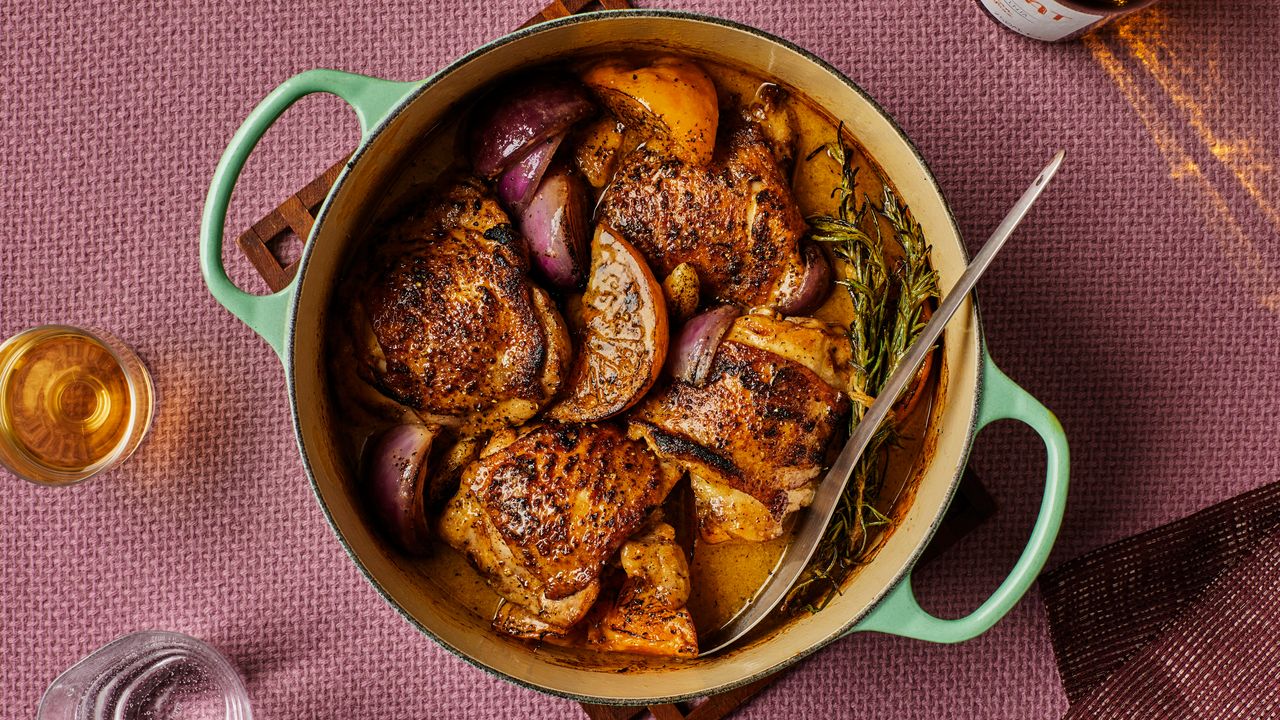
Over the past few decades, I'd argue that the Dutch oven has eclipsed the stand mixer as the most crucial piece of kitchen equipment for making a kitchen feel like a home kitchen. Is it because they're heavy and expensive? It it because couples always put them on their wedding registries? Is it because you can make soup in them and soup is comforting and feels homey and there's something to that? Not entirely sure. I can say though, that setting down one of these colorful, enameled hunks of cast iron onto a stove is akin to dropping an anchor. By committing to making a Sunday braise in a Dutch oven you're saying, “ This is my home, and because it's my home, I'm gonna make the entire place, and my clothes, smell like ragú.”But which to buy? I've spent years and years thinking about this, because the question of what the best Dutch oven is, is a question that requires a lot of caveats and asterisks. Yes, there are certainly some design and quality metrics that help distinguish the Staubs and Le Creusets from Amazon Basics, but the bottom line is: Every Dutch oven on the market will deliver an extremely similar cooking performance. What it all comes down to is quality and design.Our top picksThe best Dutch oven overall: Le Creuset Signature Round 5.5-Quart Dutch OvenThe other best Dutch oven: Staub 5.5-Quart CocotteThe best budget Dutch oven: GoldilocksCheap Dutch ovens work just fine, but their affordability comes at the cost of quality control. Budget Dutch ovens consistently feature manufacturer defects, chipping, and thinner enamel layers that can lead to accelerated wear and rusting.As for design, while there are some practical advantages that some have over others, a lot of it comes down to subjective preferences. There are two people who have worked on this test over the years and we have vehemently disagreed with each other over the top spot, though, to be clear both of our choices are great Dutch ovens.I'll get more into the two that always tussle for the top spot, as well as the most well-designed budget picks that also come with lifetime warranties. Keep reading to learn about how I and my team have tested Dutch ovens over the years, how to keep the enamel in tip-top shape, and which brands didn’t make the short list.New in this update: I added reviews for the Crockpot, Goldilocks, and Müeller Dutch ovens, and moved Le Creuset into a clear top spot.More on my top picksHow we tested Dutch ovensWhat we looked for in a Dutch ovenOther Dutch ovens we tested and likedDutch ovens we don’t recommendFAQA Beautiful, easy-to-handle Dutch oven with a light interior: Le Creuset Signature Enameled Cast-Iron 5.5-Quart Round Dutch OvenLe CreusetSignature Round Dutch Oven, 5.5-QuartPros:Heirloom-quality cookwareEven heatingRelatively lightweightLots of size and color optionsLifetime warrantyCons:ExpensiveLight interior enamel will show wear more readily than dark enamelInterior enamel: Light and smoothAvailable sizes: 2-qt., 4.5-qt., 5.5-qt., 7.25-qt., 9-qt., 13.75-qt.Weight (5.5-qt. size): 11.6 lb.Multiple color options: Yes, though availability varies by size and retailerHeat resistance: 500ºFWarranty: Limited lifetimeWhat I love: We’ve been recommending Le Creuset’s Dutch ovens for as long as we’ve been recommending Dutch ovens. So if you have your heart set on one of these iconic pieces and you’re wondering whether it’s still a wise investment, the answer is a resounding yes.Le Creuset’s smooth, sand-colored interior enamel produced a beautiful, even sear—and the light enamel makes it easy to keep an eye on browning and fond development. Le Creuset’s 5.5-quart Dutch oven also weighs about a pound less than Staub’s with thin loop handles that are easy to grip with or without oven mitts. The lighter weight comes courtesy of noticeably thinner cast iron, but it’s still thick enough to offer wonderful heat retention. Le Creuset Dutch ovens typically have a wider cooking surface and lower sides. This means more space for searing meats for braising—an essential Dutch oven task.A few years ago Le Creuset began offering metal knobs on its Dutch ovens, which was a meaningful upgrade as the old phenolic knobs could melt if you tried to do something like use your Dutch oven to bake bread at 450℉, it would melt.Then there is the manufacturing quality. Le Creuset is a century-old French brand, and though some of its cookware and tableware is now made in other countries, all of the enameled cast-iron cookware—including the Dutch ovens—is still made in the original manufacturing facility in Fresnoy-le-Grand, France. And while we know from experience with inherited pieces that the chip-resistant enamel can last a lifetime (with proper care, of course), Le Creuset Dutch ovens do come with a limited lifetime warranty.What I’d leave: When covered at a boil, the Le Creuset may sputter at the edges a little. If you choose a Dutch oven with light-colored interior enamel, and cook in it often, you should expect some gradual discoloration. If you’re intent on keeping it pristine, you may jeopardize the lifespan of the enamel. Abrasive cleaners can wear the seal off of it and lead to even more staining.A gorgeous, top-notch Dutch oven with a dark interior: Staub Round CocotteStaubRound Cocotte, 5.5-QuartPros:Heirloom-quality cookwareEven heatingDark, textured cooking surface browns quicker and hides stainsLots of size and color optionsLifetime warrantyCons:ExpensiveHeavier relative to its liquid capacityLint from some dish towels can catch on interior enamelInterior enamel: Dark and texturedAvailable sizes: .425-qt., .85-qt., 1.25-qt., 1.75-qt., 2.75 qt., 4-qt., 5.5-qt., 7-qt., 8.75-qt., 13.25-qt.Weight (5.5-qt. size): 12.57 lb.Multiple color options: Yes, though availability varies by size and retailerHeat resistance: 500ºFWarranty: Limited lifetimeWhat I love: In terms of craftsmanship and price, Staub’s Dutch oven, which the brand calls a “cocotte,” is in no ways inferior to the Le Creuset. Both are premium enameled cast-iron round Dutch ovens with high-quality chip-resistant enamel, and both heat and sear evenly.Interior enamel is a matter of preference, and the Bon Appétit staff is divided on this matter. The Staub's dark, textured enamel interior does absorb more thermal energy which is helpful for producing an intense sear. The enamel also also has a rougher surface texture, which Staub claims helps distribute fat beneath ingredients to encourage browning and an easier release.While there is some truth to this, the relationship between surface texture and food sticking isn't cut and dry. Many other variables, such as temperature, time, fat volume, technique, and the type of food, have an impact as well. As Robert J. Macfarlane, a materials scientist at MIT pointed out to me, surface texture can increase surface area, which combined with poor technique and inadequate oil can actually make sticking worse. All of that to say: This Dutch oven produces a great sear, but the added benefits of Staub's dark textured enamel aren't significant enough to champion over classic light enamel. One thing that is for sure though—the dark interior won’t show discoloration like a light one will.Looking beyond the enamel, the Staub's lid is well-designed, preventing liquid sputters when shut at a boil. The bumps underneath are supposed to distribute condensation, though we've never observed a difference in the end product between Dutch ovens with bumpy lids and Dutch ovens without. I prefer the flat lid over a curved one, as you can invert the lid and stack the Dutch oven for easy storage.Yes, it’s pricey, but with proper care it will be something your kids fight over once you're gone. Like Le Creuset, Staub is a French cookware brand (now owned by Zwilling), its Dutch ovens are still manufactured in France, and they maintain an exceedingly high bar for what ends up on store shelves. One of the big reasons for the price is the high volume of units they reject along the assembly line (cast-iron is a material that evades easy refinement). This scrutiny means that your Dutch oven will almost certainly be free of surface defects and chips. If you do find any, definitely reach out to them, as Staub also offers a limited lifetime warranty on its enameled cast iron.What I'd leave: The dark enamel makes it a bit harder to monitor browning, which might be intimidating for greener cooks. Also, the Staub is heavier than the Le Creuset and the handles are slightly smaller, but it's a pretty negligible distinction if you're trying to champion one excellent product over the other.The best budget Dutch oven: GoldilocksGoldilocks6 Quart Dutch OvenPros:Generous surface areaLarge handlesAffordableLifetime warrantyCons:Heavier relative to its liquid capacityToo young a brand to judge longevityInterior enamel: WhiteAvailable sizes: 6 qtWeight (5.5-qt. size): 13.7 lb.Multiple color options: Blue, red, green.Heat resistance: 500ºFWarranty: Lifetime warrantyWhat I loved: As a relative newcomer to the cookware space, Goldilocks has consistently produced well-made, affordable cookware. It's clear that they pay attention to design, and that is evident in their Dutch oven.This Dutch oven was a pleasure to cook with, and had no apparent defects in design or performance. The design prioritizes width over height, something we appreciate for searing and browning meat before a braise. In fact is one of the widest round Dutch ovens relative to its height and volume. But rest assured it fits fine over standard burners. Its handles are also nice and large, making them easy to grab and maneuver, even with thick oven mitts on.It is still more expensive than some of the better known and more popular cheaper models made by Amazon and Lodge, and we can't yet speak to the longterm longevity of the enamel coating since this is still a newer product. However, I'd argue that the physical dimensions themselves also make this a superior choice to previous budget picks.What I'd leave: Again, I can't yet speak toward longevity yet so we will update this test in the future. Beyond that, it is slightly heavier than the winners, and also is extremely limited in size and color offerings. However, 6 quarts is the median ideal size for a Dutch oven.How we tested Dutch ovensSince 2018, we have tested more than 23 popular and top-rated Dutch ovens. Each year, we’ve made either a beef stew or a pork ragù that allows us to see how each oven browns and braises.We also tested the lids by conducting steam tests and filling each one about halfway with water that we brought to a rolling boil in order to see if the lid would prevent spattering. Ideally, the lid will release some steam at such high temperatures, but contain water in its scalding, liquid form.Most importantly, we evaluated the physical dimensions of each Dutch oven: how much they weigh relative to their size, how large their handles are, and their height-to-width ratio. We also do longterm testing on winning models to evaluate issues with wear and longevity. Both the Test Kitchen team and the product reviews team use Dutch ovens on a regular basis, which helps inform our testing as well.What we looked for in a Dutch ovenWithout the kind of serious long-term testing we’re able to do with the Le Creuset and Staub Dutch ovens many of us have owned for years, it’s hard to tell just how durable a Dutch oven’s porcelain enamel will be. But sometimes really cheap enamel will have small chips or pinholes right out of the box. You can also look at customer reviews; most will have at least a few reporting enamel damage. If it’s a small percentage of reviews, it’s likely a manufacturing defect, but if a disproportionate amount of reviewers complain about chipped or damaged enamel, it’s likely a durability issue.Even when they’re empty, Dutch ovens are pretty heavy—hell, the lids alone are heavy—so the handles should be comfortable to hold with your bare hands. They should also be easy enough to hold or grip while wearing oven mitts.A larger cooking surface relative to the total liquid volume means more space for browning meat and other ingredients with less risk of crowding, which can cause things to steam rather than brown. If you remember Julia Child's advice for making boeuf bourguignon, do not crowd the meat!A Dutch oven’s lid should fit snugly on the pot and not rattle around when you’re carrying it or boiling water in it. That said, it’s normal for some steam to escape from even a heavy tight-fitting lid when water inside is at a rolling boil.Enameled cast iron, in theory, is very durable, and the very best Dutch ovens are heirloom-quality pieces that will last at least a lifetime with proper care. If a manufacturer offers a very short warranty on their enameled cast-iron cookware, it could (though may not always) indicate a lower-quality product.Other Dutch ovens we likedMade InRound Enameled Cast-Iron Dutch Oven, 5.5-qt.Made In fits in the middle tier here, as it is a great Dutch oven made with a higher standard of quality than budget models. It is heavier than both Staub and Le Creuset, and the handles are divisive among staff. Some like the wide flat handles for holding when full, while others find there to be not as much knuckle clearance, making them more challenging to grasp completely with oven mitts on.Zulay Kitchen 6-Quart Enameled Cast Iron Dutch OvenThis is a good Dutch oven that had a brief run as our budget pick (before Goldilocks became available), as it comes with a limited lifetime warranty not typical for budget Dutch ovens. It performs well, and was lighter than other budget Dutch ovens. The drawback is that the handles are slimmer than I'd like for easy gripping.Amazon Basics 6-Quart Dutch OvenAmazon Basics Enameled Cast Iron Round Dutch Oven, 6-QuartAmazon Basics’ kitchen gear is really hit or miss, but the Amazon Basics Dutch oven is surprisingly good—especially for something with such an accessible price tag. This was also a former budget pick. Performance wise it gets the job done. Like the Zulay, it has narrow handles. It’s a good option for home cooks on a budget. However, unlike the Zulay Dutch oven, which has a lifetime warranty, this one comes with a one-year warranty, so inspect it for defects as soon as its out of the box.Kana Milo Classic Dutch OvenKana Milo 5.5-Quart Classic Dutch OvenOverall, our testers were impressed with this sleek, stylish 5.5-quart dutch oven from DTC lifestyle brand Kana. The smooth, light interior enamel produced an even sear on both meat and vegetables, and we didn’t experience any cold spots or notice any chips in the enamel out of the box (some customer reviews have complained of chipped enamel). It’s about a pound lighter than the comparably sized Le Creuset, which means it can heat up and cool down a bit quicker, but the thinner cast iron won't retain heat quite as well. If you want a budget pot and like the modern look (or you really want a moderately priced Dutch oven with a gold-toned knob), the Milo by Kana is a good choice.Dutch ovens we don’t recommendThis large, oval Dutch oven from Great Jones is gorgeous. We love the color options, and for a 6.75-quart enameled cast-iron Dutch oven from a popular brand, the sub-$200 price tag is nice too. But, with only one rather large size and the oval shape, it’s not the best option for everyday use—or for induction cooktops with round “burners.” But it’s the perfect size for roasting a whole chicken and large cuts of meat, and the large loop handles are easy to grab with or without oven mitts. Great Jones does offer a smaller round Dutch oven, the Dutch Baby but at 3.5 quarts it’s on the small side of the Dutch oven sweet spot.Tramontina’s relatively affordable stainless-steel cookware is often compared to All-Clad, so we had high hopes for the Brazilian brand’s 5.5-quart enameled cast-iron Dutch oven too. Out of the box, we liked the tall sides (great for deep-frying), but unfortunately it just didn't perform well in our testing. Our testers noticed a persistent cold spot that resulted in uneven cooking—and food sticking to the smooth, light interior enamel.We like Cuisinart’s enameled cast-iron skillet, but the Dutch oven is disappointing. Unlike the skillet, which has a dark, textured interior enamel, the Dutch oven has a smooth, light interior that didn’t perform well in our sear test. We also found multiple cold spots even when it was fully preheated, which produced pork that was unevenly cooked.In addition to its popular pottery and ceramic tableware, English brand Denby offers a small selection of enameled cast-iron cookware, including several Dutch ovens—which it calls “casseroles.” They’re moderately priced compared to similarly sized Dutch ovens from other well-known brands. When we tested the round 5.5-quart (listed as a 26-cm size) the performance was adequate, but the handles were small and hard to grab, especially when it was hot. And overall, nothing about it wowed us. But if you like the look and it’s within your budget—and you don’t mind the small handles—you may be happy with the Denby Dutch oven.We love a lot of KitchenAid gear (hello, gorgeous stand mixer!) but in general, we haven’t been that impressed with the brand’s cookware, and that trend continued with the enameled cast-iron Dutch oven didn’t impress us—though we were certainly impressed with its heft. The 6-quart Dutch oven weighs 20 pounds, empty! That’s the only size available, and it only comes in two colors too.The first time we tested Misen’s Dutch oven, we really liked it. It’s large and deep, which is great for deep-frying, and it made a pretty good stockpot too. But then Misen changed some design elements—most notably it did away with the traditional Dutch oven lid and instead offers the choice of either a silicone option or an enameled cast-iron grill pan that can double as a lid (a traditional lid is available on the larger 7-quart model, which, as we've said, is bigger than most people need). Both lid alternatives made this less functional and appealing than it was when it had a traditional enameled cast-iron lid with a metal knob. Also: Our testers have experienced some minimal enamel chipping with long-term use.This 4-quart Dutch oven from Vermicular comes as-is or alongside Vermicular’s Musui-Kamado, a stand-alone induction heating element that holds the pot, sort of like a very high-end, precise slow cooker. The interior enamel is an off-white color and minimally textured, though not as textured as the dark interior enamel of the Staub. The rim is unfinished to provide a “precision seal.” However, this makes it susceptible to rust, and during testing, did not do a better job at sealing in moisture than the Le Creuset or Staub, which do have an enamel coating around the rim. The side handles on the lid were also unnecessary, and made it difficult to grab, especially when removing it from the oven.This is one of the few cast-iron Dutch ovens we've tried without an enamel coating. While this is a beautiful piece of cookware, it’s the sort of thing that only really makes sense for dedicated cast-iron enthusiasts who love to care for and maintenance their cookware.We’ve found that developing a seasoning on this is quite challenging, and that the type of cooking we generally employ our Dutch ovens for (soups, braises, stews) tends to hinder the process. Smithey recommends a just-cook-with-it method for developing the seasoning, and the brand also claims that it’s fine to use when making soups or acidic braises. However, we found that tomato sauce stripped the seasoning and developed a metallic taste. A really robust seasoning would potentially withstand this, but you’d need to do several rounds of seasoning on your own, and with a big pot like this, that isn’t an easy task.We also found that the cast-iron lid is prone to rust spots. This is because (if you’re primarily cooking on the stovetop with your Dutch oven) the lid never gets hot enough as has no direct contact with fat, which means that it will not develop a seasoning as you cook with it. This is a problem especially because moisture condenses on the interior of the lid while cooking.All in all, having an uncoated Dutch oven is a labor of love. If you do a lot of deep-frying, or cooking on open fires, or you just really like to season cast iron as a hobby, you might be able to tame this beast. If you’re just looking for a regular-shmegular Dutch oven, we’d advise against it.The side handles are shallow and difficult to hold, and currently the Dutch oven is only available in a 6.5-quart size.Not terrible for a cheap Dutch oven, but it had a smaller cooking surface and was on the heavier side.Over the years, we've have tested both Lodge Essentials Dutch ovens and Lodge USA Enamel Dutch ovens, the latter of which is made in a newer manufacturing facility in North America. Unfortunately, not all Lodge cookware is created equally, and even though the USA Enamel line is clearly a much higher quality than the Lodge Essentials enameled cast iron, customers have complained about chipping with both. On the other hand, a colleague has been using a Dutch oven from the USA Enamel line for more than a year and hasn’t experienced any chipping. The issue here seems to be inconsistency in quality, but we’ll continue to use these Dutch ovens to see if the newer lines prove to be more durable.FAQWhat size Dutch oven should I get?The size you get really depends on what you’ll use it for—if you’re cooking every night for a family of six, a 7-quart Dutch oven will make sense. But for most home cooks (and anyone with four or fewer people in their house), the Dutch oven sweet spot size is 5.5 or 6 quarts. It’s big enough to accommodate a pot roast or a whole chicken, but not too big for a loaf of sourdough if you’re the bread-baking type. It’s also a good size for deep-frying and gives you plenty of room for tossing four servings of pasta without overcrowding the pan.What material is a Dutch oven made of?Dutch ovens can be made of various types of metal or ceramic, and they can be enamel-coated or uncoated. For example, Emile Henry makes an enameled clay ceramic Dutch oven and Dansk makes an enameled carbon-steel Dutch oven (er, “casserole”). You can even get high-quality raw cast-iron Dutch ovens from brands like Smithey and Lancaster, but they require seasoning and more maintenance than enameled cast iron.However, its enameled cast-iron Dutch ovens that are ubiquitous. The cast iron offers incredible heat retention and is compatible with gas, electric, and induction cooktops while the durable porcelain enamel protects the cast iron from rust and corrosion caused by water as well as acidic foods like tomatoes. The enamel also eliminates the need for seasoning.Are Dutch ovens nonstick?One of the biggest misconceptions about this kind of cookware is that the cooking surface is supposed to be nonstick. It’s not. Porcelain enamel may look like a ceramic nonstick coating, and it’s far easier to clean and care for than raw cast iron, but it is not a nonstick surface. Its purpose is to protect the cast iron underneath. That said, with the right temperature and enough butter or oil, food releases from enamel pretty easily.How do I protect my Dutch oven from damage?Enameled cast iron can withstand high heat as well as freezing temperatures, but you do want to avoid thermal shock to your Dutch oven. For example: Don’t take it from the fridge and put it straight over high heat on your stovetop. And when you’re preheating it, do it slowly over low to medium heat. Sudden temperature changes can cause the enamel to chip and in some cases damage the cast iron itself (up to and including actually cracking it), and this kind of damage will often be grounds for the manufacturer to void the warranty.What’s the deal with braising divots?Many Dutch oven lids are pocked with divots, which supposedly help to evenly distribute moisture when braising—in theory, kind of basting the meat inside the closed pot. That said, in many years of testing, we haven’t seen any clear evidence of this actually happening.How should I clean a Dutch oven?Enameled cast-iron cookware is incredibly durable because the porcelain enamel protects the cast iron from rust and corrosion. And unlike traditional and ceramic nonstick cookware, a high-quality enamel coating can last forever if you take good care of it—which, sorry to say, means never putting it in the dishwasher.While it’s true that some enameled cast-iron pieces, including Le Creuset’s colorful Dutch ovens, are marketed as dishwasher-safe, if you read the manual, you’ll learn that most manufacturers generally recommend hand-washing. That’s because over time, harsh dishwasher detergents can erode the enamel, making it more porous, which can lead to staining and stuck-on food.Complete your cookware setThe Best Nonstick Pans After More Than 6 Years of TestingThe Best Cast-Iron Skillets for a Lifetime of Searing, Frying, and RoastingThe Best Carbon Steel Pans, the Pan of Choice for Pro Chefs
Best Dutch Ovens for Braising, Baking, and Beyond (2026)
Full Article
Original Source
Read the full article at Bonappetit →KhanList aggregates and links to publicly available news content. We do not host full articles from third-party sources. Always verify important information with original sources.