
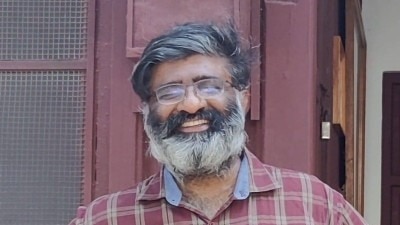
Before starting Akshayakalpa Organic, Shashi Kumar had spent over a decade at Wipro, where he served as a chief architect. The Tiptur native left a well-paying job and ventured into organic farming. His journey is both a testament to perseverance and an inspiration for those who feel deeply rooted in their hometowns and aspire to return to their roots.What if choosing farming over a 9-to-5 job meant losing your father’s support for eight years? For Shashi Kumar, it was the price of following an idea he had carried since his college days. A Bengaluru University alumnus who later completed his postgraduate studies at the Illinois Institute of Technology, Chicago, Kumar spent years in the technology industry, including 12 years at Wipro as a lead architect. But farming remained close to him. In 2010, he decided to leave his corporate career and build a business around farming, which almost made him bankrupt 9 times, before tasting success.The decision did not go down well at home. His father, like many fathers, remained hesitant about allowing his grown-up son to get his hands dirty in farming.Kumar's father had spent his life farming but never wanted his children to enter the profession, stopped speaking to him. The silence lasted eight years.Kumar went ahead anyway. Today, he is the founder and CEO of Akshayakalpa Organic, a dairy and farming enterprise built around a larger question: how can farming become a profession that young people want to choose? THE FARMER HE LOOKED UP TOShashi Kumar’s academic journey began in Bengaluru, as his roots in Tiptur made the city the most feasible choice for his higher education.He pursued his Bachelor of Engineering at Bangalore University from 1991 to 1995, following his pre-university education at Kalpataru Science College. His engineering education laid the foundation for a career in technology, which he later broadened through postgraduate studies at the Illinois Institute of Technology in Chicago.Kumar’s interest in natural farming goes back to 1991, soon after college. He had asked his father whether their ancestral land could be converted into a natural farm. His father rejected the idea and told him to pursue a career in software.Around the same time, Kumar met Cherkady Ramachandra Rao, a natural farmer near Udupi. Rao farmed about two acres and lived largely off what he produced. He grew coconut, pepper, pineapple, vegetables, paddy, millets, mangoes and other crops.Kumar returned to his farm almost every year to work and learn.Rao also taught him that farming could make economic sense. He bartered his produce, sold surplus crops and saved money. His post office savings grew from about 15 lakh in 1991 to 21 lakh by the time he died in 2010.Entering the entrepreneurial journey was never easy; it was an uphill task. Kumar came close to bankruptcy nearly 10 times.The Rs 600-crore venture that stands today owes much to the people who stood by him and gave him the strength to weather the storms along the way. Two of those who stepped in to support Kumar were from his own family.His wife, Shilpa G, invested Rs 30 lakh from their savings, while his uncle, Dr Muni Reddy, invested another 10 lakh.That Rs 40 lakh, Kumar says, kept the company alive.BUILDING AKSHAYAKALPA AROUND FARMER INCOMEWhen Akshayakalpa was started in 2010, Kumar’s focus was not initially on building an organic dairy brand. He wanted to understand why young people were leaving agriculture.His answer was economics.“We need to start thinking of farming as a vocation. Farming as a means to make money,” he says.The company chose dairy because milk could provide farmers with regular cash flow. It later expanded into areas such as soil management, beekeeping, poultry, banana cultivation, manure production and other farm activities.The idea was to build diversified farm businesses rather than depend on a single crop.Akshayakalpa now works with around 2,800 farmers across 2,800 villages, according to Kumar. The average age of its farmers is about 32, while around 1,200 are women.Kumar says the average monthly payout to a farming family was 1.28 lakh last financial year. A study commissioned after the British government became an investor also found a significant increase in income among farmers associated with the programme.WHY YOUNG PEOPLE LEAVE FATMINGKumar believes the biggest challenge facing Indian agriculture is not a lack of young people, but the absence of young people choosing farming.“Young population in villages, they are getting educated and they are moving out of the farm,” he says.He describes India as a young country with an ageing farming population.Kumar also draws a distinction between growing crops and understanding farming.Agricultural universities may teach crop science, but farming, according to Kumar, also involves understanding soil, weather, animals, local ecology and generations of accumulated knowledge.From a technology career to a farming venture, Kumar’s journey has been shaped by the same question he began asking decades ago: can farming become a profession that the next generation chooses willingly?For him, the answer depends on whether farming can provide young people not just with food to grow, but with a livelihood, dignity and a reason to stay connected to the land.- EndsPublished By: Rishab ChauhanPublished On: Aug 26, 2026 15:11 IST
Bengaluru engineer quits Wipro to build Rs 600-crore farming venture
Full Article
Original Source
Read the full article at Indiatoday →KhanList aggregates and links to publicly available news content. We do not host full articles from third-party sources. Always verify important information with original sources.