
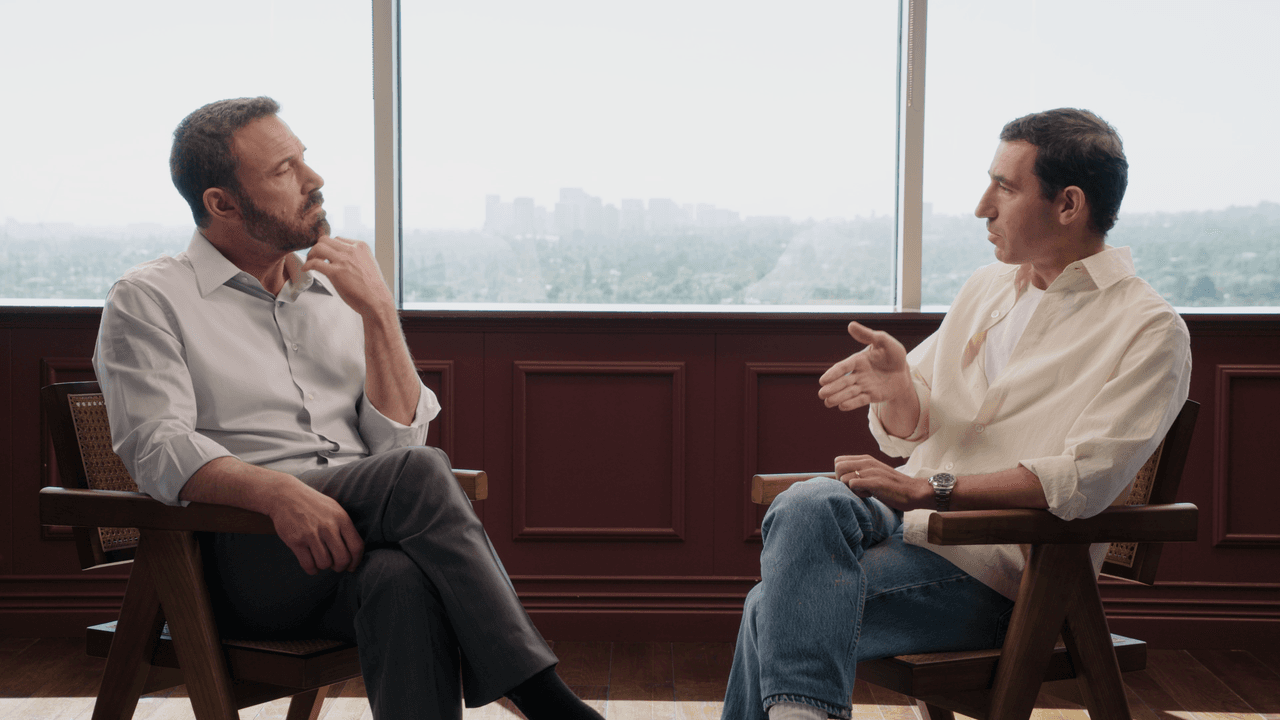
“We’re all moving inevitably toward irrelevance and death,” Ben Affleck says. “The former doesn’t seem all that unappealing to me. The latter, I’d like to forestall a little bit.”He says this sitting on the penthouse floor of Soho House, the same building where his production company, Artists Equity, is housed. We are talking about the last time we saw each other, when Affleck found himself, not for the first or last time, to be the subject of strange tabloid rumors, for reasons that made no sense to him then or now.This time around—the last week in September—things feel quieter, calmer, which is what Affleck is celebrating. He’s had a strange and complicated year. In January, he starred in Netflix’s The Rip. In March, Affleck sold his AI company, Interpositive, for a reported $587 million. This spring, he lost both of his parents. And now he is back in theaters as the star and director of Animals, about a Los Angeles mayoral candidate whose life and marriage are fundamentally changed by the abduction of a child.In this conversation, we talk about all of it. “You think about your own mortality and your own life and your own children and what you want to do with it,” Affleck says. “And the bare fact of the very fleeting nature of all of our lives kind of stares you back in the face. And you realize, yeah, we only get so much time.”The following conversation is lightly edited and condensed from the latest episode of One More Question with Zach Baron. Watch below or on YouTube. Listen on Spotify or Apple Podcasts.GQ: The last time I saw you was two weeks after the LA fires and you were in a very intense tabloid moment. Maybe your house had burned down, or maybe it hadn’t. Maybe the FBI had raided your home. Maybe it hadn’t. Maybe I’m paying less attention this time around, but it feels like a quieter moment for you.Ben Affleck: I have them much less frequently now, which is nice, but there are still occasionally these strange flareups. At the time, there were both rumors that the FBI had raided my home and that my house had burned down. They can’t both be true. It’s like all these things, and then none of it turns out to be true, and nobody remembers it. There is a kind of cultural amnesia or something where just there’s maybe so much like flotsam and jetsam that stuff comes up and we all kind of hear about it or read about it. And then there’s not really a follow up. It’s like, “Oh yeah, did that turn out to be real or not? I don’t know.”Even you had a moment, when I brought that up, where you had no idea what I was talking about.I mean, it’s true. I’ve forgotten more things—sentences like that make you sound old, but that’s one that’s actually true. Sometimes people will talk to me and go, “Can you believe they’re saying this about you?” And I want to say: This is so ephemeral. I literally have forgotten many moments of outrage or lunacy. But also I think there’s some comfort in the fact that—well, personally there’s comfort, I don’t know if societally it’s a good thing—but that nothing matters. It doesn’t matter.This isn’t me calling you old, but is it possible that you finally become enough of a middle-aged dad to have aged out of this tabloid moment?I mean, I’ve been hoping that’d be the case for 20 years. It’s bound to be the case. We’re all moving inevitably toward irrelevance and death. The former doesn’t seem all that unappealing to me. The latter, I’d like to forestall a little bit. But the notion of relevance as an abstract thing to be desired strikes me as, I don’t know: Be careful what you wish for. Because relevant to what and in what way? What happens to things that are relevant is that they’re dissected and hotly debated. And unless you have something that you really care about, that you want to bring forward, that you really want to engage in that particular kind of debate around, I don’t think personally to your character or soul, there’s value to it. Obviously, we live in a world where there’s a lot of commercial value to commoditize. And for people [who are] like, “Hey, look, I want to pay the rent”—I get it. I understand it.You have lived the rough edges of that thing, though.I have. But listen, I’m not some great victim. I mean, I’m in a unique position. I’ve seen some unusual and weird things in my life. The benefit of that is that eventually you sort of get sanguine about it. I’m 54 years old. I have three kids. A kid in college, senior in high school. I did not ever expect to be in tabloid equivalents anywhere close to this time. Certainly [when I was younger,] I thought, if you’re 50, you clearly don’t have sex anymore and your life’s about to end. So I assumed that would be the case.We are speaking in the same building as your production company, Artists Equity. Are you still nine-to-fiving it here?I am. Yeah, I am. I come to work.I think people would be very surprised to know that you come to work every day.I know. What does that say about you, that people are shocked to know you come to work? Yeah. I mean, look, it’s meaningful to me. It’s important and it’s something that I want to do and is important to me to do, which is to follow through with building something. Building any kind of entity of any sort is difficult. And to try to change some existing structures and modalities is even more so. So it definitely requires me to be present.To be clear, I wasn’t like, “Isn’t it a shock that this playboy comes to work every day?” It was more just like, when you are an actor and you have lots of opportunities in life, not everyone chooses to do the same commute every day.Definitely. I mean, that was a self-conscious thing because six, seven years ago as an actor, I was also, and more importantly, a divorced dad with shared custody of his children. And I just no longer had any interest in going to New Mexico, Shreveport, Massachusetts, London, or wherever they’re making a movie and missing out on this period of time in the life of my children where both I get the most benefit of my life from being present and where there’s reasonable evidence that suggests that you want to be present during your children’s development and life. And being absent for long periods of time, it just was no longer something I wanted to do. And so I wanted to self-consciously construct a life, a daily routine and a life that was here, where my kids go to school and get picked up from school and go see their friends and go to the things they do after school and all that stuff and just be around.There’s a specific model to Artists Equity, which I will butcher, but effectively: You guys take on a little bit more risk, financially, but if you succeed, everyone, including the crew, also succeeds. At least this was the 1.0 version. I’m curious if the model has evolved.Look, part of it, we’re evolving it as we don’t get to dictate terms entirely. This is all working in concert with this existing economy and ecosystem, but the model is basically what you described. And if you could distill the sort of philosophy down to one word, it would just be “fairness,” right? “Equity” in the fairness and in the kind of investment sense. The idea is, okay, great. We want to help get this movie made. We’re going to treat you like an investor rather than the sort of classic Hollywood sense, which is like, “Well, just pay me a bunch of money up front and then I’ll walk away at the end.” And if it’s successful, you kind of feel taken advantage of because it’s hugely profitable and you feel, “Oh, I didn’t participate in that.” And if it’s not, the flip side is if people are like, “We invested in this, this person’s not promoting it,” whatever it is. Just aligning those incentives and clarifying that and then giving that kind of more expanded sense of authorship and authority over both financial and creative over the project that they’re doing, I think actually is going to lead to a better outcome, both for investors and the people building it and also for the quality of what you’re doing because you’re putting people, you’re making them care about the same thing. This business has had a history of promising things that didn’t get delivered on. And so it’s really important for me, talking about version 1.0, to show that in success, people actually will be compensated, because otherwise it just sounds like you’re some other producer going, “Yeah, we’ll get you on the next one. Don’t worry about it.”Before we started rolling, you and I were talking about Obsession and The Odyssey and how it feels like a big story of this year is a return to movie theaters. You produce movies, you make movies, you guys have this company. Do you think this theatrical thing is real? Do you trust it? Do you believe in it?I think it’s definitely real. I think people want to go out of the home, as they say, and be entertained and have experiences together. I don’t think human beings are going to just become sort of insular and live in little caves and stare at screens because I think that’s counter to what people want to do. But I think that the bar has been raised sort of collectively, societally, culturally for what’s required to get people to want to make your movie or event that thing that they go to. And so there’s this shifting balance between what is a theatrical movie? What is a movie that’s better served in streaming? And I don’t associate any value judgments with that. I think it’s an interesting question.I was going to ask about this because both of the movies you star in this year, The Rip and Animals, are primarily streaming films. I wonder, do you feel ambivalence about that?No, I actually feel great about the release strategy for Animals. I’m really proud of it. I love the movie. I think it’s really interesting. And what I tried to do with that movie was what I wanted to do with The Town or Argo, which is sort of understand the genre components that exist in this movie. And in this case, I feel like within that genre, it fits really well in what Netflix does and with the kinds of things that people tend to want to watch on Netflix. Remember they have 330 million subscribers. It’s this massive audience, right? And the great advantage is that you’re getting to reach people, hundreds of millions of people. Some of them don’t have access to a theater, many of whom just don’t have the kind of life now where they are going to four movies a week or whatever. And to reach them and kind of do so within the construct of something they go, “Oh yeah, I like this kind of thing. I’ll watch that.”Yes, that was very nice. That was really, really cool of him. I thought that was really sweet and generous of him to go out of his way to write that and do that.There’s a section of it that I wanted to get your reaction to. He writes: “Also, at its centre The Rip has Damon and Affleck, who after more than 20 years in the public eye and so many movies, I think audiences have taken for granted (I know I have). But not any more. They’re truly sensational in this movie and, as good as they can be on their own, they’re fantastic when they act together. Not to mention they’ve aged into really dynamic camera subjects.” Do you think you have been taken for granted by audiences?Oh man. It’s hard to know. I mean, I don’t know because even what that really means to say that you’ve been taken for granted is to say people haven’t seen the mightiness that is me. I would say it sounds to me like what he’s getting at there is a basic truth, which is that familiarity, well, for one thing, creates the sense of something is not special or new. So that’s just part and parcel of trying to continue to have a career over a period of years. And also not every movie works. You know what I mean? When I was a kid, looking at Harrison Ford, who was this great, iconic, biggest movie star you could possibly be. And part of that, I think, just had to do with every time Harrison was in a movie, it was good. And that’s an extremely difficult thing in a high risk occupation to keep a streak like that alive.He also says that you’ve aged into a really interesting camera subject.I mean, that’s very flattering. When I think about it from someone else’s point of view, what he’s really saying is, I think, is that men particularly tend to get more interesting when the way they look is kind of less youthful. Because you can think it can suggest a kind of a callowness or an insouciance that’s—there’s this sort of young-man look that can always border on sort of pinup thing and that’s unserious. And so you have these boy bands who come and go because that serves a certain audience, but particularly I think other men tend to be more interested in men who seem to have lived more, have more experience. And the truth is, as an actor, I’m amazed by young actors who can bring the perception of real depth of life experience. It’s the hardest thing to conjure without having experienced it. One of the nice things about living for a while is that you go through enough stuff that your own life becomes interesting enough that you can sort of mine from that.I can’t know anything I’m about to ask for certain, and you and I don’t know each other like this, but it seems like you’re having a very complicated year. You have this movie coming out now, you sold this AI company, and I believe you lost both parents this year. That is an awful lot. That’s really intense. How are you doing?It’s a big year of life. My brother and I, our parents died just two months apart, beginning of April and June. That’s a lot, man. And it just brings up all these—I mean, your childhood, how you were raised, you see things differently, you appreciate your parents in different ways, and you think about your own mortality and your own life and your own children and what you want to do with it. And the bare fact of the very fleeting nature of all of our lives kind of stares you back in the face. And you realize, yeah, we only get so much time. And the kind of youthful illusions that at least I had around, well, “When you get older, there are these answers or the things that sort of resolve.” And maybe I’m so acculturated to the three-act structure that I kind of impose that on the human experience. It doesn’t really conform to it. Often the end of life isn’t full of wisdom and resolve. Stuff you haven’t fixed in life stays unfixed. And in the case of my mom, she was pretty extraordinary and brave. I mean, she’s an amazing woman and her death really did cause me to even more deeply and fully appreciate her and her life. But yeah, you face that stuff and it makes you think, “Okay, how do I want to spend the rest of this time? Because you realize there’s not all that much of it.” I mean, my parents are lucky. They lived long lives, longer than one’s expectation is, whatever, from an actuarial basis. That’s kind of what you get. That’s it. I mean, my mom said to me at one point, she said, “I had a great life and I have no regrets, but I thought 83 years would feel like longer.”Man.And I thought, “Shit. I get it.” It’s that weird thing of whatever age you are, you think, “I can’t believe that many years have gone by.” And I was 30. I thought, “Well, that was quick.” And 40 and 50, you go, “Wait a minute. All of a sudden we’re into the third quarter here? How did this happen?” I look in the mirror and I still kind of expect to see some 30-year-old guy staring back at me. And the real thing for me is a couple of lessons. One was, at the end of life, what isn’t remembered or valued, it just doesn’t matter, is all that stupid little shit, whatever it is, the internecine thing, the work conflict, the petty dispute. The shit we get involved in with ourselves, the little resentments, like the time you spent being offended, that shit is just a waste of time. And so as much as you can sort of let it go, I just think that’s so clearly the way to try to live. And also that if you don’t do it and you don’t fix it, if you don’t resolve it, it’s not just going to happen with time. It’s the estranged family member—Are you talking about your dad a little bit? Actually, sorry. First of all, I’m sorry. What a truly intense and kind of horrible thing to have to live through.It is horrible, but it’s not tragic. You think it’d be really sad and not a tragedy. That was an interesting thing. This is normal. I certainly don’t want to outlive my children. That would be the worst thing I could imagine. So this is the way it’s supposed to go, but it’s still really sad for me. And yeah, sure, what you’re alluding to about my dad, we had a complicated relationship and not a very close one for the last few years of his life. For lots of reasons that I just don’t want to talk about, frankly, to people. But it’s definitely showed me that if you don’t deal with it, you don’t fix it. It’s just not going to happen. I remember when my grandmother died, I was young, she was an alcoholic. And I always thought when I was young, “Oh, eventually she’ll kind of quit drinking. Eventually the happy ending will happen. She’ll reconcile with the kids.” And then she kind of just didn’t. She kind of had a stroke and then she sort of couldn’t talk and then eventually she died. And it was jarring to me, in my early 20s and maybe mid 20s—that idea that, “Oh, you mean the story can just end and that’s that?” And there was never that redemption or that wisdom or that moment or that resolve. And I feel that more acutely now and you’ve got to, I think, try to view this stuff from the point of view of, what can it teach me now about my life, and how can I approach this?I was just to Matt [Damon] about this actually, about the value and just being present and available to people and actually experiencing what’s going on because you realize, raising kids, they move out and they’re out of the house. And that whole phase of life where you live with them and you’re their parent and you have that kind of relationship is over and it never, ever comes back. I look back at my own childhood. I mean, as soon as I was 17, I was out the door, gone. My daughter’s at college, I’m like, “Hey, it’s me.” I see people that have closer relationships and maintain that and I think that’s great. But also it’s different no matter what. No matter what kind of relationship you have, it’s a different one. And so when you see something that’s so meaningful to you and you realize the finite nature of it, it’s causing me to make different decisions, appreciate things differently. It’s really easy for me to just [be] like, “Oh, my son wants to play basketball?” Put the phone down, get off the thing. This shit, I won’t even fucking remember it. You can keep it. And that person, I didn’t get back to them that night. I’m willing to have that if I have to choose rather than to think back of moments where I wasn’t available, too busy. Fuck that. I just don’t want to live that way.Do you feel like any of these feelings made their way into Animals?You can’t help it. I mean the movie, it was an interesting movie. We were going to do it, realized there was another movie sort of at the last minute that had a very similar plot design.Highest 2 Lowest, the Spike Lee movie.Yes. It wasn’t out. We heard they were making it. And then I was like, “Oh shit.” And then that was based on another movie.High and Low, Akira Kurosawa. Based on an Ed McBain book.Neither of which I’ve seen. But I just thought, “Okay, well I’ve been in the other asteroid movie.” It happens sometimes. There’s people thinking about the same sort of stuff or whatever. It was a script that we got submitted to us. It was original script. I had rewritten some of it and then I though, okay, well, it’s smart to head this off at the pass and I don’t want to have to be the other movie. And then a few months later, there were elements of the script that really didn’t have to do with some of the stuff that was kind of that plotty stuff that was more similar that I stayed interested in and just started rewriting and rewriting myself. And then the movie got really interesting to me again. And because it started being about some things that I was thinking about and looking at, one of them is the nature of moral development in the world and posing this question of: Are we moral people or are we principally people that are self-seeking and seeking our self-interest? And then building a story around that.The film is about a guy, running for mayor, played by you, who ends up in a moral dilemma after a kidnapping.This kid’s kidnapped and they’ve got this family, he’s running for mayor. They’re well to do. He’s kind of in the shadow of his dead father who is this wealthy [Los Angeles] businessman, and he’s sort of spent his inheritance on this campaign and stuff. And now their whole life is turned upside down. That just gets us to: What happens when the mask comes off?One of the things I like about it is that it’s a movie about marriage. Kerry Washington plays the part of your wife, but it was originally going to be Jennifer Garner, to whom you were once married.Matt [Damon] was going to do it. Matt and Jen Garner. And when Matt made a decision that he surely regrets now—I don’t want to rub it in because the movie was such a failure. Yeah, it didn’t work out. But he went to do The Odyssey. I mean, it’s a shame. I’m sure he’ll regret that for the rest of his life. But he went and did that movie. And then when I got interested again, I was like, “Hey, I think I’m going to do the movie.” He wasn’t like, “Oh, wait another year and a half.” He was like, “Yeah, you do that.” At that point, I talked to Jen and she was like, “Yeah, we can’t…” Speaking of the headwinds and audience perception—history has shown that’s a bad idea because the audience brings all this stuff to it in a negative way. Though I would love to work with Jennifer Garner, she’s brilliant.There’s a lot of LA in the film. You see post-fires LA, it’s about a mayoral election, Netflix is literally putting it out a month before LA has a mayoral election. How deliberately were you tracking onto real life?Not at all. In fact, the whole mayor thing, I mean, that’s really a device because it’s about who’s in a position where this sort of thing can happen to them and where the things that people can relate to about their curated social media image — this is just that writ large. It was totally serendipitous that then there was this sort of mayor election and then there was a sort of unlikely candidate who ran.Last time we spoke, I asked you if you had a theory about why you worked as a leading man. You said something really interesting. I asked you if you had a theory and you quoted a review that you had read recently: “Affleck, of course, works successfully as a tarnished leading man.” When I read that back to you now, what is your feeling?My feeling is that, yeah, those are the only interesting really, for me, characters to play. I don’t think any good actor’s interested in playing somebody who’s two-dimensional or just particularly virtuous. It’s always: Become this guy and he’s the best. He’s the best there ever was at whatever it is. It becomes predictable.I think last time there was some resignation in your voice about the tarnished thing.Really what that means is this guy’s life has not been perfect, and this guy is not showing the world the perfect outside. And I’m not pretending that. Once you’ve been, however briefly, the world’s leading example of the beleaguered man having a cigarette behind his house, and people look at a picture of you and go, “Yeah, I felt that way too”—I’m not going to try to pretend that everything I do has always been happy and cheerful and perfect. It hasn’t, right? But that’s kind of who we all are, right? That’s the point. I guess why I’m not resigned in a negative way, the tone of resignation is because I think that’s much more interesting from a filmmaking point of view. I fucking don’t want to have my hands tied and be like, “No, your character wouldn’t say that or can’t say this.” It’s just not interesting. And if my life and the events of it, or at least the perception of them have contributed to allowing me to do that, well then great. That’s a silver lining.You sold an AI company this year, Interpositive, to Netflix. I’m a moron. Could you briefly explain to me what this thing does and why Netflix wanted it?I’ve always been kind of into computers and taking them apart and putting them back together since I was young. And then when film started to move from analog film to digital, I became more interested in that aspect of it. And the visual effects workflow for many years has included machine learning, so I can write pretty shitty Python scripts and stuff like that, because with convolutional neural networks, which were the sort of precursors to what the transformer can do, which is just much more computation simultaneously, that you would do things like look at what’s called a tensor, which is just the numerical translation of a visual image in numbers, like the batch number, the frame number, the red, green, and blue values of each pixel in each frame. It’s just that simple. And that numeric is called a tensor. And a tensor, you use a convolutional neural network to identify patterns in that that would reveal what’s called edge detection or feature extraction, which is just identifying patterns enough to know this is where the window ledge is so we can more easily take the green screen image out and replace it. So that was sort of familiar to me early on because I, prior to Artists Equity, had a small visual effects company. Some of it was working with those guys and also frankly from being a gamer. I like that stuff and I’m interested in it.So I’ve worked with GPUs a lot too, and the visual effects guys said, “Hey, you should see. There’s this company, Google, and this other company, OpenAI, are doing really interesting stuff with transformers in video.” I have learned I can call up people and say, “Hey, it’s Ben Affleck. Can I come see what you’re doing?” And sometimes people say yes, to my astonishment. And so I did that. And then I had this moment, I remember as I called Matt and I was like, “Dude, we’re fucked.” You can just, with a few keystrokes, generate very realistic-looking video. It was a day or two where I really was like, “Oh shit, we better do all the movies we can now because it’s going to run out.” Then I went back and sat down with a bunch of people, engineering teams, actually looked at the data, how it was captioned, but I started going, “Well, hold on, this doesn’t work. You can’t really control this. It’s not really consistent.”And so in looking at that, it became clear to me that this was a brilliant technology developed by people who are brilliant at these researchers and scientists who understood and developed, built something new, but that they had no understanding of the domain expertise of filmmaking to the point where they didn’t understand that native filmmaking, unless you’re scraping H265 clips from the internet, which is how most of these were trained, actually comes with a very specific and ordered data set. Native, you don’t even have to capture. It exists in the raw format.I appreciate the way that you’re talking to me like I understand any of this.Well, I’m not doing a very good job. But the point being I said, “There’s a different way to do this that relies on the understanding of filmmaking and how an image is actually created in the world.” And they said, “No, it’ll generalize. It’ll just learn that with enough data.” I had some experience with that and I realized when I got some offers like, “Hey, well, why don’t you work with us and show us what you’re talking about and we’ll do the AI for you.” I thought, “Well, then you’ll just take all the value and these are companies that aren’t in Hollywood that don’t care about rights and likeness or any of that stuff.”I thought, “Well, I don’t want this technology just developed somewhere else and not be available to anyone who’s a filmmaker who wants to make their movie,” because then I realized you’re never just going to type your movie out. That’s never going to happen. This is going to be the last thing that gets disintermediated by AI for reasons that are long and complicated and I’m happy to go into, but I firmly know that that’s not the case. One thing’s enormously expensive actually, which people don’t talk about, but it is to generate video. The scale of compute is a lot more than language models and language models now have gotten extremely large and very costly to train, to run inference on. So I basically went, used some money that I had access to capital. I started my own business. I drew some capital down. I started a second company and I went and created a data set because they were like, “Can we buy your data?” I was like, “We build data. You don’t have to just buy it. You can make it.” And they said: “It’s not enough." I said, “But it will be if it’s…” “No, it won’t.” But I went and did it anyway and made for months and months and months with a lot of cameras and some other equipment and some patents using LiDAR and location specific devices and incorporating on real and volume stages, built a very robust data set that was essentially a way of creating AI images that didn’t rely on training on some work that one of my peers did that I’d have to tell them, “Oh yeah, well, part of the intelligence native to this is something that was learned in a tiny fraction, but nonetheless, from something you did.” I was not comfortable with that. And I also realized you don’t have to do that. But there was this mad rush and people didn’t want to pause and stop.Anyway we built out this data set, hired some really, really great engineers, inference specialists and data architects and visual effects folks, started this company. The entire goal of which was to capture this technology for filmmakers and for artists that they could control, feel comfortable with, and then socialize that and go, “Look, we’re not making up movies and replacing everybody.” That’s all bullshit.I’m sure you aware that societally, and definitely in the creative community, there is a lot of ambivalence about AI as a technology.Yeah. Ambivalence, a lot of terror and rage. And I understand why, but on the one hand, the only real voices that you’ve heard by and large are constantly sort of, whether they’re puffing up their chest or advertising their product or whatever they’re doing, they’re doing it in a way by saying, “And it’s so powerful. It’s going to wipe everything out, which is why we need to control it or which is why you need to download our model.” And there are dangers in AI to me, because you have to use it responsibly. And I wouldn’t just give an unpredictable stochastic technology the controls over something that had a life or death impact on people. Is it going to turn into Skynet and take over the world? No, that’s not the case. That’s not going to happen. But what might happen is somebody might say, “Oh, we want to let AI target all of the targets for our war machines or do security.” And if you come up, it’ll lock you in or shoot you or something. If you do that, you’re going to have accidents. Because it’s unpredictable by nature. Anyone who’s used AI knows that it’s very different from deterministic computing. That’s what we’re used to. We’re used to computers that are like calculators. It gives you the right answer every single time. In order for it to do what it does, it has to work fundamentally different from that, which it’s called generative or stochastic, which just means to aim. It doesn’t mean exact, right? It means good at aiming inference, which is running information through the attention layers and the perceptron layers and then the outputs and generating an output is called inference because you’re inferring. So not only can you not rely on it, we all know that. So you’d be a fool to say, “Yes, I’m going to hand the keys over to this in this very important matter.”Those are societal concerns. Do you think the creative community is right to be as concerned as they are?Anybody who’s told, “Hey, this is going to replace you and your livelihood,” is fucking concerned. The notion that that’s somehow a surprise just baffles me. Going out and saying, “We’re going to wipe out half of all white-collar work,” does little to stir enthusiasm to adopt your product. It’s complicated. The progress of human life and existence seems to involve building machines that help us. And what I would think is that you would want to take a measured, thoughtful, responsible approach. And one of the best tools we have to ensure that is that if you have a company that hurts people, you’re liable for that. And it’s one of the counterweights to, I think, the desire to accrue more money that’s behind the sort of frenetic race to just improve regardless that will be helpful in mitigating some of that.You sold the company for a lot of money. The reported number, which, who knows, but I think I read $587 million. Do you feel vindicated? Are you surprised that your path to potentially generational wealth is through a tech company?Well, first of all, that number’s not right. Second of all, I didn’t own the whole company. One of the things that’s very important to me is that employees in the company all had equity and Artists Equity did as well. Am I surprised? I mean, I’m not surprised.I also offered you “vindicated.”Am I vindicated? Maybe a little bit with the engineers that I was constantly arguing with. Those dudes, I’m like, “This motherfucker thought he was so much smarter than me.” And I have a little bit of that guy who didn’t graduate from college and didn’t go to fancy schools.The guy who is still thought to be the character he played in Good Will Hunting.I recently went on Who Wants to Be a Millionaire? and won a million dollars. And I was telling somebody the texts I got are all kind of like… The underlying tone is one of slight bafflement. Like, “How the fuck does this guy do that?”We’re just going to show those people you talking about AI for 20 minutes.But to me, that episode was really interesting because that actually was, in terms of me riding a much smarter person’s coattails to great success, I think what people assumed was the real story behind the writing of Good Will Hunting. But look, at the end of the day, it was a difficult thing to do to build. It certainly was not all me. And I was really gratified that we were able to sell it in particular to Netflix because the thing that I really cared about was not just, again, contributing to the sense of the extraction, but Netflix—they are a film studio, they make movies. They cannot make a movie with you in it without compensating you. They’re a guild signatory. It’s a way of enshrining this technology inside a space that does exist for all of its failings with an understanding that the producers and the artists and the crafts, we’re all in this together and that one can’t survive without the other.This year I got to spend a little time with Matt Damon. And he said something very interesting about The Odyssey. He said something to the effect of, “I knew when I was doing this that this was the last one of these I was ever going to get to do.” Did you guys ever have a conversation like that?All the time. I mean, that was very evident. I remember talking to him when he got the part and an ongoing basis. That’s why I wanted to come visit the set. The whole David Lean, pack up 300 people and sail around the world and use all these extras and do everything in camera on film is going away, has been going away for decades. There’s just very few movies like that because we moved into visual effects and because the audience started expecting that kind of thing as a blockbuster rather than, “Ooh, look at all the extras marching across the desert.” And you also have Chris Nolan as the great filmmakers of this time or any other time making the movie and everybody knows it. So you get all these amazing people there. It really is a once in a lifetime experience.I thought about you when he said that because you guys are at a similar age, obviously similar career kind of moment. Do you feel like there’s one more out there, but not more than one out there for you, if that makes sense?I don’t think about it that way that much because like I said earlier, if they had offered me The Odyssey this year, I’d probably…. I mean, look, that would be a very difficult question because of all the movies in the world, you would think, “Okay, I’m going to do a movie with Chris Nolan.” But by and large, I’m very comfortable with the idea that a movie could come along that I would think this is going to be amazing, an amazing creative experience, a great movie and a massive hit and I could be great and oh my God, actually I’m not going to do it because I don’t want to leave. That’s why I’ve kind of created this life. I’m okay with that.Really?Yeah. I’m okay. I get it. I would go, “Yeah, okay. Well, I’m not going to be in that movie and that movie’s probably going to be really great.” It wouldn’t thrill me, but I wouldn’t have lasting regret or anything like that. That’s what I mean. I mean, movies are great. Making them is great. It’s great to have that kind of purpose and drive in your life, but if you make that paramount, it will be. There’s a cost to doing that. Maybe in four or five years, I’ll go to Bulgaria and run around. It’s this window of time right now. You can’t get too obsessed with or hung up on whether there’s going to come along and what you’re going to do with it because again, to that earlier point, then you kind of miss out on what’s here and what’s happening. I really believe at the end of the day, Matt will always be glad he did The Odyssey, that will always be a great experience. I don’t think that on his deathbed, that’s going to be what he’s thinking about. I can promise you he’s going to be thinking about his children and his wife and his family and the people he loves and who he was as a person. That shit’s great and it’s nice and he’s worked really hard. He’s really fucking talented and he’s great at that. And also I don’t think it’s the most important thing to Matt either because I’ve seen him walk away from lots of things that people would think, “Oh my God, how can you not do that?” Because it wasn’t in line with how [he wants] to live the rest of his life. And you have to, I think, be okay with doing that.
Ben Affleck Talks AI, Mortality, and Why He’s Clocking in at a 9 to 5 Office Job
Full Article
Original Source
Read the full article at Gq →KhanList aggregates and links to publicly available news content. We do not host full articles from third-party sources. Always verify important information with original sources.