
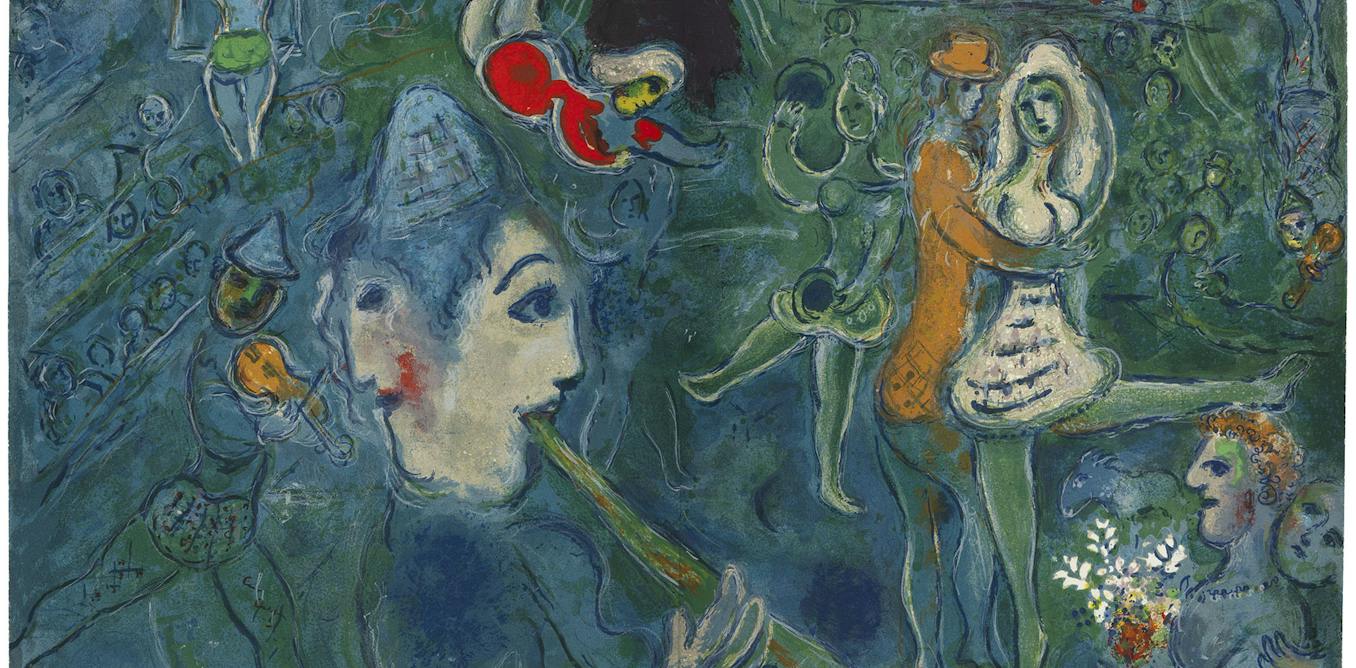
For most visitors, the circus is a place to escape reality, but for Marc Chagall, it was a way to hold on to it. Marc Chagall: The Circus at the Hepworth Wakefield reveals how the artist turned childhood memories of travelling performers into a lifeline through migration, war and loss. Chagall first encountered travelling circus performers in Vitebsk (then part of the Russian empire, now Belarus), where he was born into a Jewish family in 1887. Chagall spent most of his adult life outside Vitebsk, living in France, Germany and later the United States. Chagall and his wife Bella sought refuge in the US following the German invasion of France in May 1940. He had become a French citizen in 1937 at the age of 50 as Europe descended into antisemitism and war. But thanks to Alfred H. Barr Jr, the first director of the Museum of Modern Art (MoMA) and the Emergency Rescue Committee, the Chagalls were able to flee to New York in 1941. Marc Chagall: The Circus argues that the circus became a visual language through which Chagall carried memories of his hometown across decades of movement and exile. It persuasively shows how the performers, animals and spectacles became recurring motifs that Chagall revisited time and again as he navigated life abroad. How Chagall’s interest in the circus began. Despite the jocularity of the circus imagery in Chagall’s work, the exhibition is really about the relationship between performance and identity, as well as the precarity of modern life. Curator Eleanor Clayton told me she was struck by “how much his childhood memories of travelling circus performers remained a vivid reference for his works”. She noted that: “Chagall would later remark that these recurring symbols functioned as a visual vocabulary, like a poet uses words, nonetheless creating new poems each time.” The exhibition devotes an entire room to Chagall’s Cirque, a suite of colour and black and white lithograph prints created in 1967. Commissioned as an artist’s book by the French publisher Tériade, Cirque is represented through both its lithographs and accompanying text. The display of lithographs, enhanced by the first full English translation of Chagall’s 1967 essay Cirque, reveals how singular Chagall’s focus was on certain figures and motifs. By viewing the lithographs together, viewers can readily see the importance of continuity in exile for Chagall as he returned to these figures and motifs across many years. The perspective in these lithographs is often from above, looking down. Certain figures appear throughout, such as a fiddler, a red horse and a performer in a pointy hat. Countless tiny, faceless people line the circus ring from top to bottom while the performers are magnified as they float through the space of the circus ring. The effect is dreamlike, yet oddly familiar, as though viewers are glimpsing remembered fragments. Inside Marc Chagall: The Circus at The Hepworth Wakefield. Anya Fiáine/Courtesy The Hepworth Wakefield One of the most revealing works in the suite is Circus (Mourlot 500) because it brings these elements together into a single composition. Slightly above the centre of the image, a couple on a trapeze poses with what appears to be a red, green and white horse with a yellow mane. The upper figure is yellow and seems to hold the second figure, a woman who is depicted mostly in white with some pink highlights. Far below them is a bright yellow circus ring, where a yellow-hued performer in a pointy hat lunges away from them, clasping a bouquet of white flowers in one hand while looking back over his shoulder. The Dance and the Circus by Marc Chagall (1950). Tate They all seem to occupy a space between performance and dream. The work recalls Chagall’s repeated depictions of himself and his wife Bella, who died during their American exile, turning a circus performance into a kind of reunion instead. In contrast with this lithograph is a painting, on loan from Tate, “The Dance and the Circus” (1950). Here the viewpoint shifts below the action, looking up at the flying figures of a fiddler rendered as a red cow, with the couple reappearing on the far left. A young girl painted in shades of green and blue lunges towards the fiddler and couple, thrusting a bouquet at them with a slight smile on her lips. The entire painting is infused with yellow. The recurring elements are present, but recollection and performance are more closely entwined. The painting opens outwards, while the lithograph appears enclosed in its depiction. This suggests that for Chagall, the circus was an imaginative space where memories and relationships could be projected indefinitely. Beyond the spectacle The exhibition’s greatest strength is how it shows the persistence of these motifs over the decades. Marc Chagall photographed by Pierre Choumoff in the 1920s. Wiki Commons It highlights how the circus served as a space where Chagall could continuously revisit and rework themes of memory, family and loss. However, on occasion, the focus on universal themes risks downplaying the specific historical Jewish and eastern European contexts underpinning these images. The recurring figures, animals and symbolic characters point towards the vanished world that continued to influence Chagall’s imagination. Chagall’s life and career moved across national borders, but the exhibition overall reminds viewers how deeply rooted his imagination and practice remained in the Jewish culture of eastern Europe. For Chagall, the circus was a means of preserving memory when his home had become inaccessible to him. The exhibition’s achievement lies in showing how Chagall used the circus motif as an imaginative space to which he could return when the world that had shaped him could no longer be recovered. Marc Chagall: The Circus is at The Hepworth Wakefield until 25 April 2027
Behind the joy of Marc Chagall’s circus art is a story of loss and exile
Full Article
Original Source
Read the full article at Theconversation →KhanList aggregates and links to publicly available news content. We do not host full articles from third-party sources. Always verify important information with original sources.