
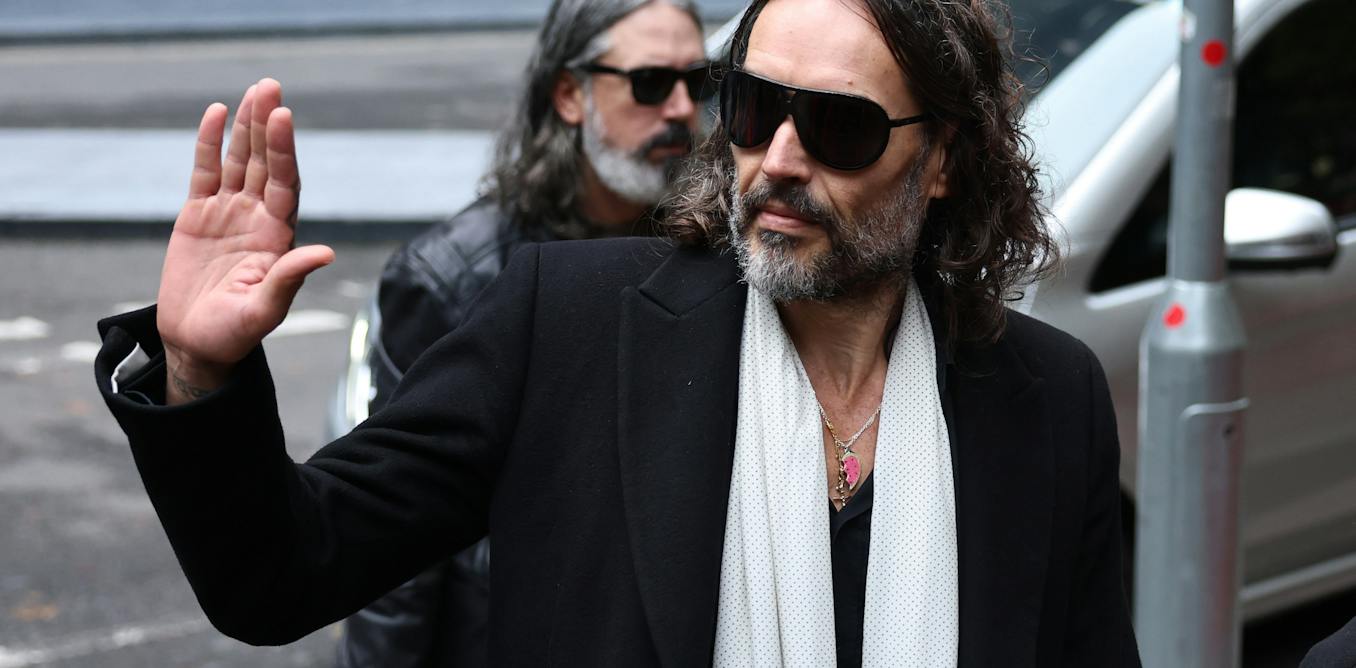
When Russell Brand was sentenced to ten years and six months in prison for rape and sexual assault in November 2026, a peculiar image stood out: his rosary. Various news outlets reported that Brand was using a rosary during his sentencing. Reporters even caught sight of a crucifix through the window of the prison van that transported him. As both a sociologist of religion and an ordained minister, I am not necessarily preoccupied with whether Brand is a sincere Christian. Instead, I am interested in what this public display of faith says about the shifting links between religion, masculinity and celebrity culture. This has led me to look into what I call the “blokeification” of Christianity. Something that will be explored further in my forthcoming book, Global Awakenings Populism, Conspirituality & Conversion Narratives. In a British context, I would describe the “blokeification” of Christianity as an attempt to reshape Christian faith and religious identity through a masculine, often laddish, lens. It’s a move that pushes back against the idea that church is excessively formal, sentimental, or feminine. How Russell Brand became a Christian influencer. In recent years, I have seen this in churches where religious belief is discussed over a pint in a pub, where football and “banter” build community, and where leaders try to present themselves as ordinary, relatable blokes. There is nothing inherently wrong with making church more relatable for men, but it is worth questioning the particular kind of masculinity it projects. This is especially obvious in certain online Christian circles where faith starts to merge with gym culture, self-improvement and established gender roles. While many churches and religious groups are working to push back against the kind of masculinity promoted by personalities such as Andrew Tate, is equally important to examine how Christianity itself might be building and promoting its own specific masculine ideals. At the same time, even if they aren’t coming from the same religious groups, more populist and far-right movements are appropriating Christian symbols. In these spaces, Christianity becomes less about actual belief or practice and more about cultural identity, nationalism and masculine strength. Muscular Christianity and blokeification In the UK, you could argue that the roots of this go back to the muscular Christianity movement of the mid-Victorian era. Starting in the 1850s, several clergymen and educators felt that Christianity had become too passive, domestic and disconnected from men’s lives. Through writers like Charles Kingsley and Thomas Hughes, they pushed to reclaim – or “blokeify” – Christianity by focusing on physical strength and moral character. This played out in the growing connection between Christianity and organised sports. In fact, many of Britain’s most famous football clubs (including Manchester City, Aston Villa and Bolton Wanderers) started as church teams in the late 1800s. Similar ideals can be found in the Boys Brigade, which combined religious teaching with military-style drills, and in the Young Men’s Christan Association (the YMCA), founded in London in 1844, which combined physical strength, moral worldview formation and shared community experiences. Russell Brand struggles to find a Biblical passage during an interview with Piers Morgan. The core strategy of such movements hasn’t changed much: take the secular spaces where men already hang out and fill them with Christian meaning. While the Victorians used rugby pitches and boxing rings to show that a man could be both tough and devout, modern blokeified Christianity uses pubs, five-a-side football, gyms and podcasts to do the same thing. This brings us back to Russell Brand and how he fits within these wider sociological trends in religion. The public presentation of Brand’s coming to faith appeared less concerned with a Damascene encounter (a sudden and transformative religious experience, akin to St Paul’s conversion on the road to Damascus), and more with a rugged, performative expression of Christianity, laden with celebrity culture. Brand’s media-friendly baptism in the River Thames, stripped to the waist and wearing swimming shorts, was presided over not by an ordained minister but by celebrity adventurer Bear Grylls. Brand would later replicate the ritual for another convert, this time wearing water-drenched white briefs. Responding to the backlash, Brand remarked: “It might seem a bit soon to be baptising people, but the Apostles did it on day one, so here we are.” In aligning his expressions of faith with the manosphere, Brand followed an increasingly well-trodden path among influencers and conspiracy theorists, drawing on Christian rhetoric to legitimise and market their particular interpretations of the world. Then, there is the question of style over substance. Brand was pictured carrying a Bible to court, and even released a step-by-step guide to becoming a Christian in seven days. But his apparent difficulty recalling or accurately quoting scripture during interviews raises questions about the relationship between the public performance of Christianity and the slower, less glamorous process of religious formation. While Brand’s flashier moments of conversion have dominated the headlines, the quieter work of faith – and the real test of character – usually plays out away from the spotlight. Seen through that lens, Brand’s public turn to religion is less a standalone curiosity than a mirror of how masculinity and celebrity culture are reshaping faith today.
Russell Brand and the ‘blokeification’ of Christianity
Full Article
Original Source
Read the full article at Theconversation →KhanList aggregates and links to publicly available news content. We do not host full articles from third-party sources. Always verify important information with original sources.