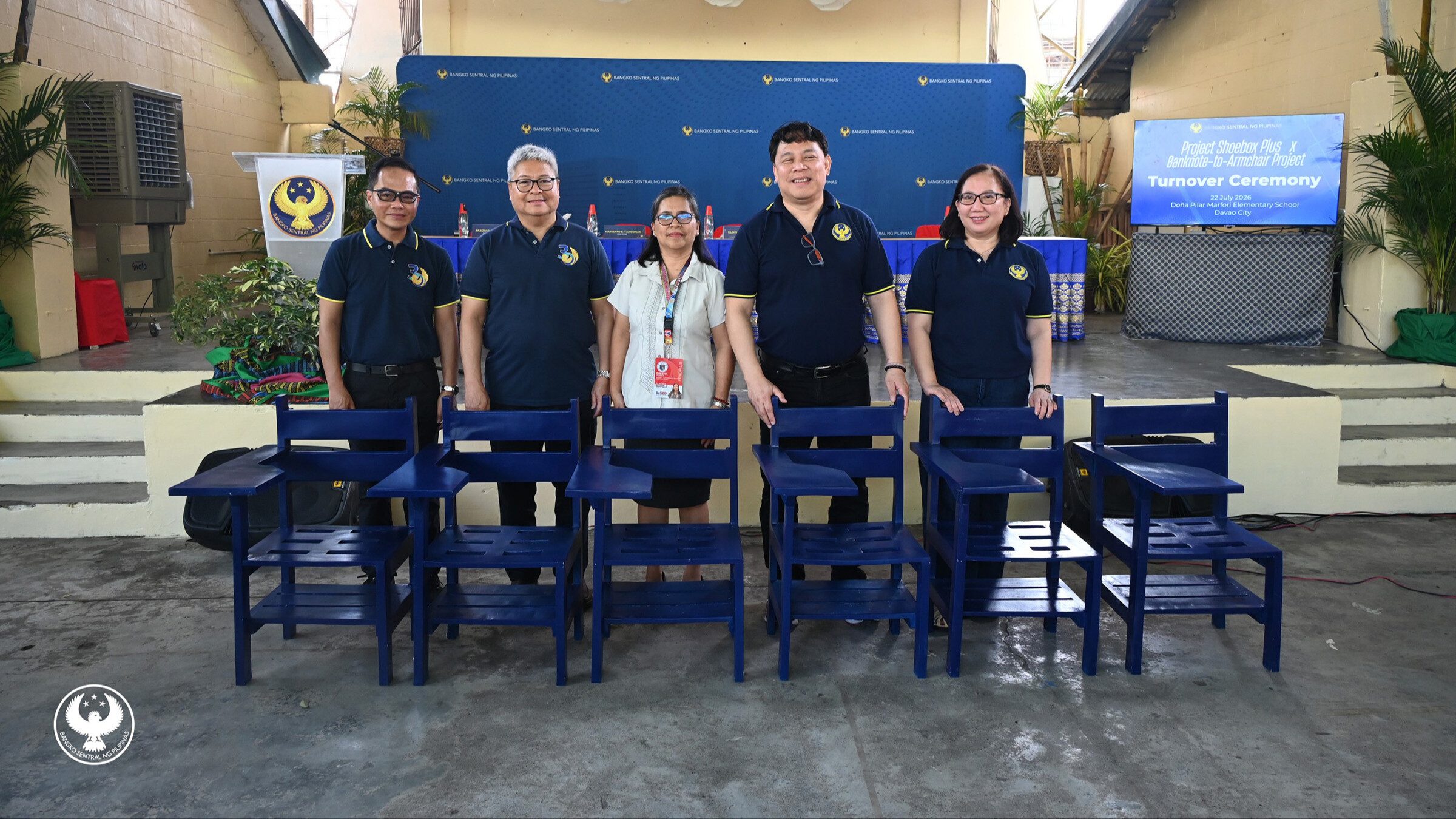
RECYCLED. Bangko Sentral ng Pilipinas officials pose with donated armchairs made from recycled worn-out polymer banknotes. Bangko Sentral ng Pilipinas The next stop for some worn-out Philippine banknotes is not the shredder or the landfill, but the classroom MANILA, Philippines – Nearly 100 armchairs made entirely from recycled polymer banknotes have been donated to Doña Pilar L. Marfori Elementary School in Davao City, giving the notes a second life after they were deemed unfit for circulation. The chairs were turned over on Wednesday, July 22, through the Banknote-to-Armchair Project of the BSP Employees Association Inc. (BSPEAI). BSP Deputy Governor Mamerto Tangonan, BSP Mindanao Regional Office officer-in-charge Jason Capocao, BSPEAI president Brent Lucero, and Currency Policy and Integrity Department director Eloisa Glindro led the ceremonial turnover to the school, represented by principal Eloisa Questo. The project transforms damaged or worn-out polymer notes, along with manufacturing byproducts, into durable classroom furniture. The employees’ association partnered with private recycling company Envirotech Waste Recycling Inc. to produce the armchairs. “Polymer banknotes follow a planned lifecycle from circulation to recycling. End-of-life management is built into their design,” Tangonan said. Bangko Sentral ng Pilipinas Deputy Governor Mamerto Tangonan stands in front of a class in Doña Pilar L. Marfori Elementary School in Davao City. Photo by Bangko Sentral ng Pilipinas. Lucero said the Davao City elementary school was selected after the group assessed the needs and priorities of communities on the ground. The project also highlights one of the BSP’s arguments for shifting from paper to polymer notes: they are designed to last longer and require less frequent replacement. (READ: Senators, farmers question design of new P1,000 polymer bills) From 2022 to May 2026, the BSP said just 0.02% of the P1,000 polymer banknotes issued to banks were returned to the BSP because they were already worn out or damaged. By comparison, 54.75% of the P1,000 paper banknotes issued over the same period were eventually returned in worn-out or damaged condition. The BSP said it had also yet to receive any unfit lower-denomination polymer notes since the new P50, P100, and P500 polymer bills were first released in December 2024. – Rappler.com How does this make you feel? Loading
Bangko Sentral recycles old peso bills into armchairs for this Davao City classroom
Full Article
Original Source
Read the full article at Rappler →KhanList aggregates and links to publicly available news content. We do not host full articles from third-party sources. Always verify important information with original sources.