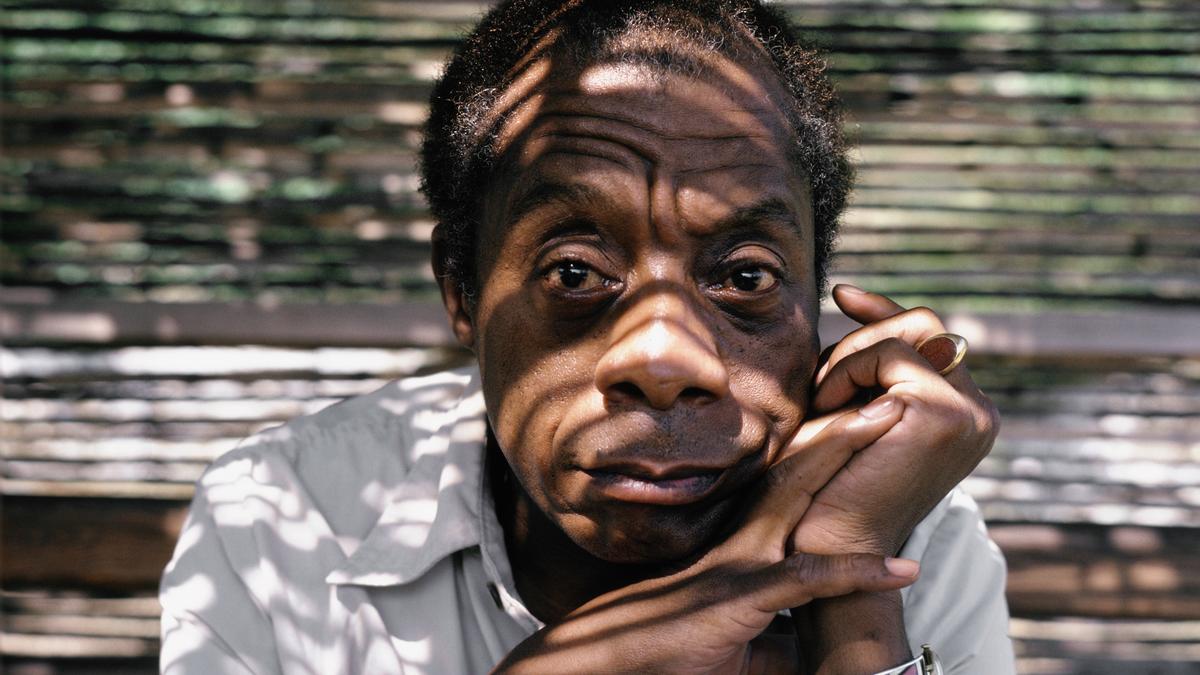
Home Books Authors Boggs discusses the American novelist’s fiction and essays, resistance to categorisation, and enduring relevanceUpdated - July 17, 2026 08:01 am IST Author-activist James Baldwin | Photo Credit: Getty Images Nicholas Boggs’ Baldwin: A Love Story is a new biography of the towering American novelist, playwright, essayist, and civil rights activist, James Baldwin. Drawing on hitherto unexplored archives and unpublished material, and moving — much like Baldwin’s own life — between the American East Coast, the Deep South, Paris, Istanbul, and the French village of Saint-Paul-de-Vence, Baldwin: A Love Story is a brilliant new portrait about the man, his work, and his times. Edited excerpts from a conversation over Zoom: Let me start by asking you about a theme that runs through your book: the relationship between Baldwin’s fiction and his non-fiction. There is this narrative that Baldwin is a master of the essay form, which is true. His fiction, meanwhile, has been treated as inferior. That is something that scholars have been arguing against for the last 20 years, but it persists in popular imagination. As I was writing the book, I came to understand the essays and novels as intertwined. The best example: Baldwin went to Istanbul in 1961, where he finished Another Country. But what I did not initially realise was that he wrote almost all of The Fire Next Time in Istanbul. These works are inextricable. In Another Country, he is looking at these messy relationships between black and white Americans and the necessity for white Americans in particular to confront their past and find a way to love their countrymen and women who are not white. They fail to do that in that novel, but then in The Fire Next Time, probably one of the most important essays ever on race relations in the U.S., he is calling upon black and white Americans to come together metaphorically like lovers in order to change the world. Or, looking at If Beale Street Could Talk and No Name in the Street, so much of Fonny’s trial in the former mirrors Baldwin’s real-life attempt to exonerate his friend, Maynard, in the latter. It reminded me of a book called the Op-Ed Novel, by Becquer Seguin, where he writes about how Spanish writers post-Franco use the novel form and the op-ed form as vehicles to explore the same ideas, but to accomplish through one what the other can’t do. That’s a great example because in this case, unlike how the failures of Another Country were turned into hope in The Fire Next Time, here it kind of gets reversed. In No Name in the Street, Baldwin is really fed up and disappointed with the failures of white Americans and the civil rights movement. He is reflecting on those failures. But in If Beale Street Could Talk, he follows Toni Morrison’s advice to ignore the white gaze. Rather, he focuses on the black family, black liberation, the black hope symbolised by a child – even as he examines the complications of what we now call the prison-industrial complex. And of course, racism is there, but he is offering a vision of hope through the black family that is sort of a counterpoint to No Name in the Street. Nicholas Boggs | Photo Credit: Noah and Loof You write of the swing in Baldwin’s reputation, which comes with the perceived escalation of the political in his novels, and Edward Wright’s observation that political fiction is less elegant. What struck me was Baldwin’s counter, that what makes a writer is less his respect for art than his respect for life. Alejandro Zambra has something very similar to say about another queer writer, Pedro Lemebel: “His work was forged in the night, in the barrio, in life, and not in literature.” I love those comparisons. Someone should write a book across these kinds of figures. When Another Country got negative reviews, he wrote to The New York Times and he said, “Well, you’re wrong.” And also, “I don’t judge myself by the standards of Western literature” – or in this case, the white American literary imagination. “Instead, what I’m trying to approximate is jazz and blues.” Of course, jazz and blues is still an art form, but it is also an art form that is all about the brutalities of life and transforming them into something useful and beautiful. He has a great essay on that, The Uses of the Blues. The blues sensibility: yes, there is suffering, but there is also joy, there is also resilience. The entire African-American literary tradition is a story of resilience, as are the slave songs and the blues and jazz. So, I think life and art in that way are inseparable for him, but he starts with the life part, right? What comes across very clearly in your book is Baldwin’s resistance to categorisation. You discuss how he wrote If Beale Street Could Talk from the perspective of a pregnant black woman and how Toni Morrison helped with that. How would you think of that in light of current debates around identity? Great question. Baldwin had so much to say about it. He was one of the few people who defended his friend, William Styron, writing The Confessions of Nat Turner, which was a controversial novel. He defended the right of anybody to write anything. But I think he also made it clear that a work of art was going to be judged. And so if you’re going to write from across cultures, for example, you have to do your research and you have to be prepared for conversations about it. Those are the kinds of conversations that, today, we need to have, but we don’t always have. In Baldwin’s case, If Beale Street Could Talk is a great example of the complications that he faced. Toni Morrison and Jessica B. Harris may have felt that he did well with that voice, but other black feminists like June Jordan did not. And I kind of agreed with June Jordan that the voice didn’t always work, but I was interested in why. And why, in part, I think, was because, as she said, “It sounded like James Baldwin.” And it sounded like Baldwin because he was voicing many of the emotions that he was feeling at the time about the man that he dedicated the novel to, Yoran Cazac, whose wife was pregnant at the time. So he was writing from the perspective of a black woman, but he was also unquestionably voicing his own concerns. That produced a very interesting book. And I think it also helped him when he got to writing Just Above My Head. If you look at the archives, a lot of these drafts that he was working on in If Beale Street Could Talk, even the heterosexual sex scenes, reappear and get redrafted as same-sex love scenes in Just Above My Head. So it’s all part of this continuum and this freedom that he needed as an artist to explore different perspectives and different characters. In his book, Love in a Dark Time, Colm Toibin traces the lives of nine queer personages from history, but he is categorical that he doesn’t wish to just reduce them to their sexuality. How would you think of Baldwin’s work, given that his writing would inevitably be read through the lens of sexuality, while he himself sought to capture what Teju Cole in his 2014 Baldwin essay would call “the incontestable fundamentals of a person?” Thanks for bringing up both of those writers, who are two of our greatest writers on Baldwin. There is a lovely conversation on YouTube between Baldwin and Maya Angelou, where Angelou is saying that for Baldwin, homosexuality is not a noun, it’s maybe an adjective, and it’s definitely a verb, right? Baldwin was resisting all these categories by that time in his life. He didn’t want to be known just as a black writer. That doesn’t mean he wasn’t a proud black man. And he didn’t want to be known just as a gay writer. That doesn’t mean he was in the closet. He resisted all these categories. He understood that they were systems of domination. They were created by the oppressor to kind of control people. And he claimed the right to self-determination. In your book, you talk about Baldwin’s views on Palestine and the State of Israel. In No Name in the Street, as early as 1972, he presents us with a critique of Israel. A little later, he writes that commitment to black freedom would mean reordering all our commitments to support, among other things, black freedom fighters in South Africa and Angola, Cuba, the Arab nations, and so on. How would you think of Baldwin’s commitment to black emancipation in the context of his internationalist views, which were clearly at odds with the U.S. nation-state’s declared interests? Such an important question. I think there should be even more writing about this. It’s an example of Baldwin’s idiosyncrasy and his ability to change his mind, which is something that I came to really admire about him. It’s very moving to read his letters and see how his mind changes. By later in his career, he was getting into a lot of trouble. This is part of why the liberal establishment was so against him: he was not toeing the line. He wouldn’t even toe the civil rights line at the march on Washington. When Baldwin was teaching at UMass Amherst, he got into a big fight with Julius Lester, because he said something that was not anti-Semitic, but it was taken that way. And the Afro-American department wrote a pamphlet in defense of him. So, the issues that we’re grappling with right now have obviously been around forever. But that is a good example of how Baldwin, later in his career, was always thinking of black liberation globally. He really believed in American exceptionalism early in his career. But his trip south was transformative. That’s one of the tragedies of his early death: he was getting more interesting, more international, more radical, in the good sense. If we think about trans debates today, Baldwin was writing about how we are all androgynous and each contains the other, male and female, female and male. He was exploring this in his plays and the fiction he was working on when he died. You mentioned UMass Amherst. In 2025, the Baldwin Memorial Lecture at UMass was delivered by Steven Salaita, who of course lost his job in the U.S. because of being pro-Palestine. Salaita said that there could be no James Baldwin today, because the establishment has become much better at co-opting radicalism at the outset. I agree that it’s very repressive in terms of who gets to speak and how they get to speak. However, I would also say that the old model, in which there was room for only one great Black voice at a time — whether Baldwin, Richard Wright, or Ralph Ellison — has disappeared. And that is interesting because you could say it has disappeared precisely because of its repressive nature. But I would also say there are just a lot more voices out there. There’s Tressie McMillan Cottom, Nikole Hannah-Jones, Eddie Glaude, Charles Blow. And they don’t all feel the same way. John McWhorter can have a very different opinion than some of those other folks, but he has a voice. I feel like Baldwin showed us a way of thinking about the voice of the black writer in America or in the world. He wasn’t the only person who did this, but he was part of this moment of broadening it. That’s separate from how the media landscape functions in the U.S., allowing and repressing different kinds of voices in this particular moment. Your book is titled Baldwin: A Love Story. Love is so crucial to all that Baldwin wrote and all that he was: love as capaciousness (“a clarified sense of mutual consequence”), as transformation (confronting oneself), as illumination (“revealing the beloved to itself”), and terror (“love takes off the masks that we fear we cannot live without and know we cannot live within.”) Could you talk about how you see Baldwin’s ideas of love and how they shape him and his art as well? They shape him utterly. All the novels are love stories. And love is the ethic that he thinks makes political and cultural and social transformation possible. But importantly, this love is not a sort of saccharine love. It’s a terrifying love. Love is a war, love is a battle, love is a growing up. And he says that white America was in this infantile state, insisting on a false innocence, and that the role of the artist is the same as the role of the lover, which is to reveal the beloved to himself. Baldwin’s done that, and Black America has done that — but it’s still the white Americans, white American men in particular, and women as well, who are failing to be the kinds of positive patriots that I think Baldwin was hoping for. Speaking of infantilisation, you quote Baldwin on the false safety of innocence that white America seeks to preserve in order to maintain its racially unjust status quo. In a recent essay, Richard Hunsinger and X Rivera-Maya note how “public safety” becomes a way for both reactionaries and liberals, whom Baldwin is very critical of, to collaborate on disciplining the larger public. Could you speak a bit about this repressive idea of “public safety” in Baldwin’s work? I think one of the last things he wrote was that honour and safety are strange bedfellows. He lived it. I don’t think he gets enough credit for what he endured in order to write the books and essays that he wrote — being followed by the FBI, seeing his friends Medgar Evers and Malcolm X murdered, and being rightfully afraid for his own life and for his family’s well-being as well. This wasn’t abstract for him, in the way that maybe love was at sometimes. He really risked his life. And today, when there is such an oversaturation and desensitisation with respect to violence, especially against African Americans, these are questions that I think he would have been helpful with: how our safety is mobilised against us, our commitment to, or our hope for, safety. We are really seeing that now through the proliferation of these technologies, right? Finally: Baldwin, the Dramatist. You speak of his formal innovation and staging and dramaturgy that would push the audience towards critical consciousness and political action – and Bertolt Brecht’s influence, even Jean Genet. Baldwin really wanted to be a playwright. The Amen Corner made it to Broadway. So did Blues for Mr. Charlie. He was influenced by seeing Jean Genet’s The Blacks. Maya Angelou had starred in that. And the way that the stage set was set up was to mimic a courtroom so that you implicated white audience members as jurors. I found it interesting that when he went to Istanbul, he had been against method acting because he had this bad experience with Actors Studio, but there he sat around with the actors for Fortune in Men’s Eyes, which was the only play he ever directed. And he used method acting to get these incredible performances. For him, directing was an act of love. It was about connecting. And this was probably one of the most joyful creative experiences of his life, creating this play about alienation and prison and violence, and using it to explore some of his themes about false innocence and about the need for social connection even under duress. It goes back to what we were talking about: Baldwin was allowed to be a singular voice as a writer, but he was not allowed to be a director, a screenwriter. Think about what happened to him when he went out in Hollywood and tried to write about Malcolm X. There’s so much more that he wanted to do and could have done in Hollywood and on the stage that he couldn’t. We are still living with that in Hollywood now and in the drama world. Things are shifting somewhat, but these legacies remain challenging for black artists and directors. Baldwin was starting to open all these doors, yet that was one of the great frustrations of his life. Even so, he was able to have this incredibly impactful experience in Istanbul. And I believe that Blues for Mr. Charlie was also a ground-breaking Broadway achievement. The interviewer is a Delhi-based author, reviewer and editor. Published - July 17, 2026 06:45 am ISTSign in to unlock member-only benefits!Access 10 free stories every monthSave stories to read laterAccess to comment on every storySign-up/manage your newsletter subscriptions with a single clickGet notified by email for early access to discounts & offers on our products
Baldwin: A Love Story | In conversation with biographer Nicholas Boggs
Full Article
Original Source
Read the full article at Thehindu →KhanList aggregates and links to publicly available news content. We do not host full articles from third-party sources. Always verify important information with original sources.