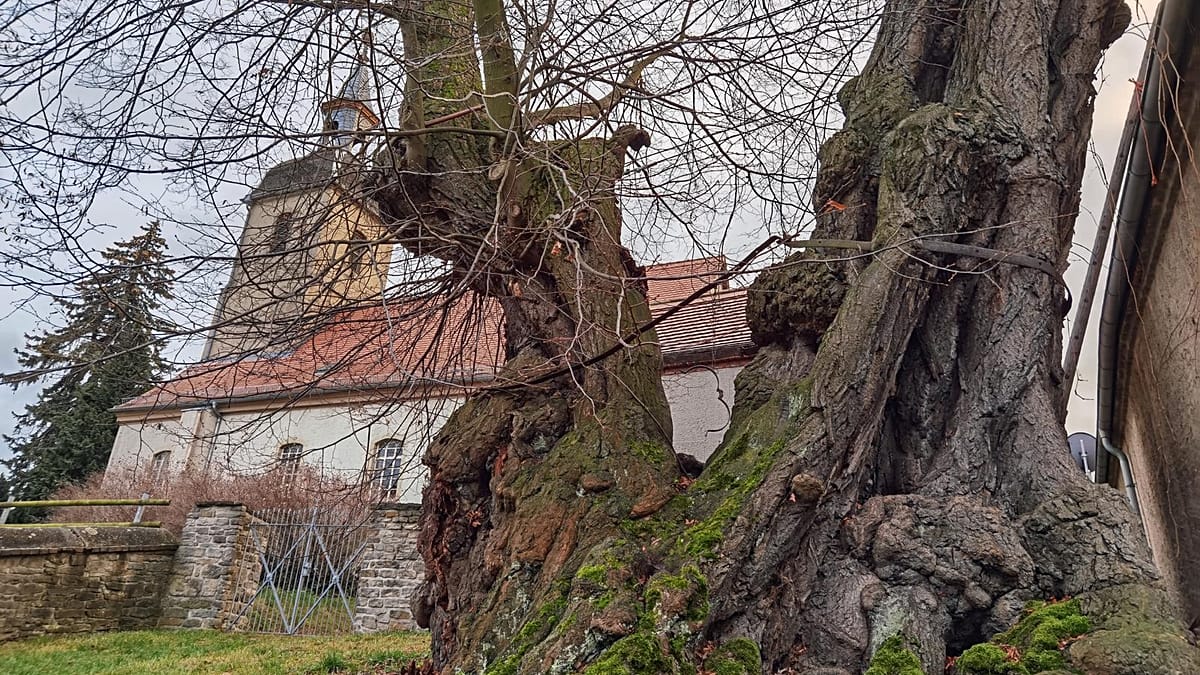
Published on 16/08/2026 - 8:10 GMT+2 In the small village of Großpörthen, around five kilometres south-east of Zeitz in Saxony-Anhalt, stands a tree that has witnessed history over the centuries. The mighty winter lime tree beside the village church is estimated to be between 700 and 900 years old. Its trunk has a circumference of around 9.85 metres and it is about twelve metres tall. This probably makes it the thickest known winter lime tree in Germany. ADVERTISEMENT ADVERTISEMENT But it is not just its age that makes the lime tree special. It owes its name to its presumed role as a "court" and pillory tree. A rusty iron collar can still be seen on its trunk today. It is a reminder of a time when public punishments were part of everyday legal practice. Middle Ages: punishment by chaining offenders with iron collars An iron collar was a metal ring that was placed around the neck of a convicted person and locked. Public pillory punishments involving iron collars are documented in the German-speaking world from at least the 14th century. This form of so-called shame or honour punishment was particularly widespread in the late Middle Ages and the early modern period. However, it remained in use for several centuries and is documented in German legal sources well into the 18th century. The punishment was aimed above all at public humiliation and thus the destruction of the offender's reputation and, depending on the place and the judgement, was combined with corporal punishment. In some cases, the offenders were given signs to wear stating their offence. The pillory was historically used for a very wide range of offences. Sources mention, among other things, minor theft, insults, slander, disturbing the peace, violations of moral norms or cheating on measures and weights. Court lime tree almost 1,000 years old The exact age of the lime tree cannot be determined. For trees of this age, precise dating is difficult, partly because the trunk changes over the centuries. The unusual position of the winter lime on a slope has led to severe thickening and overgrowth in the trunk and root area. Experts from the German Dendrological Society estimate its age at between 700 and 900 years. The tree has also survived serious damage. A larger part of the trunk is said to have broken off around the mid-20th century. Nevertheless, the lime tree has recovered and is considered to be in good health. Germany's now second-oldest tree stands in Upstedt in Lower Saxony. It recently lost the top spot to a yew about 1,100 years old on an alpine pasture in the Allgäu. The Upstedt tree is also a lime tree, more precisely a summer lime, which is regarded as less robust. The historic square in the centre of the village where it stands was already used as a meeting place in the early second millennium; in the 13th century the lime tree became a court tree. There is, however, no evidence that this tree, like the winter lime in Großpörthen, was also used as a pillory.
Großpörthen's pillory lime: 900-year-old tree with dark history
Full Article
Original Source
Read the full article at Euronews →KhanList aggregates and links to publicly available news content. We do not host full articles from third-party sources. Always verify important information with original sources.