
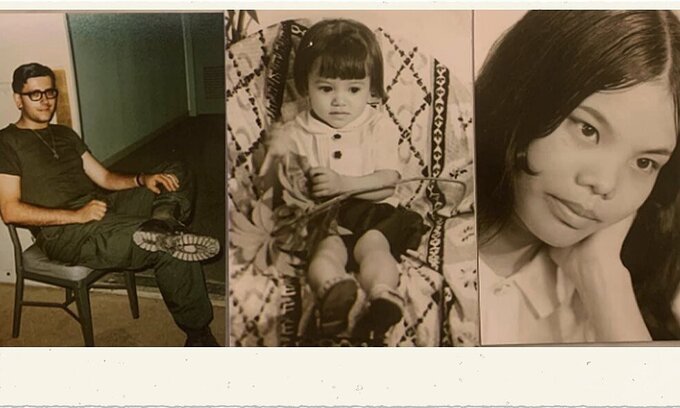
Nguyen Thi My Phuong (Devaki Murch) was nine months old when she was picked up by the first Operation Babylift flight from the South Vietnam war zone in April 1975.Huyen Friedlander was the last child to board the last flight in this operation. Huyen Friedlander (L) and Devaki Murch in their old photos. The largest adoption operation in history, launched by U.S. government in 1975, changed the lives of over 3,300 children including these two.They were uprooted from their homeland in the twilight of the war and carried into the U.S. After more than half a century, they still look for answers about their origins. Huyen Friedlander (L) and Devaki Murch in in May 2026. Photos by Phung Tien In 1977, Huyen was six when her adoptive father in Sacramento, California, read to her for the first time a "declaration" of her origins."I, Cherie Clark, director of Friends of the Children of Vietnam -FCVN, under oath, state as follows:Name of child: Le Thi Huyen. Female. Vietnamese.Le Thi Dem, the child’s single mother, came during the third week of April 1975 to discuss placing her daughter with FCVN for adoption. She said she had tried multiple times to meet me but could not get inside the complex because it was too crowded. Ms Dem is currently unemployed and has many difficulties finding work, as well as encounters problems because of her daughter’s mixed blood. She feels her child would not be accepted in Vietnam and would be better off in the U.S. She has asked many questions and many times affirmed that she had ‘made up her mind’. It is clear that she was distraught, but seems to have thought long and hard about this decision."Friedlander still remembers the last time she had seen her mother in April 1975. Dem rode her on the back of a bicycle from Bien Hoa to the FCVN orphanage in Saigon, and met a blonde woman, Clark.Behind the big iron gate was a large yard with Fisher Price plastic toys from America that the child had never seen before. The mother let Huyen play alone in the yard. When she returned with another woman, she said: "Stay here, I’ll go buy food. I’ll be back to get you.""I kept playing and playing, until it was dark. The lights in the yard came on. I was scared and longed for my mom," Huyen tells VnExpress.Hearing a whistle and seeing other children line up in front of a nun, Huyen cried and asked the nun: "Why hasn't my mom come to pick me up yet?"She hugged her and said: "I have a place for you."After that day, she did not see her mother again for a very long time.Since then, one question has lingered in her heart: "What if my mom doesn’t love me, or I don’t matter?" Huyen Friedlander with her adoptive American parents (L) and with her doll at their house in Sacramento, California, U.S. Photos courtesy of Huyen FriedlanderDevaki arrived in America 24 days before Huyen. She had no memories of her biological family.Adopted by an "amazing and loving" couple in Hawaii, she became their only child and grew up "without wanting for anything."Devaki realized early on that she was adopted, as her complexion and black hair stood in clear contrast to her white, blond parents. Her parents always tried to gather or write down any information shown on TV, newspapers, or books to help Devaki learn more about her origin.Hawaii is an open and accepting place with many mixed-race, Japanese, Chinese, and Filipino people, and she has never faced discrimination. She knows of many adoptees who live among white families and are not accepted at school."I was very lucky; I grew up in a world with people just like me," she says.Surrounded by a diverse Asian American and Pacific Islander (AAPI) community, Devaki never felt the need to look for her biological family until she was 28, when she moved to live in Little Saigon in San Diego.She says: "There, no one asked where I was from. No one took a second look at me when I walked in. I suddenly belonged there. I looked no different than anyone else in Little Saigon. That's a part of me that I never knew of. It was different from Hawaii." Devaki Murch as a little child in Hawaii. Photos courtesy of Devaki MurchAnd it was in San Diego that her past story came to her."My dad has something for you," a friend told Devaki in 2004. That night, they went out for dinner, and his father brought out the April 5, 1975, issue of the San Diego Union-Tribune, with a first-page headline about 178 people killed in the crash of the Operation Babylift flight that Devaki had been on.In 2005, Devaki decided to return to Vietnam for the first time to search for her roots and history.Hurried establishment of Operation BabyliftIn April 1975, the government of the Republic of Vietnam was in disarray. The Liberation Army was advancing towards Saigon. Many Americans tried to leave."The air was dense with anxiety and fear," John Williams, former president of the international adoption agency Holt, who implemented an international adoption program in Vietnam by the Union, wrote in a reflection on 50 years of Babylift.Amid the chaos, the U.S. government announced an unusual plan to bring thousands of Vietnamese children out of the country. At a press conference in San Diego, California, on April 3, 1975, U.S. President Gerald R. Ford said: "I have directed that money from a two million dollar special foreign-aid children fund be made available to fly 2,000 South Vietnamese orphans to the United States as soon as possible."This program was Operation Babylift."I have directed American officials in Saigon to act immediately to cut red tape and bureaucratic obstacles preventing these children from coming to the United States," Ford said."I have directed that C-5A planes and other aircraft especially equipped to care for these orphans during the flight, be sent to Saigon. I expect the flights to begin within the next 36 to 48 hours. These orphans will be flown to Travis Air Force Base and other bases on the West Coast and cared for there. "These 2,000 Vietnamese orphans are all in the process of being adopted by American families."After this announcement, at around 4:30 p.m. on April 4, 1975, a C-5A Galaxy military transport aircraft bearing number 68-0218 departed from Tan Son Nhat Airport with over 300 people, including the first 228 children.It was not a smooth flight.The aircraft shook in the air 12 minutes after takeoff. Cables snapped, causing the cargo door to burst open and the passenger cabin to lose oxygen. The aircrew desperately tried to turn the aircraft around, but it crashed into the rice field only a few miles from the runway.Williams recalls: "We panicked. Holt's building was close to the airport. I could see the smoke from my office." After sliding for a quarter of a mile, it bounced across the Saigon River, shattered into pieces, and caught fire. All documents and equipment inside were destroyed. Many people in the lower part of the plane did not survive.This tragedy took the lives of nearly 80 children and medical personnel, volunteers, nurses, flight crew, and American soldiers. Ruins of the Lockheed C-5 Galaxy aircraft which operated the first Operation Babylift flight leaving Saigon on April 4, 1975. Archive photos by Bud TraynorDevaki was on that flight.She was among 150 children who survived and were taken back to New Heaven Orphanage in Saigon's District 3 for care. Although the accident shocked the world, the White House decided to continue the operation.Nuns and nurses then transferred the orphans onto a Boeing 747 leased from Pan American World Airways.Dominating front pages in the western media on April 5 and 6 were pictures of Ford holding the first of 325 orphans flown to Presidio, San Francisco.The final evacuation flight was on April 26, 1975, with a C-141 transport aircraft carrying 184 children and 14 caretakers taking off from Tan Son Nhat Airport.Huyen was the last child on the airlift list, number 184."I almost wasn't let on the plane," Huyen recalls. There were at least 20,000 mixed-race children born to American fathers in the Vietnam War, and not all of them were included in the operation.The plane stopped at Clark Air Base, the Philippines, and landed in Colorado on April 29. Huyen started a new life here. The first Babylift children arrive in the U.S. and greeted by President Gerald Ford (R), as reported by the Los Angeles Times. Photos courtesy of The Gerald R. Ford Presidential LibraryDevaki was first taken to Presidio. It was a military base, and all Babylift children were gathered there before being adopted or transported to other countries.She was cared for at a hospital for five weeks before being given over to her adoptive parents, Randy Wayne Murch and Sunday Ananda Murch of Hawaii, on June 4, 1975.Her discharge summary and discharge certificate said she had not yet recovered from "orphan syndrome", and had boils, conjunctivitis, eczema, and scabies. Fluid was draining from her ear. Her abdomen was distended, possibly because of intestinal worms, and she weighed only 7.03 kilograms.Her adoptive mother, Sunday, recalls the moment she picked her up in Presidio: "They placed the child in my arms; she wrapped her arms around my neck. She didn't let go. I told her, 'I will take care of you for the rest of my life'."The family named her Devaki Murch.In search of rootsIn April 1996, Huyen returned to Ho Chi Minh City with her original birth certificate bearing the name Le Thi Huyen, which her adoptive father had managed to attain.Huyen was then 24 and heartbroken because her boyfriend of seven years had once again broken up with her. The fear of being abandoned followed Huyen throughout her youth.She could not escape this rejection cycle time after time because of being too hopeful that the other person would see her worth, and they would live happily ever after. She realized she was reenacting a pattern of abandonment rooted in the pain of being rejected by her biological mother.Therefore, the moment President Bill Clinton lifted the embargo on Vietnam in 1994, Huyen planned to return to Vietnam to look for her biological mother. She had spent a year working to save up for the trip."That was an empowering period in my life, when finally I let myself focus on healing from the transnational adoption experience by returning to my homeland and seeking the truth," she says.Americans adopting children from the Babylift Operation can only take one look at their original certificates before starting the adoption process. But Huyen's adoptive father secretly obtained a copy of her birth certificate from a community worker. Because of that, Huyen's journey of looking for her mother became many times easier than for many other Babylift children. Huyen Friedlander's birth certificate and a photo of her with her American parents. Photos courtesy of Huyen Friedlander"Something was healed the moment I set foot in Tan Son Nhat Airport," she says.She went with her adoptive aunt. On her second day in HCMC, they found a place that used to be an orphanage. A man named Triet, who spoke a little English, opened the door. When he knew that she was looking for her mother, without a moment's hesitation he accompanied them in a hired car to Bien Hoa in Dong Nai that borders HCMC.After visiting five local police stations in vain, she found hope at the sixth. The officer, after checking, named a hospital and two churches: "I think that's where you were born. Go to the churches, perhaps the parish priest will know your family."Huyen still had some memory of where she was born – "Ho Nai, Bien Hoa".When she was a child, her mother would take her to church every Sunday, at "Hanoi parish".At the second church, the priest looked at her birth certificate and said he knew a person who had witnessed her birth. A few moments later, a man approached them and said his daughter had helped deliver her when she was born.The priest asked for Huyen's parents' names and then asked someone to search for them. After about 20 minutes, a woman and a thin, elderly, black-haired man came. They were both crying. The woman held a frayed and faded photograph of a two-year-old Huyen, which she had kept for the past 20 years. They turned out to be Huyen's aunt and grandfather. They said her mother was somewhere else, and set up a meeting for two days later.Huyen recalls: "I was truly shocked. On the ride back to HCMC, I didn't know how I should feel. Is it real, or a prank?" The northern motherIn 1954, the family of Le Thi Dem (now 76) migrated from the north to Ho Nai. In 1970, at 19, she worked for an American military camp in Bien Hoa in the kitchen, where she was helped by a soldier responsible for radar operations in Long Binh and Phu Lam.They fell in love. She got pregnant. He tried to apply for marriage papers to take her back to the U.S., but could not. After his one-year duty in Vietnam, he had to return to America. She stayed back and gave birth alone.Her family was large and poor, and her parents wove bamboo mats to make ends meet. People around them gossiped: "What kind of woman gets involved with Americans?"Dem says: "Many people convinced me to abort the child to avoid gossip. But I had to take responsibility for my actions. Her father was a good man. I loved him, and I was prepared to endure any hardship." In 1971, she gave birth at Bien Hoa Hospital. The baby was 3.2 kg. Looking at the child, the mother was both happy and scared, thinking of bringing her baby home to scornful eyes.Back then, many women who got pregnant with American men aborted or orphaned the child after giving birth. Her father told her to just give her to the orphanage. She cried: "I beg you. I love the child as you love me; I can't let her go. If she dies, I die. If she lives, I live. They can only talk for so many days, and would soon forget."After postpartum, she left the child at home in her sister's care. She took whatever job was available to earn money to take care of the child. A collage of the photos of Huyen Friedlander (C), her biological father Paluzzi Jerry Gerard and mother Le Thi Dem. Photos courtesy of Huyen FriedlanderIn the days leading up to April 30, 1975, there was "commotion and chaos" across southern Vietnam. Dem says: "It was rumored that mixed American children would get into danger. I was afraid. I thought a lot, then secretly rode my daughter on a bicycle from home to the American headquarters and asked to see the western women working there."With a little English she had learned working at the American military camp, she explained she wanted to go to the U.S. because she feared it would be dangerous to stay. They told her that only the children could go.She carried the child home. Halfway, she became afraid again that her daughter might be harmed, and so made the heartbreaking decision. She rode Huyen back. A blonde woman asked her repeatedly if she had thought this through, and whether she needed anything else.She replied: "Please help me arrange the documents for the child. I don't need money. I only ask for her to return and visit me when possible." The blonde woman completed the paperwork. Dem told her child to wait for her to go and buy some food.She says, crying. "She believed me. I lied to her. She was only four. Then I left." On the morning of April 14, 1996, seeing Huyen again, Dem knew right away that it was her child. She jumped to hug her: "Hello. Oh my god, it's really my baby!"From her nose to eyes, her looks were the same as her father's. I could not believe it. I have never been as happy as I am today."Huyen's first question to her was: "You told me to stay, and you'd go buy food; why did you leave me?"Dem got goosebumps and could do nothing but cry: "I'm sorry for lying to you. I had to lie, or else you would have begged to come with me."Huyen Friedlander is reunited with her mother Le Thi Dem in Dong Nai, southern Vietnam, in 1996. Video courtesy of Huyen FriedlanderShe told Huyen that, after walking out of the orphanage gate, she hid behind a tree and watched her daughter play alone until dark. Only after the child had followed a nun inside did she leave.Returning home to her parents and seven younger siblings, Dem nearly lost her mind. That night, she passed out after thinking "from now on my life has nothing."For the next few days, whenever people asked where her daughter was, she said someone had taken her away and told them not to ask again.At the beginning of May, she heard the news that the plane that carried the babies had crashed, and many had died. She thought she'd never see her daughter again. Huyen Friedlander (L) and her mother Le Thi Dem during their first reunion on April 14, 1996. Photo courtesy of Huyen FriedlanderThe American fatherAfter her first trip to Vietnam and her reunion with her mother, Huyen returned to America. They kept in touch through letters and later by telephone.When Huyen asked about her biological father, Dem only knew his name sounded like "blue" - "bluan," and that he used to work in radar operations at the Long Binh camp with the 377th Infantry.Knowing all military records were kept at St. Louis, Missouri, Huyen wrote a letter asking for access to documents from 1970, when her father was assigned to the 377th Infantry Division.She says: "I asked to search for task assignment sheets of any names that sound like blue. It was like looking for a needle in a haystack. And they gave me copies of several yearbooks back then, but there was nothing." In the mid-1990s, with the Internet now ubiquitous and improved communications, Huyen looked for veteran groups that had served in Vietnam.Howard Heckman, an ex-soldier in the Vietnam War, responded to her post online. After many exchanges and months of searching, Heckman sent her a copy of the list of soldiers he worked with.Huyen looked at each name and saw "Paluzzi Jerry Gerard". She followed many clues to find that he was living in New Jersey, that his first wife had passed and that he had remarried. But she did not contact him for a year."I just felt like I wasn't ready," she explains.Huyen continued her graduate studies to become a psychotherapist, got married, and had a child.The Sept. 11 attacks, which killed nearly 3,000 people in the U.S., changed her mind about contacting her possible father. Huyen called him on a Friday night and heard a voicemail asking her to leave a message."My name is Huyen. I think you're a friend of my family from Vietnam," she said.The next morning, Paluzzi called back."My name is Huyen. My mother's name is Dem. She gave birth to me at Bien Hoa Hospital, and I think you're my biological father," she told him.He immediately said: "I think so too. "I thought you had died."Where are you?"Huyen says: "He didn't ask: 'Who are you?' He did not hesitate. That was a priceless gift to me." Huyen wondered how Paluzzi accepted a child he'd never met so readily. But when they met, she finally understood: he had deeply loved her mother. He said her mother was his first love. When he knew she was pregnant, he asked her father for her hand in marriage, but was refused. They didn't want her to go to America. The U.S. military did not permit him to marry a northern Vietnamese either.When he returned to the U.S., through a friend, he and Dem wrote several letters to each other during the first two years of their daughter's life, and promised a reunion. That friend later told him that Dem had died when crossing the border in Thailand and his daughter had died in the Babylift crash. But many years later, still hopeful, he continued to post on online forums looking for Dem.A few weeks after the call, Huyen travelled to the East Coast with her adoptive father, husband and 17-month-old son. She was two months pregnant with her daughter. Paluzzi and his wife greeted them at a restaurant with a bouquet of flowers. After dinner, they went to his home for dessert.Paluzzi presented a picture of a little girl about two years old, an exact duplicate of the tattered one that Huyen's biological aunt had in Vietnam. Because of that, father and daughter felt there was no need for a DNA test. He gifted her the gold cross Dem had given him before he left Vietnam.Both Huyen's biological mother and father had waited for eight years after they parted to marry. Dem married a musician and gave birth to five children. Paluzzi had a son and daughter.Over the next decade, Huyen and Paluzzi kept in touch by letter or phone. After her husband died of cancer, Huyen brought her children to meet Paluzzi again.By the time of their meeting, her two children had reached adulthood. Sadly, that was also the last they saw him. Paluzzi died during the Covid pandemic in 2021. Huyen Friedlander (4th, L) is with her two children, her biological father Paluzzi Jerry Gerard (R), and his wife (L). Photo courtesy of Huyen FriedlanderHuyen says. "The day I met my mom again was the happiest day of my life. It's hard to believe that I found her, a dream come true. I was scared that I wouldn't be loved up until that moment. She loved me so much that she was ready to bear the pain of losing me and the judgement of her neighbors."The reunion brought a strange feeling. The most important answer for Huyen was that her mother did not abandon her, and she had always been loved since birth. That truth flipped on its head the story that had haunted her for the first 24 years of her life.However, of the 3,300 Babylift babies, not everyone has been as lucky as Huyen. After being away from Vietnam for 50 years, Devaki is still on a journey of finding a part of her identity. Huyen Friedlander with her mother Dem in their first reunion in Dong Nai in 1996 (L) in a photo she provided, and during their most recent meeting in May 2026 in Ho Chi Minh City. New photo by Phung Tien Story by Hong Phuc
Babylift children who have spent half their lives searching for birth mother
Full Article
Original Source
Read the full article at E →KhanList aggregates and links to publicly available news content. We do not host full articles from third-party sources. Always verify important information with original sources.