
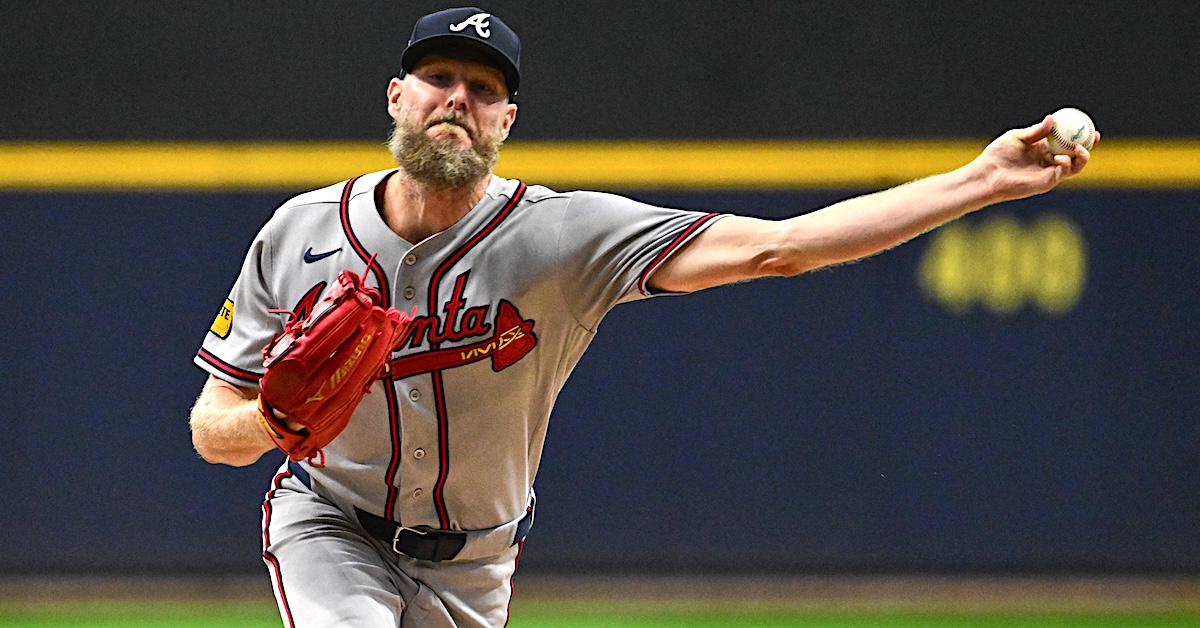
Benny Sieu-Imagn Images On Opening Day, Paul Skenes had his worst start since at least high school. He threw 37 pitches, allowed five runs (not all of which were his fault) and lasted only two-thirds of an inning. Skenes left that outing with an ERA of 67.50; even for a high-volume starting pitcher, that’s a big hole to climb out of. From that point on, the NL Cy Young race has been a heads-up contest between Jacob Misiorowski and Cristopher Sánchez; the former, with his big velocity and strikeout totals, seems to be the favorite at the moment. But a third pitcher has entered the race in the past seven weeks: Chris Sale. Since the All-Star break, Sale leads all qualified NL starters in both ERA (1.76) and WAR (2.7, which is a full win better than Sánchez and Jesús Luzardo, who are tied for second place). In 46 innings over seven starts, Sale has struck out 60 opponents while walking only three. Sale’s hot run has coincided with a tough run of form for Atlanta’s offense. In August, Atlanta hit just .248/.301/.397 as a team and scored only 102 runs in 28 games. That goes some way toward explaining how Atlanta contrived to peg Sale with a loss in three of those seven starts. Last time out, the 37-year-old Sale cut out the middleman. You Aren't a FanGraphs Member It looks like you aren't yet a FanGraphs Member (or aren't logged in). We aren't mad, just disappointed. We get it. You want to read this article. But before we let you get back to it, we'd like to point out a few of the good reasons why you should become a Member. 1. Ad Free viewing! We won't bug you with this ad, or any other. 2. Unlimited articles! Non-Members only get to read 10 free articles a month. Members never get cut off. 3. Dark mode and Classic mode! 4. Custom player page dashboards! Choose the player cards you want, in the order you want them. 5. One-click data exports! Export our projections and leaderboards for your personal projects. 6. Remove the photos on the home page! (Honestly, this doesn't sound so great to us, but some people wanted it, and we like to give our Members what they want.) 7. Even more Steamer projections! We have handedness, percentile, and context neutral projections available for Members only. 8. Get FanGraphs Walk-Off, a customized year end review! Find out exactly how you used FanGraphs this year, and how that compares to other Members. Don't be a victim of FOMO. 9. A weekly mailbag column, exclusively for Members. 10. Help support FanGraphs and our entire staff! Our Members provide us with critical resources to improve the site and deliver new features! We hope you'll consider a Membership today, for yourself or as a gift! And we realize this has been an awfully long sales pitch, so we've also removed all the other ads in this article. We didn't want to overdo it. He went the distance, pitching a shutout against the Dodgers — one of only nine shutouts so far this season. Sale struck out 11 without walking a batter. Only three pitchers this season have struck out 10 or more without walking a batter in a shutout: Sánchez, Misiorowski, and now Sale. What a year for guys who wear pants with a 28-inch waist and a 40-inch inseam. I was about to say that Sale had eclipsed his rivals in the second half, but the truth is, none of these dudes could eclipse a pencil. It’s very interesting that Sale is making yet another charge into the Cy Young race. I was sure he’d end up in one of my favorite historical classes of starting pitchers: Those who burned brightly but didn’t have the longevity to mount a serious Hall of Fame challenge. I’ve got a running list of Cy Young winners who had Hall of Fame peaks but came up short on the counting stats: Johan Santana, Brandon Webb, Tim Lincecum, David Cone, Corey Kluber, Bret Saberhagen… I was sure that Jacob deGrom, who got an abnormally late start, would suffer the same fate. Sale never won a Cy Young in Chicago or Boston, but he had a run of seven straight All-Star appearances in which he finished sixth or better in Cy Young voting every year. He was a finalist twice, finishing behind Kluber both times. But he was in the conversation every year, and in 2018, at age 28, he finally got that elusive World Series ring. But the end sure looked imminent; his age-30 season was rocky, then he missed 2020 while recovering from Tommy John surgery, and he spent all of the early 2020s getting back on track. Sale started 32 games in his first season with the Red Sox, in 2017, and 31 games in his last four seasons with the Red Sox put together. His late-career re-emergence has been truly remarkable, and he has been able to hit most of the milestones — a Cy Young win, 2,000 innings, 2,500 strikeouts, 60 career WAR — that would’ve stood between him and Cooperstown. The story sells itself, though if you need any additional convincing, Zach Crizer just wrote about Sale in his newsletter. As a geriatric Millennial myself, I do love an old-man-makes-good story, but I want to hone in on something specific with Sale. The gangly left-hander has a FIP of 0.88 in the second half. The second-best FIP in that time period belongs to Tarik Skubal, who’s all the way up at 1.74. If you remember what goes into FIP, that makes sense. Among 66 qualified starters, Sale is third in K%, second in BB%, and he hasn’t allowed a home run. Sale has actually hit as many batters in the second half (three) as he’s walked. Now that’s old school. Perhaps even more old school than Sale’s homerless streak, which is itself like something out of the 1910s. He has now gone eight straight appearances without allowing a dinger; no other non-opener starter is working on a streak of more than six this year. Only 12 times since 1920 has a starter thrown 25 or more innings in a month, while striking out at least a batter per inning and at least 10 batters per walk, with zero home runs allowed. Sánchez did it back in May, during his 50 2/3-inning scoreless streak; Sale has four of the other 11 instances, including this August. Or, if you want to just go directly to FIP, here’s every month since 2017 in which a starting pitcher recorded a FIP of 1.10 or better in 25 innings or more. Best FIP Months of the Past 10 Years Season Month Name Tm IP TBF HR/9 K% BB% FIP 2018 Jul Chris Sale BOS 25 96 0 44.8% 4.2% 0.44 2021 Mar/Apr Gerrit Cole NYY 37 2/3 140 0.24 44.3% 2.1% 0.54 2021 Mar/Apr Corbin Burnes MIL 29 1/3 108 0.31 45.4% 0.0% 0.58 2026 May Jacob Misiorowski MIL 38 1/3 136 0 41.9% 4.4% 0.67 2021 Jun Jacob deGrom NYM 27 95 0 42.1% 4.2% 0.76 2024 May Chris Sale ATL 32 124 0 36.3% 1.6% 0.82 2021 Mar/Apr Jacob deGrom NYM 35 123 0.51 48.0% 3.3% 0.88 2022 Sept/Oct Spencer Strider ATL 25 98 0.36 44.9% 7.1% 0.95 2024 Aug Chris Sale ATL 30 2/3 127 0 33.1% 4.7% 1.01 2026 Aug Chris Sale ATL 27 105 0 32.4% 1.9% 1.02 2017 Jun Corey Kluber CLE 43 156 0.21 41.0% 4.5% 1.04 2018 Sept/Oct Justin Verlander HOU 33 120 0.27 41.7% 4.2% 1.07 2026 May Cristopher Sánchez PHI 39 143 0 31.5% 2.1% 1.09 minimum 25 IP Again, Sale has four such months. Only deGrom has more than one. The wild thing about Sale’s home run prevention is not the raw numbers. He is on track to post a HR/9 of 0.5 or less for the second time in three years. Since 2022, four other pitchers — Logan Webb, Sonny Gray, Framber Valdez, and Jose Quintana — have done the same. But Valdez and Webb are extreme groundball pitchers. Sale… isn’t. Neither is Gray. Sale is in the 61st percentile for GB% this year; in his Cy Young season, he was in the 70th percentile. So he’s definitely a groundball pitcher if you had to pick a directional bias, but he’s not an extreme one like Webb or Valdez. Sale is just freakishly good at keeping the ball in the yard. If you took a look at each of the hundreds of pitchers in the major leagues right now and tried to figure out what makes each one hard to hit, Sale might be the easiest one to solve. He has elite command and velocity, and with his distinctive low-arm slot delivery, none of his four pitches moves the way hitters would expect it to. If you wanted to quantify that assertion, here’s how I’d do it. If you take Sale’s four pitches (four-seamer, sinker, slider, changeup), each breaks on two axes: horizontal and vertical. That makes eight individual directions of induced movement. For all eight of those axes, Sale’s pitch deviates from average by more than two inches; for six of those axes, his pitch’s induced movement deviates from average by more than five inches. That’s how you get an 84th percentile whiff rate and an 80th percentile HardHit% from the same repertoire. Sale has an average arm angle of 11 degrees — the only pitcher with a lower arm angle is the submariner Tyler Rogers — which allows him to release the ball low. Sale might be 6-foot-6, but his average vertical release height is the third lowest among pitchers with at least 1,000 pitches this year. Because Sale throws from such a low release point, he’s not pitching the ball in a downward pattern that lines it up with the gentle uppercut of a modern swing. Add in the crazy left-handed release point, wicked two-axis induced movement on all four pitches, and 17-mph difference between his fastball and slider, and hitters seem not to know what to make of Sale when they see him. Out of the 200 pitchers who have faced the most swings this year, Sale has induced the second-lowest average bat speed and the seventh-lowest fast swing rate. It’s hard enough to do damage on a pitcher who throws like Sale, but if you’re not swinging hard, the odds only tilt more in the pitcher’s favor. Of the 140 pitchers who have allowed 100 or more fly balls this year, Sale is 12th in both average exit velo and HardHit%. I’m starting to worry that I’m overanalyzing Sale now. Like, look at this. Hitters are swinging like they’ve just been asked to solve a system of differential equations. Of course Sale isn’t allowing any home runs.
Come, Sale Away
Full Article
Original Source
Read the full article at Blogs →KhanList aggregates and links to publicly available news content. We do not host full articles from third-party sources. Always verify important information with original sources.