
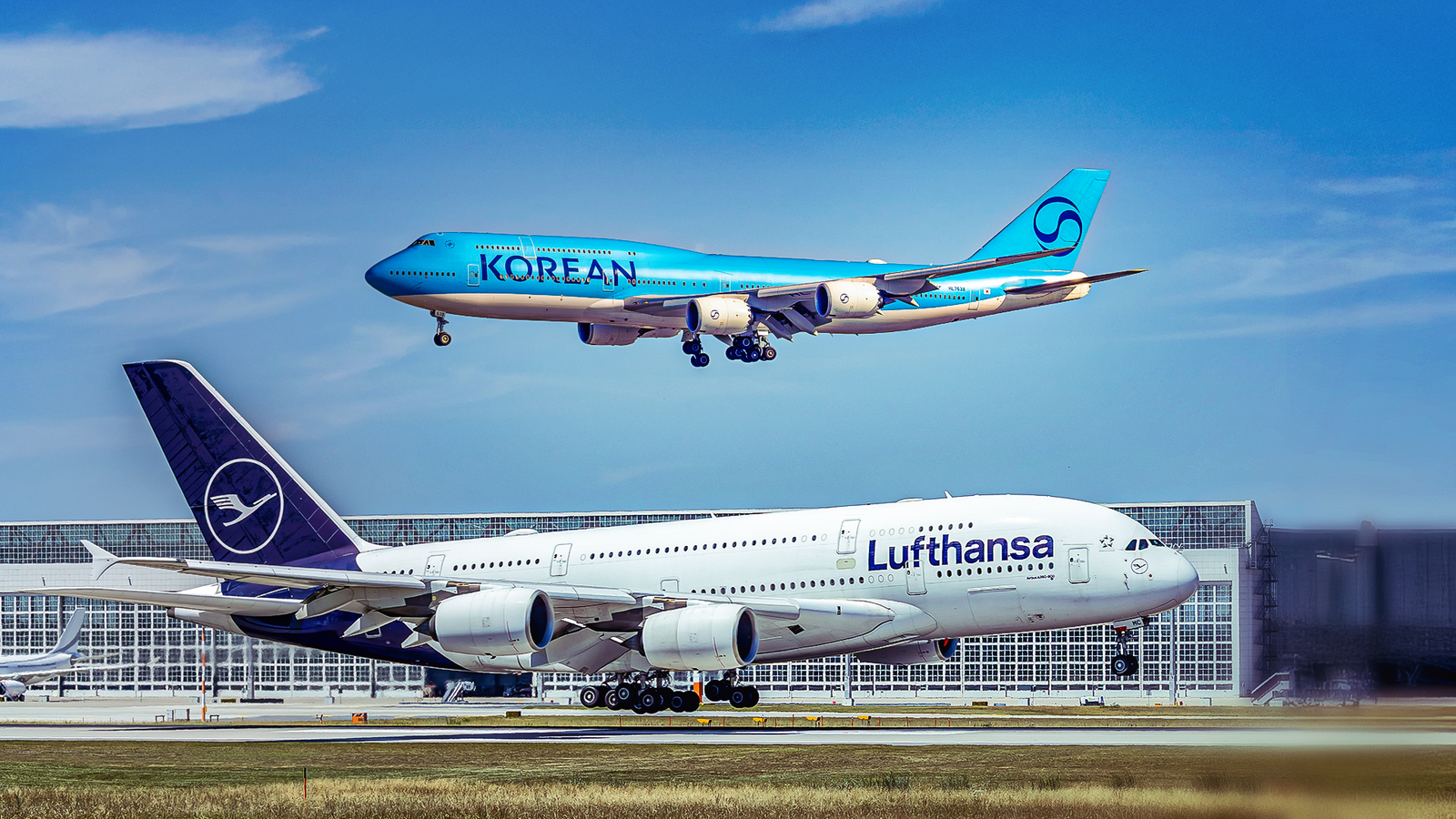
The introduction of the Airbus A380 historically dethroned Boeing as the reigning champion of big jet builders. However, that statement comes with a couple of caveats. It is true that the A380 beats the classic Boeing 747 in wingspan, height, weight, and passenger capacity, but the long-reigning 'queen of the skies' was not made irrelevant overnight. Boeing responded not with a brand-new double-decker, but by stretching its classic 747 design into the 747-8 Intercontinental. With two full passenger decks running from nose to tail, the European superjumbo dwarfed every competitor in wingspan, tail height, weight, and seating capacity. On paper, it looked as though Airbus had swept every major size and performance record in commercial flying. However, while the Boeing jet carried fewer passengers and weighed hundreds of thousands of pounds less, it quietly held onto two major world records that the massive A380 could never take away. First, by extending the fuselage, Boeing made the 747-8 the longest airliner in service, measuring 250 feet 2 inches (76.25 meters) from nose to tail. This made it over 11 feet longer than the A380. Second, thanks to its sharply swept wings and modern engines, the 747-8 cruises at Mach 0.855 (about 567 mph), edging out the A380’s Mach 0.85 pace to claim the title of the fastest commercial jetliner flying today. How a Stretched Fuselage Outmaneuvered Airport Gate Limits Credit: Victor De Leon | Shutterstock For one pragmatic reason, airport gates, Boeing decided to make the 747-8 longer rather than wider. Because the A380 has such an enormous wingspan, major airports had to widen taxiways and build special two-story boarding bridges just to handle it. Boeing kept the 747-8’s wingspan narrower at 224 feet 5 inches, allowing it to pull into standard international gates with minimal airport upgrades. Boeing extended the earlier 747-400 body by 18.3 feet (5.6 meters) to create the 747-8, the longest aircraft in the sky. Two extra fuselage sections were added by engineers, one in front of and one behind the wings, increasing the overall length to 250 feet 2 inches (76.25 meters). The 747-8 surpassed the Airbus A380 by about 11.5 feet (3.5 meters) in terms of its additional length, surpassing the previous record set by the 75.36-meter Airbus A340-600. While a four-engine Boeing remained expensive to fly, the 747-8's gate compatibility still gave airlines a practical edge over the A380. Because the superjumbo required costly terminal upgrades and triggered higher size-based airport fees, its route map was limited to a small group of mega-hubs. By staying within standard widebody gate limits and weighing far less, the 747-8 carried over 400 passengers into a wider range of international airports with slightly lower ground costs. 1960s Wing Design & Modern Engines Deliver Boeing's Speed Crown Credit: inSky_1865 | Shutterstock Boeing’s second trump card over the Airbus colossus comes down to its cruising speed world title. Rated at Mach 0.855, or roughly 567 mph at 35,000 feet, the 747-8 is the fastest commercial airliner flying today, edging out the Airbus A380, A350, and Boeing 787 at Mach 0.85, as well as the 777 at Mach 0.84. While a speed advantage of under 1% only trims a few minutes off a long flight, it gives pilots helpful schedule padding against headwinds and arrival delays. That speed advantage comes straight from a 1960s design decision. When Boeing engineers first shaped the 747, they expected supersonic jets like Concorde to take over passenger travel. As such, they angled the 747's wings sharply backward to help it cruise faster and keep up with high-speed air traffic. Four General Electric GEnx engines provide the power needed to take full advantage of that high-speed wing. Adapted from the Boeing 787 Dreamliner program, these modern engines produce strong thrust while burning less fuel than older 747 powerplants. While straight wings work best at lower speeds, swept-back wings slice through high-altitude air with far less wind resistance, a shape Boeing kept on the 747-8 alongside modern, fuel-saving raked wingtips. Paired with the wing, the powerplants allow the 747-8 to cruise comfortably at Mach 0.855 without hitting the drag penalties that slow down wider, less aggressively swept airliners. Flight-Test Setbacks & A Rocky Commercial Launch Credit: viper-zero | Shutterstock Stretching a classic fuselage to over 250 feet in length created unexpected engineering headaches during early test flights. When pilots pushed the prototype 747-8 to high speeds, the longer body and redesigned wings experienced troublesome vibrations along the wingtips. Fixing that flexing forced Boeing to reinforce internal structures and rewrite flight-control software. This pushed deliveries more than two years behind schedule and added over $2 billion in program costs. Once flight-test results were in, fuel economy turned out to be an even greater problem. The promised fuel-burn targets were not met by the new GEnx engines by 2.7%. That seemingly small miss wiped out the narrow cost advantage Boeing needed to convince airlines to buy a 747 instead of twinjets like the 777. The tension exploded in September 2011, when launch customer Cargolux abruptly walked out of delivery ceremonies and refused to accept its first two jets until Boeing and General Electric offered financial discounts. Watching from the sidelines, passenger airlines grew wary of four-engine fuel and maintenance bills, choosing twinjets or the A380 instead and leaving the passenger 747-8 with very few orders. Opposite Design Philosophies Shape How Airlines Fly Both Giants Credit: Karl Weller | Shutterstock The two biggest passenger flagships in the world have different design philosophies, which can be seen by comparing them side by side. Airbus's A380 can accommodate about 525 seats in conventional layouts thanks to its enormous maximum takeoff weight of 1,268,000 lb (575,155 kg) and two full passenger decks. The Boeing 747-8, on the other hand, trades raw capacity for cheaper airport fees and easier ground logistics throughout a 410-seat cabin by capping its takeoff weight at 987,000 lb (447,700 kg). Depending on how their wings fit actual airport gates, airlines use the two aircraft in different ways. Lufthansa, the only carrier flying both types in significant numbers, keeps all 17 of its 747-8s in Frankfurt for routes to cities like Newark, Tokyo, and Johannesburg, where the jet slips into standard gates without special infrastructure. Meanwhile, Lufthansa flies its eight A380s out of Munich to massive hubs like Los Angeles and Delhi, where airports have widened taxiways and dual-level jet bridges built for the superjumbo's wider wingspan. The 747-8’s slight speed edge also shapes daily flight planning across winter jet streams. Cruising at Mach 0.855 allows dispatchers to trim a few valuable minutes off twelve-hour westbound flights compared to the A380, helping protect passenger connections when departures face ground delays. However, even that operational flexibility could not shield the four-engine jet from brutal economic headwinds whenever cabins flew with empty seats. How Boeing & Airbus Engineered Two Very Different Giants Credit: Jinroo | Shutterstock In order to build the longest airliner in history, a challenging engineering conundrum had to be resolved: how to extend length without increasing debilitating weight? In response, Boeing developed aluminum-lithium skin panels that stiffened the stretched fuselage against repeated cabin pressurization while reducing metal density by 10%. Across the Atlantic, Airbus used GLARE, a composite laminate of glass and aluminum fibers that stops minuscule cracks throughout its massive double-deck hull, to address weight and durability on the A380. Equally different priorities are reflected in their wing designs. Specification Airbus A380 Boeing 747-8 Passengers 485-544 410-467 Normal Cruise 561 miles per hour (903 kph) 567 miles per hour (913 kph) Max Range 8,200 nautical miles (15,186 km) 7,370 nautical miles (13,650 km) Max Takeoff Weight 1,268,000 pounds (575,155 kg) 987,000 pounds (447,700 kg) In order to reduce drag during long-haul cruise, Boeing replaced the upright winglets of the 747-400 with sweeping composite raked wingtips. By contrast, Airbus fitted the A380 with small vertical wingtip fences, leaning on an enormous 9,100-square-foot wing area to lift up to 575 tons into the sky. To protect those long wings in flight, Boeing paired traditional mechanical cables with new computer-controlled actuators on the outer wing surfaces. During turbulence, the system automatically deploys wing spoilers to absorb bending forces, and at high cruising speeds it locks outer control surfaces in place to stop the wing vibrations seen in early testing. The End Of An Era Credit: jimdimitrak | Shutterstock For both aircraft manufacturers, producing the largest aircraft in commercial history came at an incredible financial cost. Before completing more than 50 years of 747 manufacturing in January 2023 and delivering its last cargo to Atlas Air after producing 155 of the stretched aircraft, Boeing had to endure nearly $4.2 billion in accounting losses on the 747-8. As airlines switched from four-engine behemoths to fuel-efficient twinjets, Airbus suffered an even worse blow after investing more than $30 billion in the A380 and closing its manufacturing line in December 2021 after just 251 deliveries. With both assembly lines closed, the 747-8 stands alone as the fastest and longest commercial airliner flying today, marking the final peak of four-engine design. Still, its length record has an expiration date. Stretching 251 feet 9 inches (76.7 meters), about 19 inches longer than the 747-8, Boeing’s upcoming twin-engine 777-9 packs massive GE9X engines and folding wingtips to carry over 400 passengers at a fraction of the fuel cost.
Aviation Gems: The Airbus A380 Is The Largest, But The Boeing 747-8 Actually Holds 2 Worldwide Titles
Full Article
Original Source
Read the full article at Simpleflying →KhanList aggregates and links to publicly available news content. We do not host full articles from third-party sources. Always verify important information with original sources.