
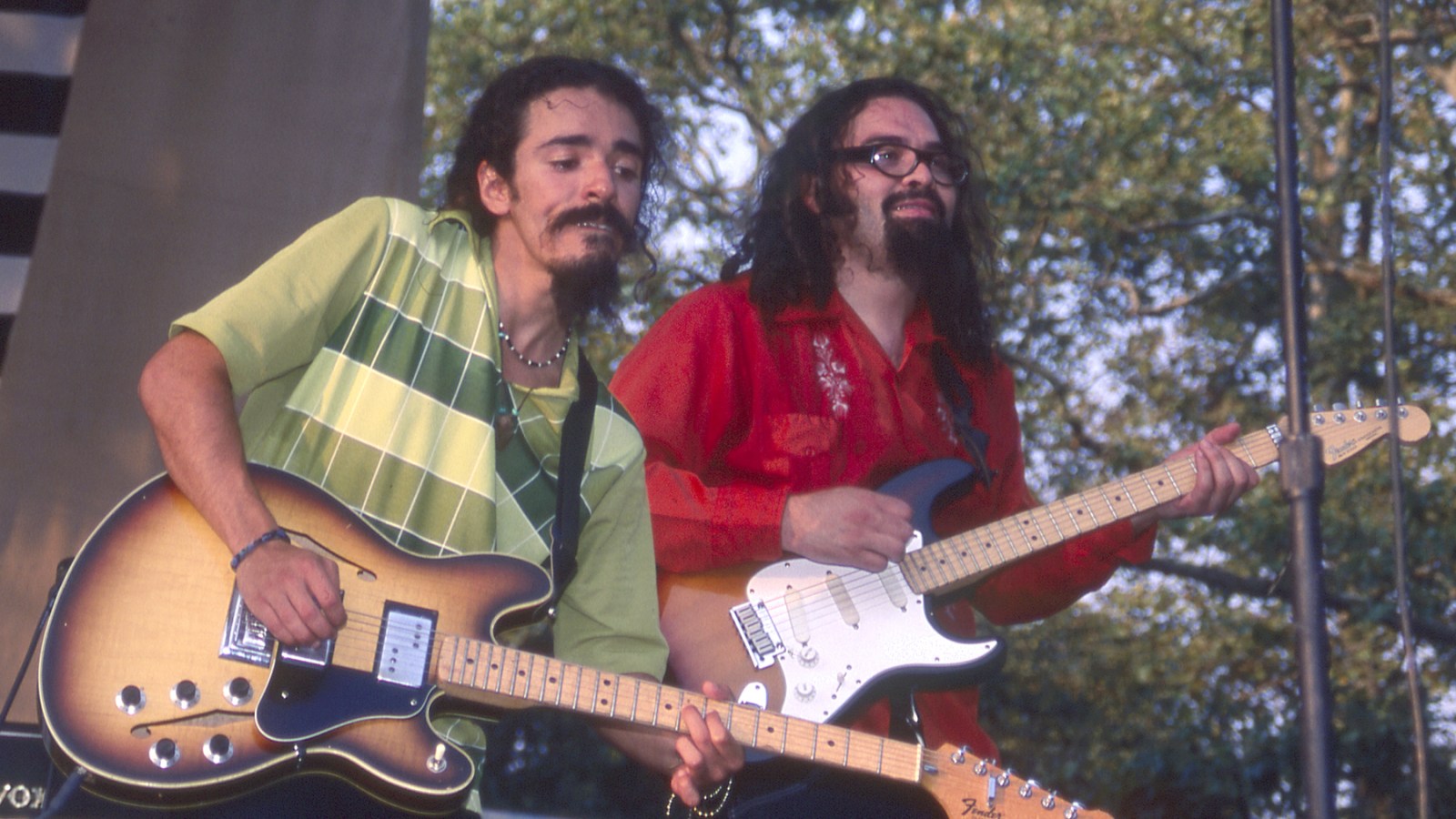
Avalancha de Éxitos was an album of reimagined Latin covers that invigorated the Mexican band — and expanded their fanbase Thirty years ago, the members of Café Tacvba found themselves physically and emotionally wiped out. The Mexico City quartet had completed an extensive tour promoting its sophomore effort, Re, which since then has been routinely hailed as one of the best albums in the history of Latin rock. To make matters worse, Tacvba’s label expected a new record, and the demos that the band had been taping between tours were far from ready to become a cohesive whole. Things got a bit tense. “We played the Viña del Mar festival in Chile, and our longtime producer Gustavo Santaolalla happened to be there,” remembers Tacvba keyboardist Meme del Real. “He saw what was happening to us. ‘You’re always playing covers of songs by other artists,’ he said. ‘Why don’t you make an EP of covers? That would get you back in the studio and working on a different frequency.’ He had the right perspective, and pointed us to a path of healing.” The result was Avalancha de Éxitos, a mini-album of radically reimagined songs that, experienced as a whole, sounds significantly more epic than the sum of its parts. Released on Nov. 5, 1996, it was not only commercially successful — five of its eight songs were released as singles — but it also made Tacvba stars in countries like Argentina, which had never embraced Mexican rock before. A brisk, exuberant record, it is also subtly conceptual, depicting Latin American culture as a chaotic, dissonant tapestry where beauty and depth can be found in a musty bolero from decades ago (“No Me Comprendes”), a melancholy pop ballad (Leo Dan’s wide-eyed “Cómo Te Extraño Mi Amor”), or a tropical anthem of hope transformed into son huasteco (Juan Luis Guerra’s socially alert “Ojalá Que Llueva Café.”) Tacvba’s sense of humor, playful and subversive, injected an adrenaline rush into provocative Mexican rock songs like opening stomper “Chilanga Banda,” with its indolent groove, and the industrial corrosion of “Alármala De Tos,” originally by Eighties troublemakers Botellita de Jerez. David Byrne guests on “No Controles,” an aggro inversion of the 1985 techno-pop hit by Mexican female group Flans (itself, a cover of Spanish band Olé Olé). Editor’s picks “I remember that record with so much affection,” says singer Rubén Albarrán from his home in Mexico City. “We were so inspired by the process of stepping out into the streets of the cities that we visited and discovering the spirit of Latin America. We were coming face to face with the realities that have become more obvious since then: the intervention of foreign countries; the genocide of our people. Our resistance was formulated by selecting ingredients from the blend of cultures and histories, and coming up with something new. We were deeply moved by discovering who we really were.” The same irreverence that Tacvba had exhibited on original songs like “La Ingrata” seeped into the Avalancha sessions. “We had the impudence not to give a damn about what the composers of the original songs may think,” laughs Albarrán, who fittingly chose the moniker of Anónimo for the project. “Perhaps they would even be offended.” “It’s so much easier to quote and unquote destroy a song if the author is not present,” adds del Real. “That was a big part of the fun — the element of adventure involved in every single arrangement. And it wasn’t like the songs were required to suffer a profound transformation. It was more like, ‘What would happen if we grab these songs and push them to the limit? What if we choke them so that they are forced to breathe again in a completely different context?’ We were really pushing the envelope.” Related Content “I think the fact they had created a work as imposing and sonically diverse as Re left them in a complicated position in terms of the follow-up album,” says Enrique Blanc, a Mexico-based music journalist and author of the book Café Tacvba — Bailando por nuestra cuenta. “Making Avalancha was like going into recess for them; a fun project echoing their beginnings as a band that played covers.” Originally, the group planned to record Duran Duran’s debut single “Planet Earth” (according to del Real, a demo still languishes in the vaults.) But Albarrán felt awkward singing the English lyrics, and the song selection remained Latin American throughout — a powerful statement in itself. “We have a different cultural context than Pink Floyd or Radiohead,” explains Albarrán. “We need to talk about other things that are more important to us and the people we share our lives with. Something happened with Avalancha, where the pristine sound quality achieved by Santaolalla and [co-producer] Aníbal Kerpel merged with our conscious decision not to copy anything from the Anglo mainstream. We have our own emotional world. It’s just as valuable as anyone else’s.” Interestingly, one of the album’s most haunting moments arrives during an obscure track: “No Me Comprendes,” a cabaret miniature by Cuban eccentric Bola de Nieve. Like most of Avalancha, it conjures up a stately, fetishistic atmosphere by combining psychedelic guitar with hand percussion and a musical saw. Toward the end, the tropical bolero suddenly morphs into a lilting bossa nova segment — almost as if the record itself chose to embrace the power of beauty over chaos and satire. “That’s one of my favorite Tacvba songs,” says Albarrán. “It’s such a gorgeous moment when that bossa bit blooms — it nourishes my heart and soul. The mocking undertone in my voice mirrors Bola de Nieve’s original interpretation. He was such a strange and uncomfortable character, and the song itself is difficult to pin down. The saw and the bossa segment — it’s like the sound of fairies, or the song of sirens.” “I remember putting on the headphones and recording my part on a grand piano,” adds del Real. He is in a hotel room in Querétaro, a few hours before stepping onstage for a concert presenting La Montaña Encendida, his debut solo album. “It felt like dining at an expensive restaurant in Paris — the kind of establishment you only get to visit once or twice in your life. I was having such a wonderful time playing, and I think my enjoyment can be heard on the final product.” It was the album’s closing track, “Cómo Te Extraño Mi Amor,” that became its biggest hit — a quintessential Tacvba moment. Whereas the Leo Dan original is fragile and wounded, Tacvba’s bouncy cover bursts out of the speakers with the shuffle of a ska beat and youthful Beatlesque confidence. “That’s Gustavo’s [Santaolalla] magic,” says Albarrán. “He captured that fleeting impression, how happy and young we were. We were experiencing success doing what we loved. It was just thrilling, and on this song you can hear the lightness in our step. It wasn’t only the music that we tackled with that kind of energy: so much laughter, and attitude, and desmadre. It was life itself.” Avalancha’s brilliance was acknowledged by both critics and the band’s fans the moment it was released. It was the record that everyone talked about as 1996 came to a close, and it generated another massive tour. Eventually, Tacvba returned to the demos of original material that had been pushed aside, and in 1999 released the stunning double album Revés/Yosoy. Still, Avalancha may well be the finest Latin covers album ever made. Trending Stories “I’m so proud of it,” says del Real. “Avalancha helped us realize how vulnerable we could be as a band. It defined our identity while helping us to recover from a few maladies we had picked up along their way. Once again, music and the creative process gave us the chance to rediscover why we remained together. Our group psychotherapy was commanded by a sense of adventure.” “It wasn’t just us,” Albarrán emphasizes. “We were part of a movement that was taking over Mexico and many other countries. There was Maldita Vecindad and Santa Sabina. We were all reformulating our roots with different results. Music was our medicine and refuge; the one place where we could find an answer for everything.”
‘Avalancha’ at 30: The LP That Recharged Cafe Tacvba After the Burnout of ‘Re’
Full Article
Original Source
Read the full article at Rollingstone →KhanList aggregates and links to publicly available news content. We do not host full articles from third-party sources. Always verify important information with original sources.