
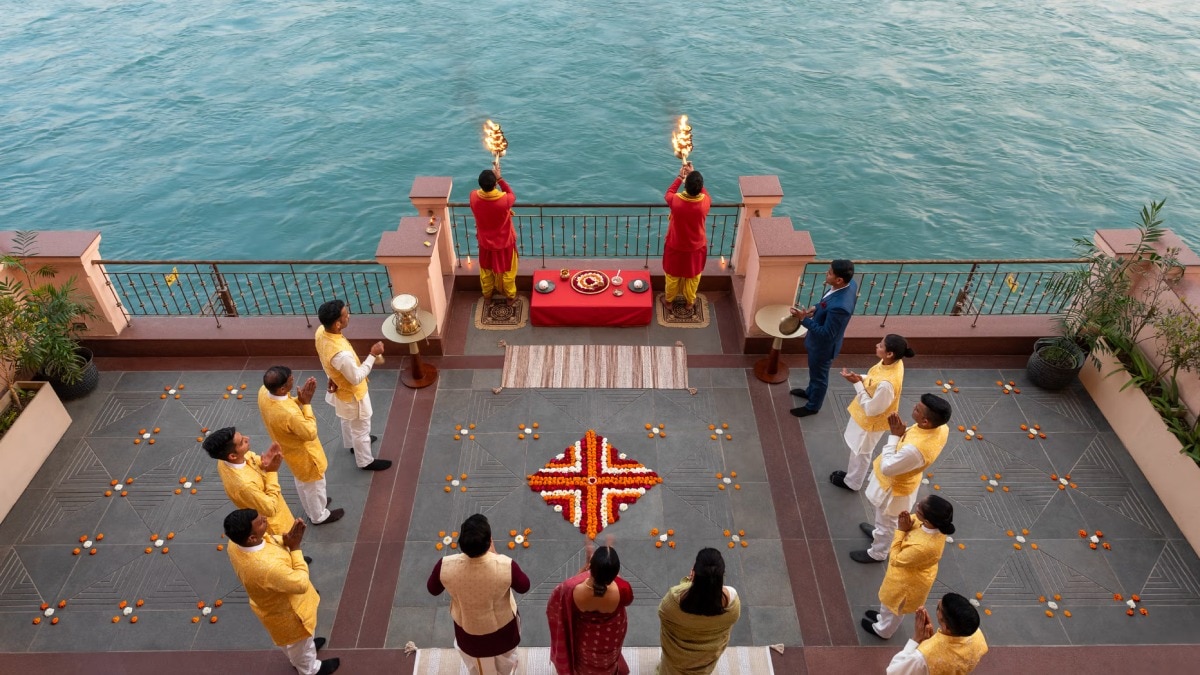
From Char Dham helicopter journeys to private Ganga Aarti and exclusive puja experiences, spirituality and pilgrimage now come soaked in luxury.Ganga Aarti at Hari Ganga Niwas, Haridwar - IHCL SeleQtionsThere was a time when going on a pilgrimage meant accepting the pilgrimage as it came: crowded trains, long queues, basic accommodation, shared meals and hours spent on the road.Now, the journey to the divine can come soaked in luxury.Want to visit Kedarnath without spending hours on the mountain trail? There is a helicopter for that. Want to complete the Char Dham circuit without spending days navigating Himalayan roads? Luxury helicopter itineraries can whisk travellers between Yamunotri, Gangotri, Kedarnath and Badrinath, pairing aerial transfers with premium hotels, ground assistance and priority darshan. Some 2026 packages are being sold at more than Rs 2 lakh per person. For Char Dham yatra, premium packages with helicopter begin start at around Rs 2 lakh per person. (Photo: MakeMyTrip) Want to experience the Ganga Aarti in Haridwar? You can still stand among the crowds at the ghat. But if you are willing to pay more, you can experience the river from a private setting, have the ritual arranged around your schedule and return to a luxury hotel rather than a modest pilgrim lodge. Want to spend an evening in devotion? A bhajan sandhya can be curated privately. Want to understand the history of a sacred city? A heritage expert can take you on a personalised ghat walk. Want to get a Navagraha puja done? A preist from a sacred city can perform that in a five-star property. Ganga aarti at VILEEN, Rishikesh. Moksha, it seems, has entered the premium segment.The luxury pilgrimage Affluent travellers want the rituals, temples, rivers and sacred landscapes - but without necessarily accepting the discomfort traditionally associated with reaching them.That is creating an unusual intersection of two worlds: ancient spiritual practices and contemporary luxury consumption.The result is what can be described as the moksha economy - a term mentioned in a Business Today story - an expanding ecosystem in which hotels, aviation companies, wellness retreats, travel designers, guides, restaurants and destination operators are building premium experiences around India's spiritual geography.The opportunity is large enough that hospitality companies are no longer simply putting hotels near temples. They are developing properties, brands and entire experiences specifically for spiritual destinations. A private Ganga ghat setting at The Pilibhit House, Haridwar. Look at where the hotel industry is putting its money.Ayodhya, Vrindavan, Tirupati, Rishikesh, Haridwar, Varanasi, Shirdi, Bodh Gaya and other sacred centres are increasingly appearing on the expansion maps of major hospitality companies.In Ayodhya, ITC Hotels signed a 143-key Welcomhotel in 2026, complete with a spa, swimming pool, fitness centre, restaurants. The Leela is developing a property on the banks of the Sarayu, close to the Shri Ram Janmabhoomi Temple, with plans to incorporate sunrise rituals and curated explorations of the city's traditions.Vrindavan is seeing the same phenomenon. IHCL has opened a 135-key Vivanta in the city, close to major temples and spiritual landmarks, with a spa, infinity pool, fitness centre and multiple dining and event spaces. The property provides guided tours for Yamuna aarti and even Gowshala visits.For decades, the hotel industry's natural habitat was the metro, the business district, the beach resort or the conventional leisure destination. Now, sacred geography itself is becoming a hospitality opportunity.A person travelling to Tirupati, Ayodhya or Vrindavan is not necessarily travelling only for darshan anymore. The temple may be the primary reason for the trip, but the journey can now include two nights at a premium hotel, regional cuisine, a heritage tour, wellness treatments and curated local experiences.The pilgrimage becomes the anchor for a larger holiday too.Paying to avoid the crowdPerhaps the most interesting product emerging from this trend is not extravagance but privacy.Take the Ganga Aarti.The ritual itself is ancient and public. But the premium version is about controlling everything around it.Instead of negotiating traffic, finding parking, navigating a crowded ghat and standing among hundreds of other visitors, a luxury traveller can have the experience arranged through the hotel. A private riverside setting, a dedicated transfer, an informed host and a carefully timed itinerary turn a public ritual into a more intimate encounter.The same logic applies to Haridwar's other experiences.A ghat walk can become a private cultural tour. A bhajan sandhya can become an intimate devotional evening. A temple visit can be arranged with personalised assistance. A havan or puja can be organised for a family rather than simply witnessed as part of a crowd.From VIP darshan to VIP everythingThe premiumisation of pilgrimage is not restricted to accommodation. There is now an entire menu of services designed to reduce friction from the spiritual journey. Helicopters are an example.In the Char Dham circuit, private and premium helicopter packages combine aerial travel with accommodation, ground coordination and priority temple access. Current 2026 offerings range from premium group packages to private charters costing well above Rs 2 lakh per person. Screenshot from MakeMyTrip. For some travellers, the helicopter is primarily about convenience: it replaces long mountain drives and strenuous trekking with a much faster journey. For others, the flight itself becomes part of the experience—crossing Himalayan valleys and approaching sacred peaks from the air.Across the spiritual tourism ecosystem, premium travel can now mean private cars, dedicated travel managers, priority assistance, customised itineraries, premium accommodation and curated access to local experiences.The pilgrimage is being professionally packaged.There is another reason hotel companies are moving aggressively into these markets: demand is becoming more resilient and more diverse.Pilgrimage is no longer confined to one demographic. Younger travellers are participating, affluent families are demanding better accommodation and older travellers are willing to spend more for comfort and convenience.India’s religious and spiritual market was worth around $70.14 billion in 2025 and is expected to almost double to $135.41 billion by 2034, growing at 7.58% a year.This growth is being driven by higher incomes, strong spiritual traditions, growing interest in wellness and mindfulness, better infrastructure at pilgrimage destinations, and government efforts to promote religious tourism.Meanwhile, affluent spiritual travellers are no longer choosing between devotion and comfort - they increasingly want both. They still want the temple, the Ganga Aarti, the pilgrimage, Ayurveda and the bhajan, but they may also want a chauffeur, a private riverside deck, a helicopter transfer, a personalised wellness programme or an intimate experience arranged for their family.And after all that, they want a beautiful room, a good meal, a spa and somewhere quiet to sleep.- EndsPublished By: Medha ChawlaPublished On: Aug 20, 2026 09:41 IST
Attaining moksha, but make it premium
Full Article
Original Source
Read the full article at Indiatoday →KhanList aggregates and links to publicly available news content. We do not host full articles from third-party sources. Always verify important information with original sources.