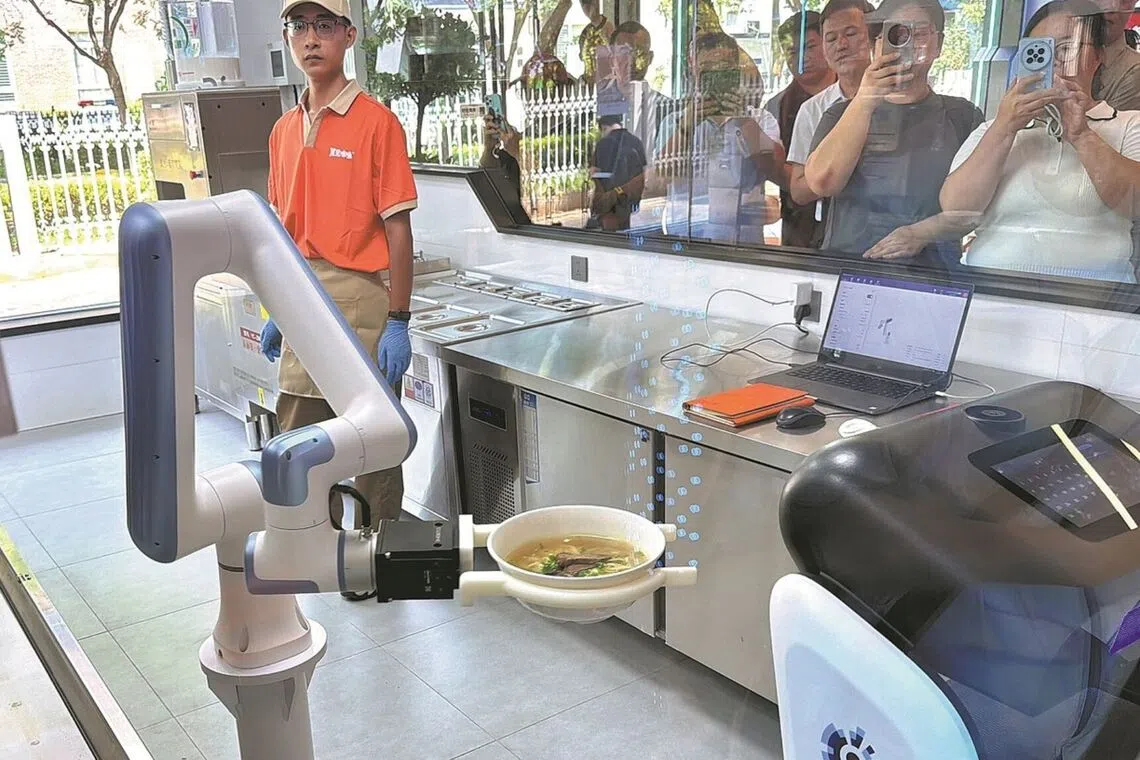
BEIJING – At a new robot noodle restaurant in Beijing, flour and water go into a machine and a steaming bowl of noodles arrives at the table just over three minutes later, with most of the work in between automated.The 400 sq m restaurant in Fengtai district began trial operations on Aug 14 and is expected to open more widely to the public later the same month. Its operator bills it as Beijing’s first fully commercialised robot noodle restaurant.What sets the restaurant apart is not any single machine, but the integration of previously independent processes into an end-to-end system designed for commercial operation, the operator said.Customers order by scanning a QR code at their table. An automated noodle-making machine mixes flour and water, then presses and cuts the dough within seconds. The noodles are cooked automatically before dispensers add sauce, broth and toppings. Robotic arms transfer the finished bowl onto a wheeled delivery robot, which takes it to the customer.Staff members are still needed to replenish ingredients, monitor equipment, prepare drinks and clear used tableware.The menu is deliberately simple for now, offering mushroom zhajiang noodles for 16 renminbi (S$3), and tomato beef brisket noodles and braised beef noodles for 19 renminbi each.The three options include both soup and mixed noodles and cater to different spice preferences, with more varieties planned.The equipment was designed and developed by Beijing Yuli Technology, which specialises in product development and pilot-scale manufacturing.Yang Haibin, the company’s deputy general manager, said some of the technologies had previously been used separately in noodle-making or cooking. Earlier applications often automated only part of the process or were mainly intended for demonstration, he said.“Customers can sit here, place an order and see the whole process – making the noodles, cooking them and having the finished bowl delivered to the table,” Yang said.The new restaurant is designed to bring those stages together for day-to-day operations and serve the wider public, he added.It also provides a real-world testing ground for technologies developed through Yuli Technology’s pilot-scale platform. The integrated system can be tested and refined in a consumer setting before moving toward mass production.Developing a reliable system took years of refinement. Yang said the noodle-making equipment had gone through five generations since development began around 2017, with engineers adjusting flour-to-water ratios, pressure, components and operating speeds to improve the noodles’ texture and consistency.Li Pengzhen, the company’s general manager, said hygiene and standardisation are two main advantages.“Automated equipment helps keep the production process clean, while standardised preparation helps keep the taste consistent from bowl to bowl,” Li said.Diners have a simpler measure of success.Tang Shuyan, a tourist from Hebei province, described her first visit to the robot noodle restaurant as “novel and high-tech”.Ye Tao, a Beijing resident who went with his daughter, said he could hardly tell the difference between the robot-made tomato beef brisket noodles and noodles made by human hands.The company is already testing the next stage: humanoid robots using embodied-intelligence technologies for tasks such as carrying items and collecting used dishes.The plans come as Beijing seeks to expand real-world applications of robotics and embodied intelligence. A 2025-27 action plan is promoting pilot validation and open testing platforms, with applications spanning research and education, industry and commerce, and personalised services.Robot applications are already visible elsewhere in the capital.In the summer of 2026, 72 robots and smart devices are being deployed across 14 municipal parks for tasks ranging from cleaning and patrols to visitor services and ecological monitoring.At Beijing Anzhen Hospital’s Tongzhou campus, robotic devices are used in a smart pharmacy system covering medicine storage, distribution, verification and dispensing.Back in Fengtai, the noodle shop offers a smaller-scale test of whether an increasingly integrated automated and robotic system can reliably deliver a bowl of noodles that people are willing to order, eat and pay for. CHINA DAILY/ASIA NEWS NETWORK
At this Beijing restaurant, robots make, cook your noodles and deliver them to your table
Full Article
Original Source
Read the full article at Straitstimes →KhanList aggregates and links to publicly available news content. We do not host full articles from third-party sources. Always verify important information with original sources.