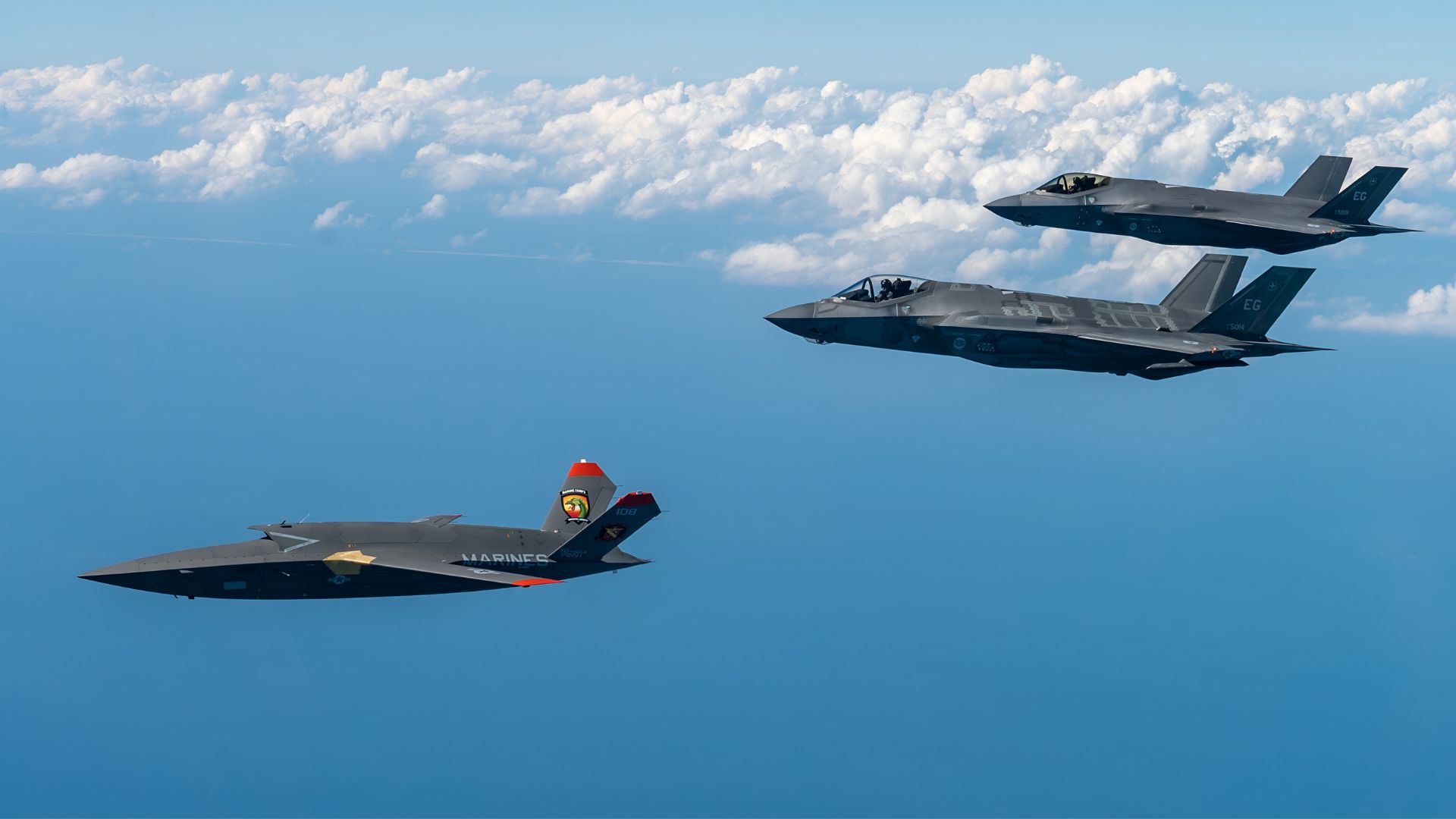
The US military is moving closer to a future where uncrewed aircraft operate alongside advanced fighters, extend their reach, and take on missions in heavily contested airspace. For the Marine Corps, that effort includes finding ways to connect autonomous aircraft with crewed F-35s and F/A-18s. Kratos Defense & Security Solutions has now demonstrated another piece of that concept with its missionized XQ-58A Valkyrie collaborative combat aircraft. During an April flight test in Southern California, the runway-independent drone tested electronic warfare capabilities and beyond-line-of-sight command and control alongside Marine Corps fighters. The aircraft launched from a zero-length launcher, connected with operators over a long-range datalink, and later transitioned between separate control systems during the mission. It also flew alongside multiple Marine Corps F-35s and an F/A-18 before autonomously returning to its recovery point. Testing long-range control The flight began with the Valkyrie launching without a conventional runway, using its zero-length launch system to get airborne. Once in flight, the aircraft validated and characterized its beyond-line-of-sight command-and-control connection. Control initially came through Kratos’ ground control station before the team transferred the aircraft to another interface developed by Autonodyne. That system complies with the Autonomy Government Reference Architecture, allowing a Marine Corps operator to control the Valkyrie over the BLOS datalink. The handoff demonstrated how operators could potentially use common interfaces to manage different autonomous systems instead of relying on proprietary control architectures. After completing the transition, the Valkyrie joined multiple F-35s and an F/A-18 for coordinated electronic warfare testing. Kratos said the aircraft achieved its planned objectives before autonomously flying back to its designated recovery location. The Expeditionary Maritime Aviation-Advanced Development Team led the integrated test effort. Marine Corps and Navy test squadrons participated alongside Kratos, Northrop Grumman, and Autonodyne. Expanding the Valkyrie’s role The Marine Corps has tested four different mission system configurations on its Valkyrie aircraft over the past three years. Each configuration has explored deeper integration between the air vehicle, its onboard systems, and communications links. Steve Fendley, president of Kratos’ Unmanned Systems Division, said the platform’s open architecture could speed the integration of new mission capabilities. “The Valkyrie team continues to pave the way and demonstrate critical unmanned technologies,” Fendley said, pointing to their potential use in contested environments. Kratos has also expanded production to support growing interest in large, jet-powered drones. The company expects to produce more than 150 Group 5 unmanned aircraft systems during 2026 and plans to scale Valkyrie production toward roughly 40 aircraft annually. Prototype arrives this summer The electronic warfare test comes months after the Marine Corps selected Northrop Grumman and Kratos for its MUX TACAIR Collaborative Combat Aircraft program. The two companies plan to adapt the Valkyrie into a missionized aircraft that combines Northrop Grumman’s mission systems with open-architecture autonomy software. Their approach relies on an existing airframe, potentially giving the Marine Corps a faster route toward an operational collaborative combat aircraft. The first MUX TACAIR Valkyrie prototype remains scheduled for completion during summer 2026. Get the latest in engineering, tech, space & science - delivered daily to your inbox.Aamir is a seasoned tech journalist with experience at Exhibit Magazine, Republic World, and PR Newswire. With a deep love for all things tech and science, he has spent years decoding the latest innovations and exploring how they shape industries, lifestyles, and the future of humanity.
Runway-free autonomous Valkyrie drone flies alongside 1,200-mph F-35 stealth jets
Full Article
Original Source
Read the full article at Interestingengineering →KhanList aggregates and links to publicly available news content. We do not host full articles from third-party sources. Always verify important information with original sources.