
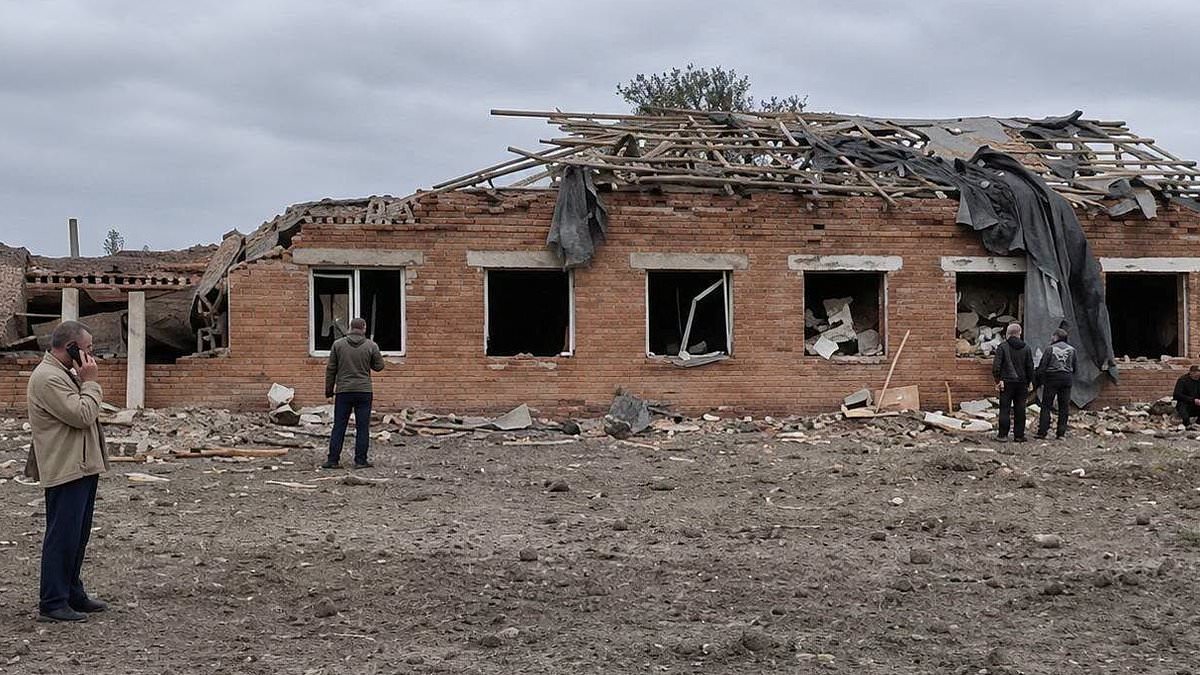
Twenty-four people are believed to be dead after Russia bombed a humanitarian aid centre in Ukraine.The attacks were carried out in the village of Komyshuvakha in the southern Zaporizhzhia region, with two members of a rescue crew among those killed.Ukrainian President Volodymyr Zelenskyy said in a post on X that ten guided bombs targeted an area that included a school building used to distribute aid and a nearby shelter.Mr Zelenskyy claimed: 'This is further proof that Russia wants no de-escalation.'The attacks occurred as a limited ceasefire expired on Monday in Kherson, a different region in the country's south. The limited ceasefire agreement had allowed humanitarian aid and evacuation missions into front-line areas in Russian-occupied territory.'There was a moment when the next steps could have shown that progress toward peace was possible,' Mr Zelenskyy said. 'With these killings, Russia is sending an entirely opposite signal: Russia is counting on more killings.'As night fell in Komyshuvakha, emergency responders used flashlights to search through the rubble of collapsed buildings, according to photos and video posted online by local officials. About 20 people are considered missing and the death toll could rise, officials say.In other areas of Ukraine, authorities reported multiple Russian drone attacks that injured at least 17 people. Residents stand at the site of an underground shelter in a compound of a local school which was used as a humanitarian aid hub and was hit by a Russian air strike Rescuers carry the body of a person killed by a Russian airstrike inside an underground shelter at a compound in KomyshuvakhaEarlier, residents of Ukraine and Russia had received bogus emergency alerts from government-run mobile apps that were hacked, authorities in both countries said. The phony alerts in Ukraine included a warning about an imminent nuclear threat.It was not clear if the cyber attacks late on Sunday in Ukraine and early Monday in Russia were related. Ukraine said its mobile app, which residents rely on to seek safety from Russian missile and drone strikes, was up and running again after being temporarily suspended. Russian authorities said efforts to restore its emergency alert mobile app were ongoing.A Russian Telegram channel with links to the country's security services said on Monday that a hacking group, Hitcore, claimed responsibility for the breach of the Ukrainian emergency alert system. The identities, affiliations or motivations of the purported hackers remain unclear.The alerts received by Ukrainians – making false claims of high radiation levels, a chemical threat and public disturbances in Kyiv – were written in English, Russian and Ukrainian. The English language alerts contained spelling and grammatical errors.One of the messages, written in Russian, said: 'Hi! There will be a nuclear threat across Ukraine. Do not worry, the Oreshnik is incoming,' a reference to a Russian ballistic missile.There was little indication the fake alerts caused panic in Ukraine. Instead, there was a flood of humorous posts online, with social media users sharing photos of their pets relaxing and apocalypse-themed images generated by artificial intelligence. A photo shared of Kyiv Mayor Vitali Klitschko, a former international kickboxing champion, included the message: 'It's a good thing we have a boxer for a mayor.'In a Telegram post late on Sunday following the breach, Ukraine's air raid alert channel said 'unauthorized parties' had interfered with the app's operation and warned users not to click on links in 'suspicious notifications'. Smoke rises over an underground shelter at a compound of a local school, which was used as a humanitarian aid hub and was hit by a Russian airstrikeUkraine's state-run Center for Countering Disinformation urged people to monitor other emergency channels on social media while the cyber attack was being addressed.Ukraine's air force commander, Anatolii Kryvonozhko, said in a television interview that the cyber attack had no impact on Ukraine's security and defence operations.In a statement, Russia's Emergency Situations Ministry said hackers sent a false alert through its app at approximately 2.45am Moscow time on Monday across 33 of Russia's 89 regions. It did not say who it believed carried out the attack.The ministry said the digital vulnerability exploited by the attackers had been identified and that 'necessary measures' were being taken to prevent a similar breach. It also reassured Russians that the wider public alert system was working normally through SMS messages, media broadcasts and municipal sirens and loudspeakers.Kremlin spokesman Dmitry Peskov said all of Russia's state agencies were under the constant threat of cyber attacks, including a growing number that use artificial intelligence.'All government bodies must take steps to improve the cybersecurity of our digital resources,' Mr Peskov said.As the ceasefire in Ukraine's Kherson region came to an end on Monday, Ukraine's general staff said Russia's military had used the pause in fighting to bolster its drone defences and replenish ammunition supplies.The brief pause in fighting, which began on October 27, was part of a humanitarian aid and evacuation mission in the Russian-occupied city of Oleshky, and marked the most significant truce between Kyiv and Moscow since Russia's full-scale invasion began nearly five years ago.Speaking to reporters in Kyiv on Monday – before the deadly bombings in the Zaporizhzhia region – Ukraine's ombudsman and lead civilian negotiator for the mission, Dmytro Lubinets, said he hoped the localised ceasefire and evacuation would act as a 'model' for other such efforts.Elsewhere in Ukraine, emergency services reported drone strikes injured 12 people in the eastern Kharkiv region and damaged a refrigeration facility, greenhouses and residential buildings.Five people were also reported injured in the Black Sea port city of Odesa, where a warehouse was targeted and homes were damaged.Russia's Ministry of Defense said on Monday it shot down 212 Ukrainian drones overnight. The head of Russia's Samara region, Governor Vyacheslav Fedorishchev, said in a statement that local air defences were repelling an aerial attack, but did not give further details.Independent Russian media outlets later reported that Ukrainian drones had targeted one of Europe's largest oil transport hubs in Samara.
At least 24 are dead after Russia repeatedly bombs a school and humanitarian centre in Ukraine
Full Article
Original Source
Read the full article at Dailymail →KhanList aggregates and links to publicly available news content. We do not host full articles from third-party sources. Always verify important information with original sources.