
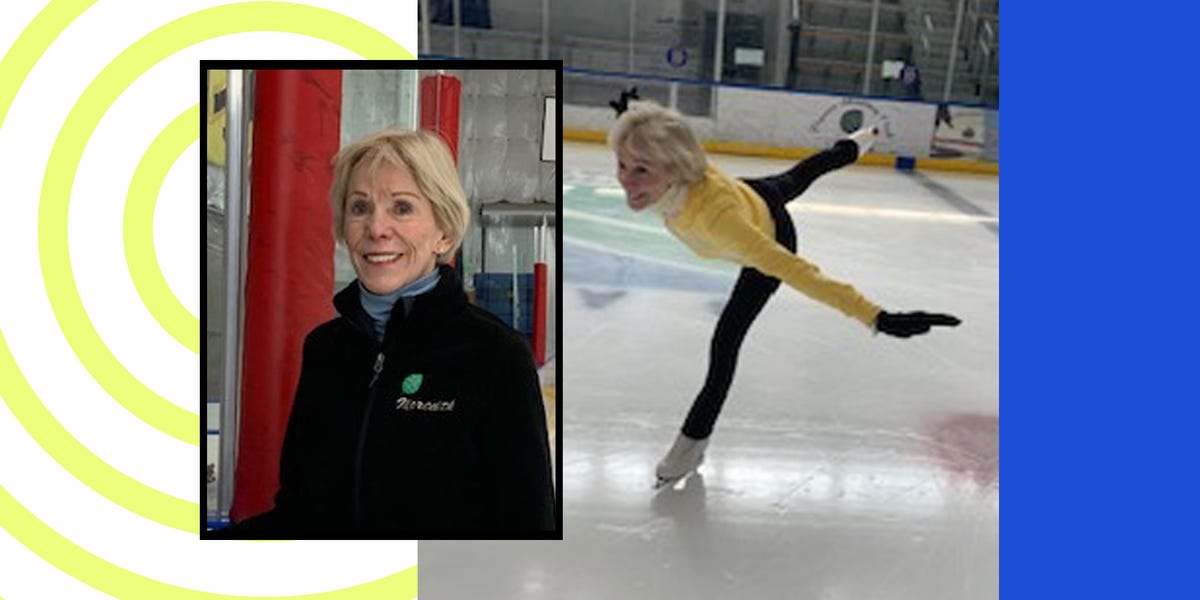
6 min readWhen people hear that I’m an 86-year-old figure skater, they usually stop and stare for a second. Then come the questions: “You really skate? You really jump? You really put on a leotard and perform?” Yes, I do. What surprises people even more is that it’s a sport I returned to at 78 after nearly six decades away from the ice.Growing up, I loved being active and challenging myself, whether I was running track or riding horses. But figure skating was the sport that truly captured my heart, and throughout my teens and early 20s, I competed around the world. Unfortunately, though, shortly after I turned 24, I was diagnosed with myasthenia gravis, an autoimmune disease that weakens the muscles, and everything changed. Suddenly, I couldn’t jump, spin, or lift my arms, and I no longer had the strength or energy to skate. There is no cure for myasthenia gravis, but it is possible to go into remission, and my doctor encouraged me to take medication and rest so my symptoms could improve. My care team also encouraged me to step away from intense exercise, so I had no choice but to hang up my skates, and I was crushed.Throughout the decades, I missed skating, but I found new ways to stay active that felt good. I walked, jogged, and skied, and I worked with a personal trainer on and off for years to help improve my strength and balance as I aged. At 78, I saw a new doctor for my myasthenia gravis after I moved to a different town, and he told me the news I never thought I’d hear: I was in remission, so the disease was no longer active in my body. I was shocked, but so happy and relieved. Almost immediately, I knew I wanted to return to the ice. Figure skating had always been where I felt the most free and confident, and I couldn’t wait to experience that feeling again.So, I found a local coach who could help me return to the sport safely, and began taking lessons two to three times a week. To start, we focused on rebuilding the fundamentals—balance on the ice, edge work (the way you use the blade to cut into the ice and glide through curving movements), and simply regaining confidence. Being back on the ice was amazing, but the coolest part was how much technique and skill came back through muscle memory after 55 years. Aside from skating, I still walked and jogged for extra movement.Practice after practice, my balance improved and I felt strong, pain-free, and had no muscle weakness. I was also happier than ever and being back on the ice gave me a renewed sense of confidence and joy. Within about a month, I was even jumping and spinning again. Were the jumps beautiful? Absolutely not. Were my spins perfect? Not even close. But at 78, I was back on the ice and having the time of my life. I decided that as long as my body felt strong, I wanted to keep practicing, progressing, and discovering what I was still capable of achieving.Today, at 86, I train five days a week with a mix of skating, cardiovascular work, and strength training.My goal with training is to have fun, stay strong, and be safe. I recently moved cities and now train with a new coach three to four times a week. Before I lace up my skates, I warm up with mobility exercises like hip circles, ankle rolls, and leg swings to loosen my joints, followed by plyometric drills (jumping exercises) such as squat jumps and bunny hops to activate my muscles. I also jog a few laps around the outside perimeter of the rink to get my blood flowing.Then, on the ice, we work on technique and skill development. Some sessions are dedicated to edge work, while others are spent working on more advanced elements like jumps and spins. That said, I’ve learned that progress isn’t about forcing something before you’re ready; it’s about building a strong foundation, trusting your body, and focusing on growth over perfection. If a jump or spin doesn’t feel quite right, my coach and I go back to the basics. We slow things down, checking my posture or breaking the movement into smaller pieces until it feels solid.Off the ice, I run on the treadmill three to four days a week to maintain my cardiovascular endurance. I love interval training, so I alternate one minute of running with two minutes of walking for four or five rounds. I also do simple strength training exercises almost every day to keep my lower legs strong, including calf raises and walking forward and backward on my tiptoes while wearing ankle weights. Those movements strengthen my ankles, calves, and tendons, helping me stay stable and confident every time I step onto the ice.These three factors are key to my athletic success:1. I work with coaches who believe in my potential. When I decided to return to skating after over five decades, I knew I needed more than someone just to re-teach technique—I needed a coach who believed in me. I wasn’t looking for someone to lower their expectations because of my age or focus only on what I shouldn’t do. I wanted someone who would challenge me while putting my safety first. I’m fortunate to have found exactly that.Since returning to the ice, I’ve worked with three amazing coaches who have encouraged me every step of the way. They’ve celebrated my progress, pushed me when I was ready, and helped me build the confidence to try skills I never thought I’d do again. Having people who see possibility instead of limitation has made all the difference and I’m so thankful for my team.2. I listen to my body. Figure skating takes an incredible amount of physical and mental strength, and at 86, one of the most important things I’ve learned is to respect what my body is telling me. That means consciously paying attention to how I feel each day and knowing when to push, make an adjustment, or take a step back. If I’m steady and strong when I step on the ice, I’ll challenge myself with jumps or spins. If something feels off, I slow down and go back to basics.I’ve also learned not to compare today’s performance to yesterday’s. Every time I’m on the ice is a new opportunity, and I remind myself that consistency matters more than perfection. Focusing on what my body can do helps me stay positive, and trusting my body enough to give it grace has allowed me to keep challenging myself while staying healthy enough to do what I love.3. I refuse to let age define what I’m capable of.People often tell me, “I can’t believe you’re still skating at 86,” but the truth is, I don’t spend much time thinking about my age. Instead, I think about how I feel when I step onto the ice, the excitement of landing a jump I’ve been practicing, and the joy of continuing to challenge myself and improve. Over the years, aging has taught me to be patient, consistent, and grateful for what my body can do. It has also reminded me that our abilities are not defined by a number. My jumps aren’t as high and my spins aren’t as fast as they were in my 20s, but that’s okay (and normal!). Instead of dwelling on what’s different, I celebrate what’s still possible.If there’s one thing I hope people take away from my story, it’s that growing older doesn’t mean giving up on the things that bring you joy. Age doesn’t have to be the reason you stop doing what you love—or the reason you don’t start again.Find the Perfect Women’s Health Training Program for YouJustin SteeleRona Ahdout//Hearst OwnedAndi Breitowich is a freelance writer who covers health, fitness, relationships, beauty, and smart living. She is a graduate of Emory University and Northwestern University's Medill School of Journalism. Her work has appeared in Women's Health, POPSUGAR, Food & Wine, What To Expect, Cosmopolitan, Men's Health, and elsewhere. As a former collegiate pole vaulter, she loves all things fitness and has yet to meet a group workout class she doesn't like.
‘At 86, I Regularly Skate, Strength Train, and Do Cardio. Here’s How I Maintain Longevity With My Workout Routine'
Full Article
Original Source
Read the full article at Womenshealthmag →KhanList aggregates and links to publicly available news content. We do not host full articles from third-party sources. Always verify important information with original sources.