
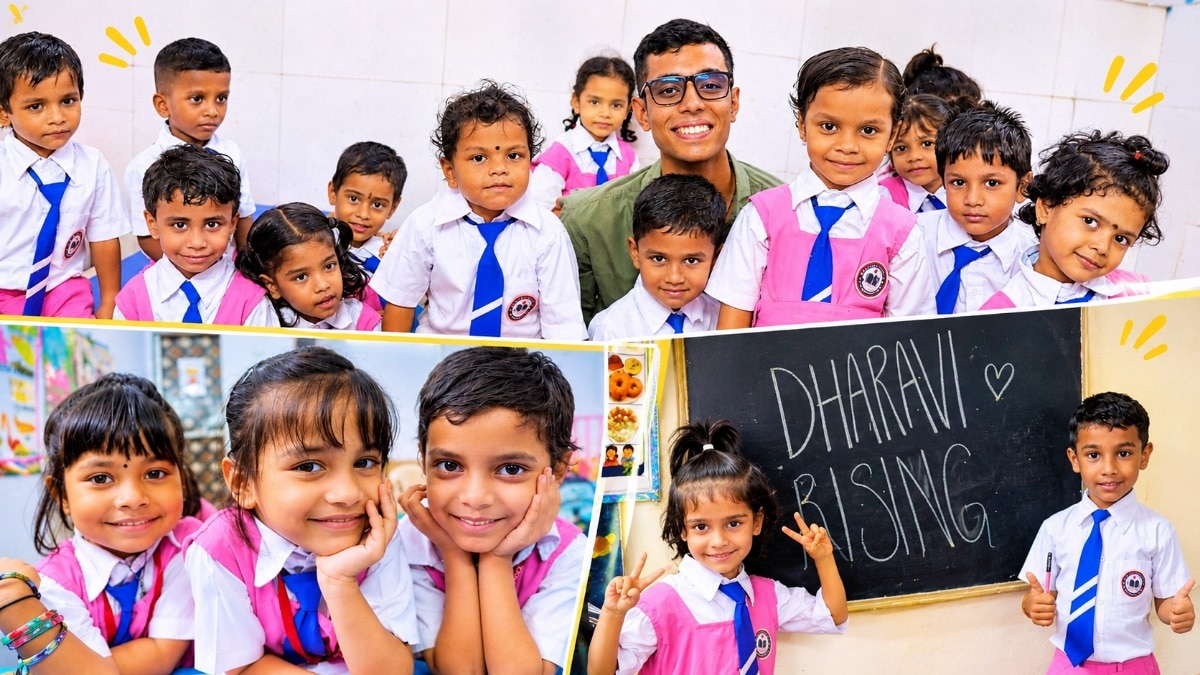
"I want to change the title of Asia's largest slum to Asia's largest educational capital," says 20-year-old Daniel Gupta about Dharavi, a neighbourhood where millions of dreams compete for space in some of Mumbai's most densely packed lanes, and where the idea of turning a slum into an educational destination sounds almost unimaginable.There was a time when all he wanted was to become a YouTuber. Views, videos and the excitement of creating content were what the young Mumbai college student had in mind. Little did he know that an attempt to get people to watch his videos would eventually take him in a completely different direction.Today, through his initiative, Dharavi Rising, Daniel is working towards a dream that he hopes will change how people look at the neighbourhood. He wants to make education a bigger part of Dharavi's identity, with an ambition to create 100 schools like New Life School across Mumbai.A third-year Advertising student at Mumbai University, Daniel enjoys designing, painting and creating things. He lives in Santa Cruz, Mumbai, and divides his days between college, studies and Dharavi Rising. Daniel with school kids He has already helped raise Rs 22 lakh for New Life School in Dharavi, opened an additional branch with the funds and is now trying to raise Rs 1.5 crore to secure land for the school.But Daniel's ambition goes much further than helping one institution. He hopes that one day, people will travel to Dharavi not to look at its crowded homes, but to study there. It is a staggering dream for someone who admits that he had absolutely no experience of fundraising or social work when he started. But then, Dharavi Rising was never part of his original plan.A YOUTUBE DREAM THAT TOOK AN UNEXPECTED TURNHis journey began with a rather unusual experiment. Wanting to make videos that would attract viewers, Daniel started approaching strangers and asking them for small amounts of money. On his first day, he collected Rs 100. He tried the idea in Bandra and then Juhu, but soon realised that people were hesitant to contribute without knowing where their money would go."People need a reason why they are giving money," he recalls.That was when Daniel and his friends decided to give the exercise a purpose. They would collect small contributions and use the money to help people in need. One of their first efforts was at Juhu Beach, where they distributed mini samosas to people."When I was returning home from Juhu, I was thinking that if, in two hours, I was able to help so many people, then if I put more time into another project, how many more people would I be able to help?" he says.That question eventually led him to Dharavi Rising.THE CHILDREN WHO MADE HIS FUNDRAISING PERSONALDaniel began looking for an organisation or institution that needed financial support. He had no experience of running an NGO, did not know how fundraising worked and was unsure where to begin.Then he remembered that his friend's family was associated with a school in Dharavi. His friend's grandmother, K P Rajans, had co-founded New Life School with Dr Susai Joseph, who had himself experienced hardship growing up in the neighbourhood.Daniel knew about the school but had never visited it or worked with it. He decided to approach its administrator, his friend's father, with an idea.At first, he was thinking of raising Rs 5 lakh. Then he considered Rs 10 lakh. But the administrator had a bigger figure in mind.“I went and met him. He said that we need Rs 20 lakh. I thought, okay, done. That's how much you need. That's how much I'll try to give you,” Daniel recalls.The money was meant to help New Life School expand and take quality education to more children in Dharavi. The first campaign eventually raised Rs 22 lakh, exceeding its target.“We wanted to raise Rs 20 lakh, and we were able to raise Rs 22 lakh,” he says.The funds were meant to cover the rent for two additional locations for a year, teachers' salaries and other running expenses. One additional branch has already been rented and started functioning. The search for a suitable space for the second is still underway.“ You have to look for certain facilities that the place has. If there is no washroom, how can we make it a new school?” Daniel says, explaining why finding the right premises in Dharavi can take time.Across its branches, the school now serves around 560 children.For a young college student who had started out looking for YouTube views, the experience had turned into something much bigger. And for Daniel, the impact of the campaign cannot be measured only by the money raised.He recalls hearing about a boy who had stopped attending school. When teachers visited his home to understand why, they learnt that his mother had cancer and the family was going through a difficult time.“The teachers urged them, ‘You send the child, we'll take care of him’,” he says.New Life School charges a nominal fee, but children whose families cannot afford it can receive full sponsorship. Others are offered reduced fees depending on their financial circumstances.“There are many children whom they completely give free sponsorship based on their financial capability. If you are not able to pay, that's completely fine. You will get free sponsorship,” Daniel says.He also remembers visiting a student's home during the first fundraising campaign. The living room, kitchen and bathroom were all part of the same tiny space.“The kitchen is in the same room, the hall is in the same room, the bathroom is in the same room. There's no way you can do anything,” he says. “And the house we went to was relatively better than the other homes in Dharavi.”These encounters have made the need for accessible education more personal for him. He does not want a child's financial circumstances to decide how far they can go.WHY A SCHOOL NEEDS MORE THAN FOUR WALLSThe next challenge, however, is considerably larger.Dharavi Rising is now attempting to raise Rs 1.5 crore to secure land for New Life School. Unlike the previous campaign, which covered rent, teacher salaries and other expenses for two locations, the entire amount being sought this time is for land."The Rs 1.5 crore that we are trying to raise goes to nothing else but the land," he explains.The reason is tied to the school's future. New Life School has been operating as a preschool for around 40 years, offering nursery, playgroup, junior and senior kindergarten. However, the lack of land ownership has been a major hurdle in its efforts to obtain the necessary permissions to expand into higher classes.For him, securing land is therefore not simply about having a permanent building. It could open the door to taking the school beyond preschool education and allowing children to continue studying at the same institution.At the time of the interview, the campaign was still Rs 1.45 crore short of its target, with around 47 days remaining.He knows the challenge is substantial. But he believes that the school needs more than another rented space if it is to grow. For him, the campaign is about ensuring that children do not have to leave the institution after kindergarten and start looking for another school to continue their education.'WE DON'T WANT TO RAISE BUILDINGS, WE WANT TO RAISE PEOPLE'S LIVES'There is another reason Daniel feels so strongly about changing Dharavi's image. He is uncomfortable with the way the neighbourhood is often presented to outsiders.Dharavi is frequently associated with its cramped houses, difficult living conditions and poverty. It also attracts tourists, including visitors from overseas, who come to see the neighbourhood and its settlements.Daniel questions what it must feel like for residents to have strangers walking past their homes and looking inside."Imagine I am in one of those houses, helping my mother wash clothes, and suddenly I see tourists passing my house and looking at me. Doesn't that make you feel like you are in a zoo?" he asks.He believes such experiences can make residents feel inferior and affect their confidence."People living there are also just like you and me. Why should they feel like they are being displayed for someone to look at?"For him, Dharavi's identity cannot be reduced to its buildings or living conditions. It is the people who make a neighbourhood, and their opportunities matter just as much as its infrastructure."There is so much hope in Dharavi. There is so much of hope. Just come to the school now, and you will see a glimmer in the eyes of the children. What can they not do if they are guided properly?" he says."We don't want to just build infrastructure in Dharavi. We want to raise people's lives," he adds.His long-term ambition captures this thinking. He wants to change Dharavi's association with being Asia's largest slum and replace it with a very different identity."I want to change the title of Asia's largest slum to Asia's largest educational capital," he says.He even hopes that one day people from outside India will travel to Dharavi to study, rather than simply visit it as tourists.A COLLEGE STUDENT WITH A CRORE-RUPEE DREAMDaniel's days are divided between college work and Dharavi Rising. He is a morning person and prefers finishing his studies early so that he can devote the rest of his time to the initiative. His Advertising course has also helped him in some ways, particularly because the work involves creating, communicating and putting ideas into practice.He says he can spend five to six hours working on the initiative during his current study schedule, though his earlier workdays could stretch to eight or nine hours.His parents have been supportive of his decision to take up the initiative, even at a stage when most students are focused on building their careers. Daniel has also started a small informal gathering called 'The Garden', where he and his friends meet on their building terrace to discuss different topics and exchange viewpoints.The closely involved Dharavi Rising team currently has around four college students, with other volunteers joining them from time to time. Daniel is clear that the initiative should not depend on him alone.His immediate ambition is to have a voice in Dharavi's redevelopment process. He hopes his team can contribute to aspects such as education and the welfare of residents. But his larger ambition remains the same: a neighbourhood known for its schools, its students and the opportunities it offers.The initiative itself is still small, with around four college students working closely together and other volunteers joining whenever they can. But he believes it has grown beyond him."Even with or without me, one thing is for sure: this is not going to end," he says."I want people from outside India to come and study in Dharavi," he adds.For now, the focus remains on New Life School and the Rs 1.5 crore land campaign. But his ambitions extend to healthcare as well, which he sees, alongside education, as an important area needing attention.He once started collecting money because he wanted people to watch his videos. Today, he is trying to get people to look at Dharavi differently.And perhaps the biggest change he wants to bring about is not just in the buildings that come up there, but in what children growing up in the neighbourhood believe they can become.- Ends
At 20, he wants to turn Dharavi from Asia's largest slum into an education hub
Full Article
Original Source
Read the full article at Indiatoday →KhanList aggregates and links to publicly available news content. We do not host full articles from third-party sources. Always verify important information with original sources.