
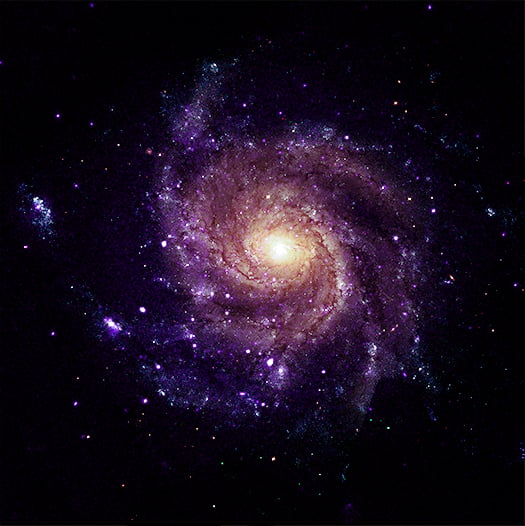
X-rays showcase some of the most unique astronomical objects in the universe. Neutron stars and black holes siphoning gas from companion stars stick out like sore thumbs at this level of radiation. However, according to a new paper by Mustafa Muhibullah and Jimmy Irwin from the University of Alabama and Rosanne Di Stefano from the Center for Astrophysics at Harvard & the Smithsonian, there appears to be another group of ultra-bright X-ray emitters that we’ve completely missed until now. They call them Hypersoft X-ray Sources (HSSs) and, according to a press release accompanying the paper, might answer two long-standing astronomical questions. First, let’s define what makes an object an HSS. X-rays are the highest energy types of photons in the universe, and range between a few hundred electron volts (eVs - the standard measurement of a photon’s energy in astronomy) up to a few thousand. Right below them in the energy range are the Extreme Ultra-Violet (EUV) photons, which range between 13.6 eV and 124 eV. Finding EUV objects in the universe is notoriously tricky, since the neutral hydrogen and helium that permeates the interstellar and intergalactic medium absorbs those photons extremely efficiently - making it very rare for any to make their way to Earth. However, an object that shines brightly in that spectrum will usually produce a “tail” of photons that extends into the “soft” part of the X-ray spectrum - i.e. the lowest energy (or “hypersoft”) form of X-rays. When looking at data from NASA’s Chandra X-Ray Observatory, which has been in operation for more than 20 years, the team set a series of criteria that they define as characteristics of HSSs - they must be observable between 150 and 300 eV, with basically no emission above that energy level, and they must produce 8 photons in the “soft” (i.e. low energy) end of the X-ray spectrum for every one they produce in the “hard” end. When they looked at six nearby galaxies, including Andromeda and the Pinwheel Galaxy, the team found 84 distinct HSSs - an extremely high number of extremely bright objects. YouTube video from Chandra explaining the paper. Credit - Chandra X-ray Observatory YouTube Channel So an obvious question is - if these sources are so bright, why are we just finding them now? Chandra has been operating for more than twenty years, surely someone had scoured the data for these objects by now. The answer has to do with a technique most research groups use to make their own data analysis easier. Calibration isn’t much talked about in the press releases announcing astronomical discoveries, but it is a critical part of any data analysis. And calibrating a telescope to accurately collect low-energy X-ray data is notoriously difficult. Therefore, most research groups simply filter out energies below 300 eV to make sure the eliminate background noise in their data set. To make matters worse, Chandra itself has slowly been losing sensitivity at that energy level. Outgassing from the telescope itself has coated the cold optical filters of the ACIS camera, forming a contaminant layer that filters out soft X-rays. By using the steady glow from galaxy cluster Abell 1795, the authors showed that Chandra’s sensitivity in that energy band had fallen below 20% of its initial capability by 2017. As such, they simply used datasets from before that time to ensure their data remained accurate. Fraser talks about the different types of supernovae Calculating the energy one of these objects is outputting results in some astonishing numbers. In the soft X-ray energy band alone, they are outputting tens of thousands to hundreds of thousands times the energy of what the Sun does for its entire spectrum. Extrapolating out what their total output is, which involves using a type of “bolometric correction” to account for the hidden EUV light that doesn’t reach Earth, the brightest of these objects reach energy levels rivaling levels of ultraluminous X-ray sources, and rank among the brightest non-explosive objects in galaxies that lack active central supermassive black holes or intense starbursts. According to the authors, these extremely bright sources could be powered by three potential processes. First, they note that at least some of them align perfectly with where we already know a nova has happened, especially in Andromeda. After a white dwarf blows off its outlet layers, the hydrogen burning it experiences gradually shuts down, cooling through a temporary “hypersoft” phase. Second, a white dwarf can pull material from a companion star, expanding its photosphere, and shifting its light into the EUV and hypersoft X-ray bands. But for the higher energy HSSs, it's likely a stellar- or intermediate-mass black hole that is surrounded by a cooler accretion disk that would cause these extremely bright objects. Fraser explains what happens in a Type Ia supernovae No matter the source, according to the authors, these objects could potentially help answer two cosmic mysteries. The first is where Type Ia supernovae come from. These stellar explosions serve as “standard candles” for measuring how far away an object is, however we have never truly found the stars that explode into this particular type of supernovae. According to the paper, there should be a population of soft X-ray stars that could serve as the progenitors of this type of supernovae, but previous surveys had come up orders of magnitude short on their population levels. The new work suggests maybe they are hiding in plain sight in the hypersoft and EUV bands. The second mystery is that of interstellar helium ionization. While the helium blocks many types of EUVs, they still irradiate out in different energy bands. However, scientists have noted that they do so with much more energy than would be expected from the types of stars typically thought to have energized them. HSSs could provide that missing energy, especially if their energy peaks concentrate around the 15-25 eV range that the helium absorbs most effectively. Even if HSSs aren’t the answer to those two mysteries, this paper is a showcase in how decade old data can still hold surprises when analyzed in new ways. It will be a little while before we get a successor for Chandra that could provide even more insight into these newly discovered luminous sources, but at least for now, maybe it's worth taking a closer second look at the data the venerable telescope has already collected. Learn More: Chandra - NASA's Chandra Unveils Mysterious X-ray Objects M. Muhibullah, J.A. Irwin & R. Di Stefano - Hypersoft X-ray Sources as a Low-Energy Class of Luminous Cosmic Emitters UT - Astronomers Using Chandra Data Produce the Most Detailed View of the M87 Jet in X-rays UT - Chandra's X-ray Vision Combined With JWST Reveals Even More Details About the Universe
Astronomers Uncover "Hypersoft" X-ray Sources
Full Article
Original Source
Read the full article at Universetoday →KhanList aggregates and links to publicly available news content. We do not host full articles from third-party sources. Always verify important information with original sources.