
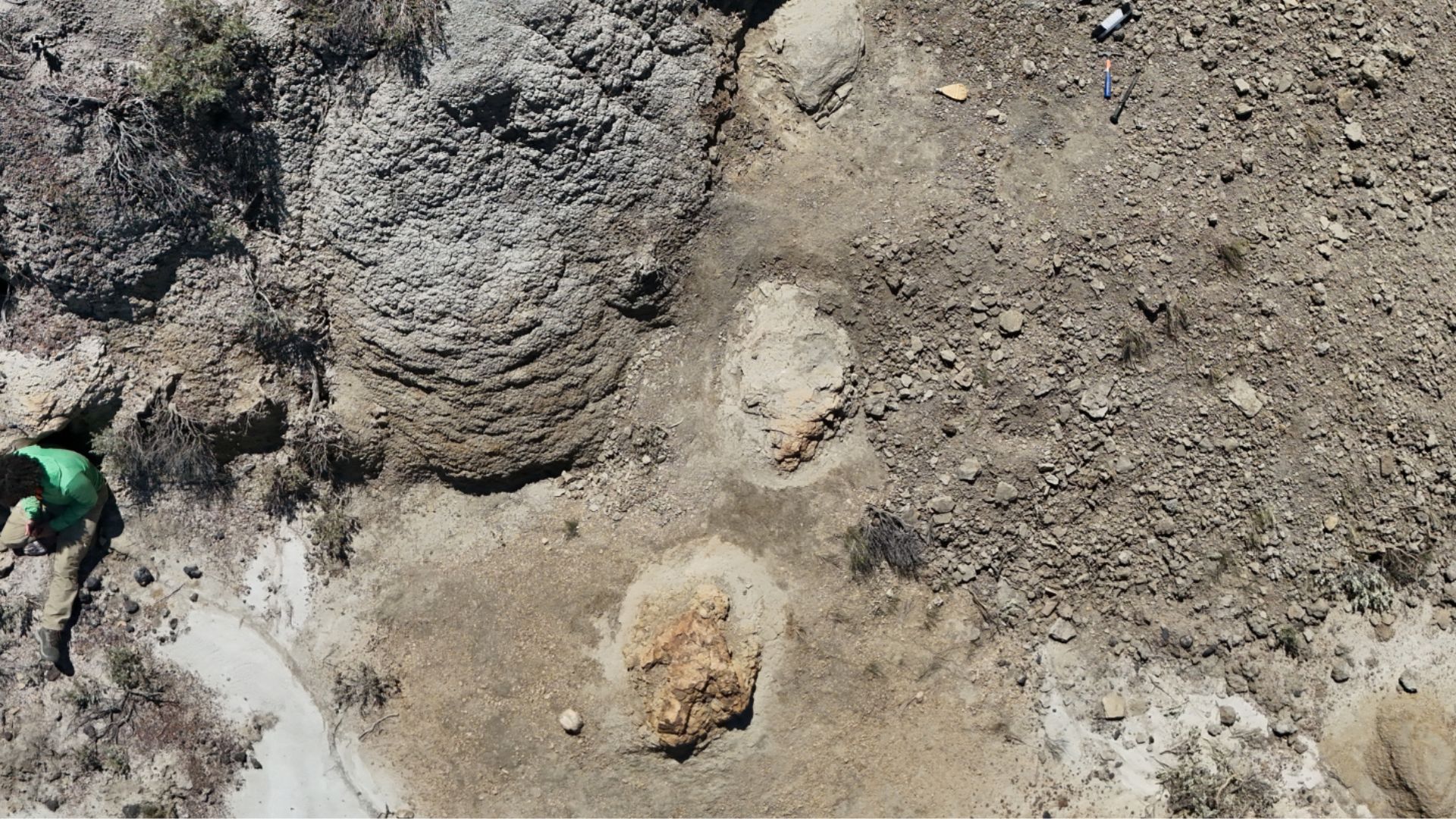
Millions of years after a massive Tyrannosaurus rex trudged through a prehistoric mudflat, paleontologists can finally follow in its footsteps. For the first time, paleontologists have documented a continuous sequence of prints left behind by a fully grown T. rex. Bones show us how a dinosaur died, but footprints capture a fleeting moment of life. This incredible trail freezes a single, ancient walk in stone. The discovery didn’t begin with a team of famed researchers, though. It started with a high school teacher seeking an easier path out of a rocky ravine. “Bones tell us an enormous amount about these animals, but footprints capture a moment of behavior. With a trackway, we can actually follow an animal as it moved across the landscape. That is incredibly rare for T. rex,” said Tyler Lyson, senior curator of vertebrate paleontology at the Denver Museum of Nature & Science. A chance finding in the badlands In 2025, Kent M. Hups was volunteering on a fossil dig in North Dakota’s Hell Creek Formation when he spotted three strange, wedge-shaped rocks protruding from the ground. Hups, a science teacher at Colorado’s Northglenn High School, immediately recognized the lumpy sandstone as dinosaur toes. “As a teacher, I’m always telling my students that science starts with curiosity, passion, and careful observation. I never imagined that could lead me to a discovery like this,” Hups shared. Lead researchers were initially skeptical. Isolated, single footprints attributed to T. rex had been logged before, but finding a sequential trail is rare because ancient water and mud easily erase soft tracks. As the dirt cleared, four huge, three-toed footprints emerged along a 23-foot stretch of the hillside. Researchers from the Denver Museum of Nature & Science and Liverpool John Moores University detail a journey taken roughly 66.5 million years ago. Stride of the apex predator Modern technology bridged the gap between field excavation and global analysis. Field teams captured high-resolution 3D surface scans of the trackway, allowing lead author Dr. Peter Falkingham to inspect the prints in virtual reality without ever setting foot in North Dakota. “The technology we’re able to apply in the digital age means my colleagues could scan the tracks in the field and then send the 3D information over to me to visualize on my computer and in VR, enabling me to take as close a look as they did in person,” said Falkingham. Each footprint measures nearly three feet in length. The team identified an adult T. rex as the trackmaker based on the print size, narrow toe arrangement, and a heavy presence of T. rex skeletal fossils in the vicinity. Scientists calculated a 13-foot stride length between the sequential left and right footprints to determine the dinosaur’s pace. Their estimates suggest the T. rex was traveling between 3.5 and 4.5 mph. The animal was far from sprinting, instead taking a relaxed stroll at a speed surprisingly comparable to a human walking briskly to catch a bus. Now, the digital phase gives way to physical recovery. A helicopter will airlift three of the heavily weathered sandstone footprints out of the badlands. They will travel to the Denver Museum of Nature & Science, where the public will soon get to stand where an apex predator once walked.The research was published in the Journal of Vertebrate Paleontology. Get the latest in engineering, tech, space & science - delivered daily to your inbox.Mrigakshi is a science journalist who enjoys writing about space exploration, biology, and technological innovations. Her work has been featured in well-known publications including Nature India, Supercluster, The Weather Channel and Astronomy magazine. If you have pitches in mind, please do not hesitate to email her.
US school teacher discovers first-ever adult T. rex trackway from 66.5 million years ago
Full Article
Original Source
Read the full article at Interestingengineering →KhanList aggregates and links to publicly available news content. We do not host full articles from third-party sources. Always verify important information with original sources.