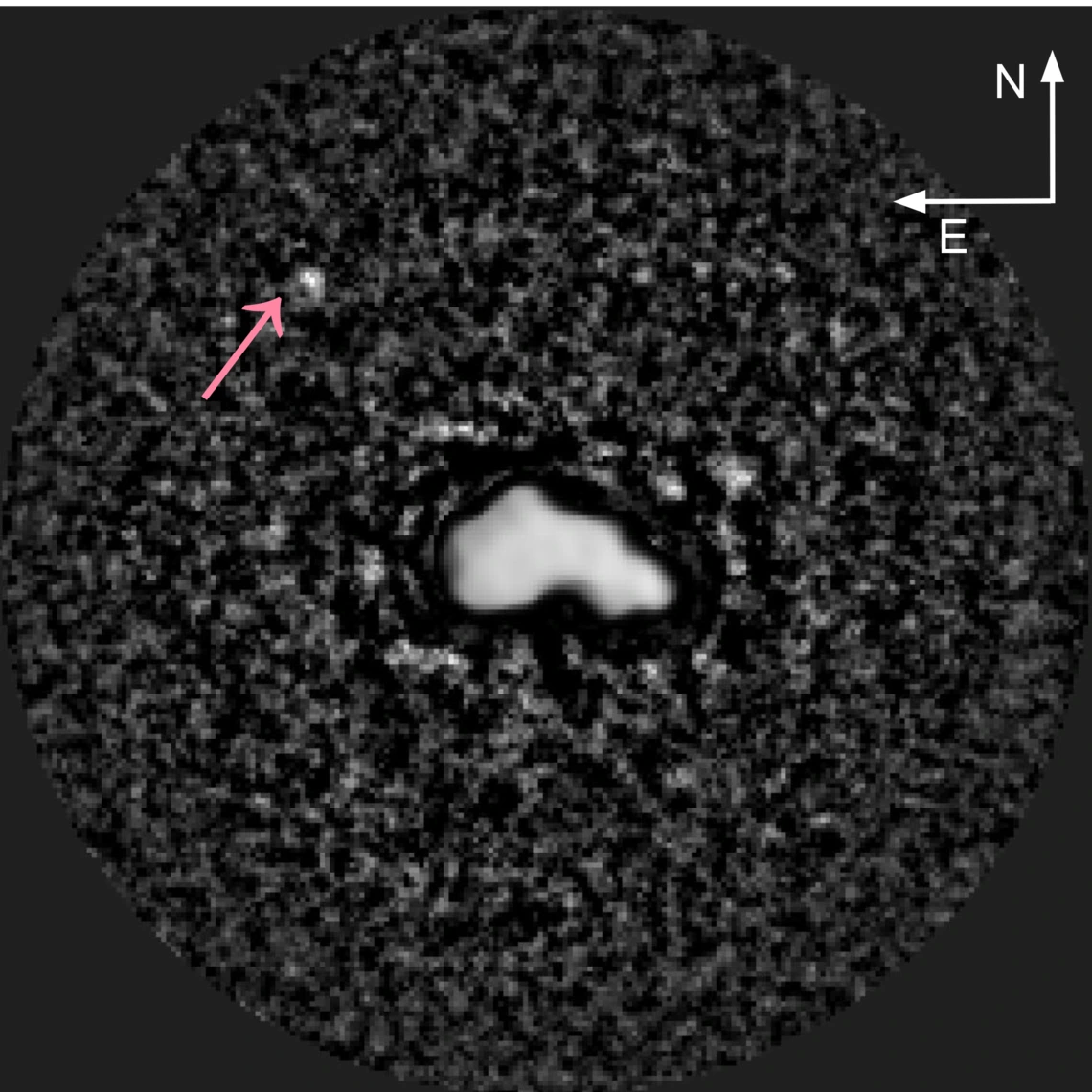
Asteroid 44 Nysa has the weirdest shape yet seen for an asteroid — the lumpy rock appears to have three different parts to it. Adaptive-optics observations obtained with the Large Binocular Telescope reveal the unusual shape of asteroid 44 Nysa. The asteroid appears highly concave and may consist of three connected lobes, making it a potential contact-binary object. Continuous observations on February 15th provided the most detailed view of Nysa to date. The asteroid's tiny moon, S/2026 (44) 1 is marked with a pink arrow.Kate Minker et al. Asteroid 44 Nysa has the weirdest shape yet seen for an asteroid, and that’s saying something. Researchers using ground-based telescopes have just published stunning sets of images taken in February and March. They show the asteroid is made of at least three large chunks, connected by narrow necks. This isn’t a potato or even a peanut; maybe it’s a ginger root? (Readers are welcome to suggest better food analogies in the comments.) As a bonus, the images reveal a companion, a tiny (kilometer-size) moon orbiting at a distance of about 180 kilometers (110 miles) from Nysa’s center of mass. Kate Minker (Lowell Observatory) and her colleagues have published a paper detailing the discoveries, which will appear in Astronomy & Astrophysics. Nysa is large to have such a weird shape. If all of its mass were squashed into a sphere, that sphere would be 75 kilometers across, much larger than most of the asteroids that have been visited by spacecraft (among that group, only Lutetia, Vesta, and Ceres are larger). But it’s decidedly not a sphere. It’s made of one big and two smaller chunks glued together in an arch shape. Nysa is unusual in other ways. It’s an E-type asteroid, not a common variety. The “E” stands for enstatite, a magnesium-rich silicate mineral found in the interiors of large rocky worlds. The asteroid is also quite dense — at more than 5 grams per cubic centimeter, it’s denser than rock, so it must be a mixture of rock and metal. Both enstatite and metal are strong materials, which would be needed to support such a weird shape against self-gravity. Asteroids make of weaker materials, like loose aggregates of rubble, pull themselves into more spherical shapes over time. Even if Nysa is made of stuff strong enough to hold its current shape, it’s still difficult to explain how it acquired its shape in the first place. The researchers proposed two mechanisms, neither of which is entirely satisfactory. One idea is that it’s a solid remnant of an earlier body that has been battered into its current shape via run-ins with other, much smaller objects. It’s difficult to imagine how it could have formed two narrow necks by such impact whittling, however. The other idea is that it’s a contact trinary, three separate bodies whose orbits decayed until they touched. While this story would explain the narrow necks joining the larger sections, it’s still hard to explain how the arch shape remains stable if the three lobes are only loosely connected. Over time, self-gravity should tug the at the two ends, closing the hollow space between them. This apparent instability suggests that Nysa has been disrupted more than once – perhaps another impactor came along and knocked one or more of the lobes loose, and they have since reconnected, and the shape is still evolving. It’s a truly weird system, and one that will be fun to follow in future studies!
Astronomers Spot Weird, Three-Lobed Asteroid with a Moon
Full Article
Original Source
Read the full article at Skyandtelescope →KhanList aggregates and links to publicly available news content. We do not host full articles from third-party sources. Always verify important information with original sources.