
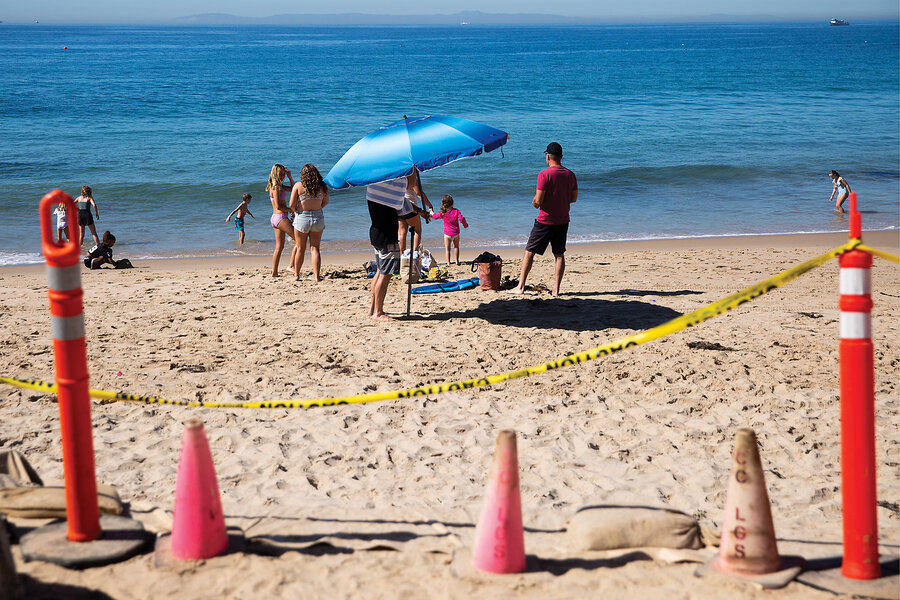
Newport Beach, Calif. | Nov. 02, 2026, 1:56 p.m. ET | 6 min read For more than a decade, Terri Bruno has waded into the water along the shores of Crystal Cove State Park. The soft sand and expansive beach made her a devoted visitor. But recently, much of the sand has been swept away, and she’s started wearing water shoes to contend with the rocky terrain beyond the water’s edge.“It’s hard right now to get in the water. The rocks are tumbling around your feet when you try to get in and out,” Ms. Bruno says. “The water is completely different from what it used to be because of all these rocks. It used to be just soft sand.”A combination of rising sea levels, intense storm swells, and shifting wave patterns is eroding some of California’s most iconic coastline, transforming postcard-perfect beaches into rocky shores, particularly in Southern California. The impact goes beyond uneven footing. The coastal recession is rendering some seaside regions structurally unsustainable, sending beach towns scrambling to quarry replacement sand. While erosion at many of Southern California’s beaches is connected to human activity, the situation is exacerbated by this year’s El Niño, which is on pace to be the strongest in modern records. El Niño is a tropical Pacific climate pattern that weakens trade winds, shifts jet streams, and can increase the risk of flooding, droughts, and wildfires. This year, it is also combining with higher average temperatures to push ocean temperatures to record levels. Jenna Schoenefeld/StaffTerri Bruno sits on the porch of Beach Cottage Museum at Crystal Cove State Park in Newport Beach, California, Oct. 5, 2026. Gov. Gavin Newsom declared a state emergency Sept. 21, ahead of the El Niño season, to help coordinate shoreline protection and flood mitigation before the winter weather sets in. The costs of sand erosion for state and local governments will likely rise, according to studies on the subject. Southern California’s sand requirements are predicted to triple by 2050, driving up costs fivefold because of global increases on sand prices, according to a University of Southern California study. Part of a state’s identityMost of Southern California’s beach erosion is from decades of sand starvation due to human interventions, says Brett Sanders, an engineering professor at the University of California, Irvine, whose research focuses on flooding and coastal erosion. He argues that harbors, breakwaters, dams, urban development, and coastal armoring, together with jetties, disrupt sand’s natural flow. “We’ve dammed up most of our rivers. And our dams retain a lot of sediment,” Dr. Sanders says. That sediment, he adds, used to make its way to the coast. But now, most of it doesn’t and is instead trapped inland. The region’s relationship with beaches has shifted over time.Before the widespread development of Southern California’s coastline, beaches were usually narrower. The beaches swelled and subsided with the seasons, he says. But during the 20th century, officials built a series of harbors and ports, which required dredging coastal wetlands and then depositing captured sand on shore. By the 1960s, Southern California’s beaches were wide and vast year-round. Jill Connelly/APWaves crash onto homes and the boardwalk, damaged by Tropical Storm Rachel in Long Beach, California, Oct. 11, 2026. Those expansive and inviting beaches became part of the state’s identity, fueling its economy and infrastructure, Dr. Sanders says. More people wanted to visit and live near the coast and, as a result, officials built more cities and roads to meet the demand. Eventually, the big infusions of sand that had built up Southern California’s famous beaches tapered off. Meanwhile, the ocean continued to wash away the sand. But not all California beaches are losing. While some have shrunk, others have expanded. A study that Dr. Sanders co-authored found that Southern California beaches increased in size by about 10% overall between 1984 and 2024, adding more than 500 acres of coastline. But the distribution has been uneven along the coast. It has also been driven by imported sand and man-made structures such as jetties, harbors, and breakwaters, as well as by natural ocean currents.El Niño’s effects felt In October, heavy flooding destroyed or damaged over a dozen multimillion-dollar homes and properties in several Southern California beach towns. The damage occurred when an El Niño-driven high tide converged with ocean swells from Tropical Storm Rachel.A major cliffside fracture prompted an indefinite, partial closure of a heavily traveled section of the Pacific Coast Highway in Laguna Beach that offers panoramic ocean vistas.In Newport Beach, high surf and seawater inundated city streets and breached protective berms, damaging some high-end properties. Parts of the city would flood again weeks later, due to a combination of king tides spurred by the moon's gravitational pull, warm El Niño waters, and an ocean-elevating Kelvin wave. A few miles northwest, in Long Beach, aerial footage showed cracked homes at risk of collapsing into the ocean, prompting city officials to issue evacuations. Weakened by past storms, the 1920s-era Long Beach Peninsula boardwalk – the last wooden coastal boardwalk in Los Angeles County – was severely damaged and partially destroyed during the October storms. The boardwalk had connected to Long Beach’s early identity as a booming seaside destination, where the likes of Charlie Chaplin, Upton Sinclair, and Albert Einstein visited during early 20th-century summer retreats.A critical seven-mile stretch of railroad track along the San Clemente coastline was temporarily closed after waves were hitting the railroad embankment, where the sand was gone, leaving only rocks. The rail line not only provides picturesque views for passengers aboard Amtrak’s Pacific Surfliner and Metrolink, it also transports $1 billion in freight every year. It is a vital rail connection for national security reasons as well, moving heavy combat gear to and from Marine Corps Base Camp Pendleton and Naval Base San Diego, the main home of the Pacific Fleet.San Clemente, a seaside town that Dr. Sanders’ study identified as one of the biggest losers to coastal erosion over the past 40 years, dodged severe damage this time. Leslea Meyerhoff, its coastal administrator, credits the millions of dollars the city spent two years ago on 250,000 cubic yards of sand to shore up its beaches.“Things would’ve been much worse,” she says. Jenna Schoenefeld/StaffSandbags and tarps resist erosion at Crystal Cove State Park. City officials are in the process of getting approvals to extract and import more sand from local quarries to nourish its beaches, she says. It’ll cost San Clemente millions of dollars, much of it due to the skyrocketing costs of diesel fuel used for transportation.But it’s a cost many coastal communities are locked into. “Coast access means nothing if there is no beach,” Ms. Meyerhoff says.More rocks, less sandRecently, Crystal Cove State Park resembled a construction zone, with crews working around the clock to form large sand berms to protect historic wooden cottages clustered on sand between the ocean and highway. Guests were evacuated from the popular rental cottages, and reservations at most were suspended as waves exposed utilities and broke a waterline to one, says Paul Andrus, public safety superintendent for the Orange Coast District of California State Parks. That cottage, known as the “Beaches” cottage for its role in the 1988 Bette Midler film of the same name, wasn’t damaged, but water washed under the foundation.Some $70 million had been spent on restoring the structures, many of which were originally built with salvaged lumber. Now, workers plan to temporarily install 50-foot chains of permeable synthetic-fiber, sand-filled cubes as a buffer against rising tides, Mr. Andrus says. They act like a sponge, absorbing a wave’s punch and allowing water to drain out safely without stealing the beach’s sand. One evening, Ms. Bruno, who lives in nearby Laguna Niguel, drove to Crystal Cove. She braced herself. Deepen your worldviewwith Monitor Highlights.Politics with respectGet political stories with respectful analysis.There‘s a world of new ideas in everyBooks newsletter.There‘s more to life, enrich yours withCulture & Learning weekly.Follow humanity‘s discoveries withScience & Nature stories in your inbox.Gain a spiritual perspectivefrom the stories in your inbox.Want to understand the deeper impact of critical events? Learn the Monitor‘s insight.Already a subscriber? Log in to hide ads. Most of the beach was closed off. She saw more rocks and less sand. There were crevices, and something of a lake formed near the cottages.Moments later, Bruno noticed the crews at work, moving sand around. It gave her hope. ALREADY A SUBSCRIBER? LoginReal news can be honest, hopeful, credible, constructive.The Christian Science Monitor was founded in 1908 to lift the standard of journalism and uplift humanity. We aim to “speak the truth in love.” Our goal is not to tell you what to think, but to give you the essential knowledge and understanding to come to your own intelligent conclusions. Join us in this mission by subscribing.
As sand slips away, California beach towns dig in
Full Article
Original Source
Read the full article at Csmonitor →KhanList aggregates and links to publicly available news content. We do not host full articles from third-party sources. Always verify important information with original sources.