
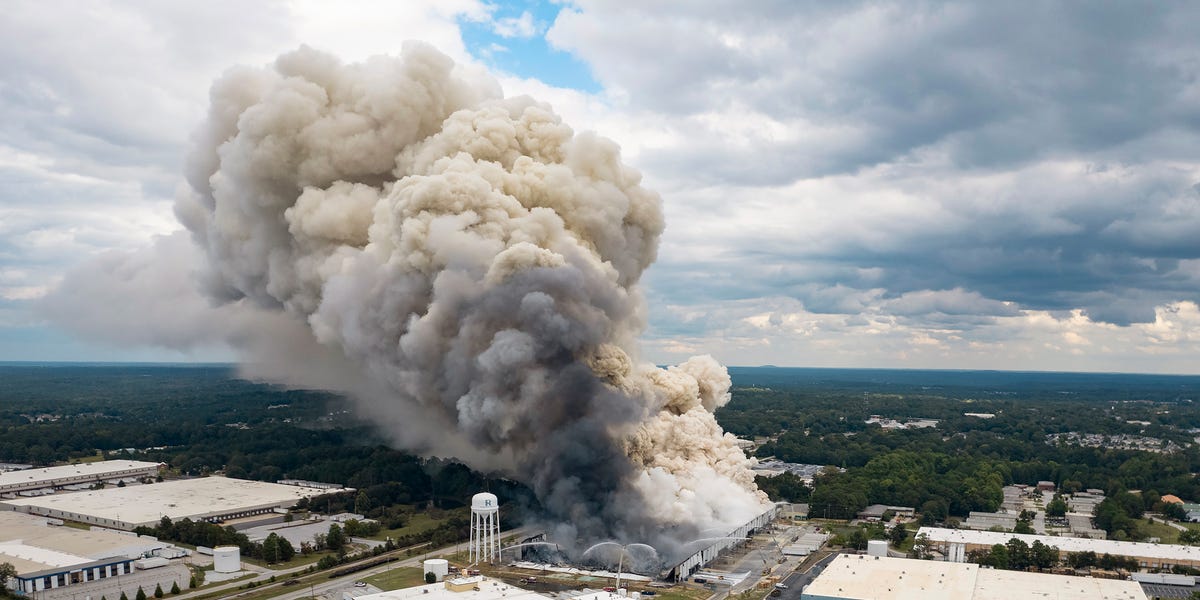
17 min readOn August 24, 2020, as Tropical Storm Laura churned up fury and foam in the Gulf of Mexico, employees at BioLab Inc. were racing to fill the trailers backed into the loading docks of the chlorine plant, located just outside of Lake Charles, Louisiana, with pallets of woven sacks. Each sack was stuffed with 2,750 pounds of granulated trichloroisocyanuric acid—trichlor for short—a chemical used to kill algae and bacteria in swimming pools. Trichlor dissolved slowly when submerged in water, the employees had learned in their annual safety training, but became hot enough to explode when exposed to small amounts of it—say, a slow leak or shallow flood, the kind of damage that might happen in a coastal region during a Category 4 storm.By the next day Laura was officially a hurricane, and about 825,000 pounds of trichlor had left the warehouse, bound for a BioLab facility in Conyers, Georgia. Employees waited for the last two trucks that would carry the remaining one million pounds of the hazardous chemical to higher ground. But those trucks never arrived.The plant’s 111-person staff had been whittled down to a hurricane crew, nine workers assigned to monitor the facility on-site during a storm. They arrived around 5 p.m. and began slinging sandbags and securing loose items. As the majority of Calcasieu Parish residents sat in long lines of traffic pointing away from the coast, the crew heaved the remaining 500 tons of trichlor on top of triple-stacked pallets—the idea was to keep the trichlor dry if floodwater did infiltrate the building. Plus, they’d be around if anything went wrong during the storm.But as the sun rose the following morning, the solemn TV meteorologists all said the same thing: The impacts of Hurricane Laura, which became the strongest hurricane to strike Southwest Louisiana since the U.S. started keeping official records in 1851, would be “unsurvivable.” By 9:30 a.m., BioLab management had directed the hurricane crew to lock up the facility and evacuate with the rest of their neighbors.So no one was in the warehouse during the early morning hours of Thursday, August 27, when Laura’s vicious, 150-mile-per-hour winds plucked portions of the roof off the building. No one was there to hear the drops of rain pelting those woven sacks of pool chemicals, to hear the pellets inside begin to crackle and hiss. No one saw those first few licks of flame, the first gust of black, poisonous smoke that would soon darken the sky.“It smelled like if you took a swimming pool of human hair and lit it on fire,” remembers John O’Donnell, who arrived in Lake Charles later that morning to check on his house after the storm had passed. “I’ll never be able to forget what that smell smelled like.”O’Donnell’s own roof had been damaged, but now his more pressing concern was the curdling, cast-iron cloud of chlorine gas that hovered over the town. Once used as a weapon of terror during WWI, chlorine can cause an array of symptoms including vomiting, blisters, shortness of breath, and burning pain in the lungs, throat, nose, and eyes.As O’Donnell’s eyes began to burn, a photojournalist covering the hurricane wandered into his driveway. “What is that?” the photojournalist asked, looking skyward.“That’s why your phone is about to go off,” said 33-year-old O’Donnell, a disaster recovery strategist who grew up in Southwest Louisiana, a storm-battered region dotted with petrochemical plants and emergency sirens. Just then, the shelter-in-place alert O’Donnell predicted blared from their phones. But shelter where? Six months into the COVID-19 pandemic, lockdown mandates had eased, but congregating indoors was still a bad idea. Anyway, it was 80-something degrees, and there wasn’t a building for miles that had electricity or water.Ben Gray for the Atlanta Journal-ConstitutionFour years after the BioLab disaster in Lake Charles, a BioLab warehouse in Conyers, Georgia, was destroyed by fire. Smoke lingered for days. Air monitoring showed chlorine levels up to 20 times the EPA’s exposure limits. Residents reported headaches, rashes, and dizziness.O’Donnell got back in his car and headed “as far away . . . as possible,” he says, a challenge given the debris and downed trees that lay strewn across the roads. “That was a really scary moment for everybody.”It was a terrifying scene—but not an isolated one. For decades, experts have warned about the looming threat of so-called Natech disasters—technological failures triggered by natural hazards. The 1972 flood that ruptured a West Virginia coal slurry impoundment, destroying 550 homes and killing 125 people. The 1994 Southern California earthquake that shattered an oil pipeline, sending nearly 200,000 gallons of crude oil into a nearby river. The 9.0 earthquake off the coast of Japan in 2011 that produced a rare, double-wave tsunami, causing a meltdown at Fukushima Daiichi Nuclear Power Plant in what is now considered one of the world’s most destructive nuclear catastrophes and the most expensive disaster in modern history.As climate change drives more extreme weather, the conditions that produce these cascading disasters are becoming more common. “There are few events that are only natural disasters now,” says Liesel Ritchie, PhD, a sociologist at Virginia Tech who studies their social impacts. “And the more technology advances, the more likely these tightly coupled systems are to fail.” Yet even as the risks grow, readiness has not kept pace. Experts like Ritchie say the country remains woefully unprepared. The focus is still on natural disasters, she says, “because Natech events seem to be so rare.”But they may not be as rare as we think. And across the country, millions of people live and work near industrial facilities like the one in Lake Charles, often unaware how vulnerable they are.In 1994, Pamela Sands Showalter, then a University of Toledo geographer, and the late Mary Fran Myers, a disaster researcher at the University of Colorado, wrote in the journal Risk Analysis that “the number of incidents where natural and technological disasters interact is rising while preparations, which recognize the complications inherent in such combined events, remain cursory.”As evidence, these preeminent disaster scholars pointed to the results of a survey they had conducted of emergency management agencies in 20 states that revealed an emerging trend in the number of chemical, oil, and radiological releases caused by natural disasters during the preceding 10 years. The results also showed that few legislative bodies had even considered the risk, let alone addressed it.“Natech” disasters, as Showalter and Myers first called them, were “a growing, but as yet unstudied problem.”Three-plus decades later, not much has changed. The risk of Natech disasters continues to grow, while efforts to prevent or prepare for them have largely stalled.Between 1990 and 2017, Natech events essentially doubled in the U.S. In 2017, Hurricane Harvey caused 46 chemical leaks and nearly 100 hazardous substance spills. In 2021, Winter Storm Uri created prolonged power and water outages in Texas that contributed to more than 246 deaths. And in 2023, the megafires that devastated the island of Maui were the deadly consequence of high winds and sparking power lines.Meanwhile, there is still no single federal law or agency dedicated to mitigating the risk of Natech disasters. Instead, preparedness is implemented through a patchwork of institutions—FEMA, OSHA, and the EPA, to name a few—and regulations regarding things like workplace safety and hazardous substances.Further, because the U.S. emergency management system is designed as a bottom-up structure, where local governments are first responders—and because each region of the country deals with its own unique climatic and industrial risks—Natech prevention and response are often passed down by default to the state, county, and municipal governments.YUKI IWAMURAIn 2023, megafires devastated the island of Maui, a consequence of high winds and sparking power lines.The problem with this protocol, according to Ritchie, is that “expertise is not as strong as it is at the federal level.” Neither is funding (few towns have the training, let alone the equipment, to deal with a toxic chemical release). Additionally, planning for emergencies tends to happen in silos, so that an agency tasked with clearing roads after a storm has little to no interaction with the folks who might respond to an oil spill. Industry managers and government officials, meanwhile, don’t often engage in sustained and transparent dialogue. The disconnect between institutions often hampers a coordinated response during a disaster, prolonging the event and worsening the danger.The natural and technical components of the disaster, on the other hand, work in tandem to intensify their impact. And these are not simply concurrent disasters, says O’Donnell, who has since taken a role as community resilience officer at the Baton Rouge Area Foundation. “They’re compounding disasters.”After Hurricane Laura, for example, a power outage caused by the storm prevented the electric water pumps in BioLab’s fire protection system from functioning, allowing the fire to spread. As emergency crews rushed to shut down the interstate and put out the blaze, that was time they were not assisting the 8,000 families whose homes were lost or destroyed during the Category 4 hurricane. A closed interstate further delayed utility companies from restoring electricity and water to the tens of thousands without it, now sweltering in the September heat. The chemical fire raged for a full 24 hours, preventing people who still had a home from returning to get started on recovery.Delayed recovery, whether it’s the additional hours for mold to fester inside homes or the expense of extra nights in a hotel, is often especially burdensome for those who live where the risk for Natech disasters is the highest: heavily industrialized, economically disadvantaged cities like Lake Charles, where almost a quarter of the population lives in poverty. Residents in these places already suffer from higher-than-average rates of health issues, thanks to prolonged exposure to pollution, and possess fewer resources to get back on their feet in the aftermath of disasters.Perhaps most insidiously, Natech events can fracture communities and damage trust in human institutions. While a natural disaster tends to inspire cooperation and widespread mutual support, “man-made” disasters create “a far more severe and long-lasting pattern of social, economic, cultural, and psychological impacts,” according to the late UC Santa Barbara environmental sociologist William Freudenburg, PhD. In the aftermath of a technological disaster, fear, uncertainty, blame, and division abound. What’s often missing is collective action.In the months after the fire, area residents did not come together to demand accountability or remuneration, even though the ensuing investigation found that the company was aware its facility had not been built to withstand severe hurricane damage or rainwater infiltration, despite the known risks involved.For better or worse, Lake Charles is “tied to this chemical industry,” says James Hiatt, a former refinery worker who founded For Better Bayou, a local environmental justice nonprofit. As many as 45 percent of the non-farm jobs in Calcasieu and Cameron Parishes are connected in some way to the area’s approximately 30 chemical plants or petroleum refineries, which together account for more than half of the local tax base. This dependence on the industry means residents can be reluctant to speak out against offending companies or even press for regulation that might prevent the next disaster.“I wish I could tell you it woke people up,” O’Donnell says. Local environmental groups “made the usual noise,” but in November 2022, BioLab cut the ribbon on its brand-new trichlor production facility in Lake Charles, rebuilt where the old one had burned down.Meanwhile, less than two years later, another BioLab facility would go up in flames.On the afternoon of Sunday, September 29, 2024, Iffat Walker was driving east on Interstate 20 to her home in Conyers, Georgia, a city of about 20,000 people just outside of Atlanta. Traffic was unusually backed up, and she was inching along the highway. That’s when she noticed the thick black cloud looming over the horizon.“You couldn’t tell what it was,” she says, “I thought maybe a car fire.” But as she crept closer to the smoke, a strong chemical smell wafted through her car. She quickly rolled the windows up, but her skin began to tingle. By the time she arrived home about 20 minutes later, angry welts had bloomed on her arms.“I was alarmed because I was sitting in it for such a long time,” says Walker, a nonprofit director. “I’m panicking at this point.”It wasn’t until she turned on the news that Walker learned a facility called BioLab, which produced and stored millions of pounds of trichlor, had caught fire that morning, releasing a plume of highly toxic chlorine gas over the Atlanta metropolitan area.It was not the disaster Georgians had expected that week. Just four days earlier, Governor Brian Kemp had declared a state of emergency ahead of Hurricane Helene. Although Helene ended up dumping more than 10 inches of rain on Conyers in just two days, it seemed the area had avoided severe catastrophe; that would turn out not to be true.In fact, according to an investigation by the U.S. Chemical Safety Board (CSB) released in May 2025, BioLab employees on fire-watch duty inside the facility during the storm had reported multiple roof leaks. And, according to the CSB report, while no rain fell the day before the fire, and the employee who called 911 the morning of the blaze claimed that water from a burst sprinkler had made contact with the pallets of trichlor, the same employee later stated, “I think that it could’ve been water off the ceiling.” (What caused the fire has never been determined; BioLab declined to be interviewed.)By Sunday evening, the warehouse was destroyed, and the fire was largely extinguished. But the danger was far from over.The next day, Madelyne Reese woke up at her home about five miles outside of Conyers, where she sleeps with the windows open, and smelled something funny. She assumed it was just the lingering odor of the bleach she had used to clean that weekend, but when she opened the back door to let her dog out, she says, “I got smacked in the face with it.”It had been 24 hours since the fire at the BioLab facility had started, but Reese had received no indication of the airborne contaminant—no sirens, no text messages. While neighborhoods in the immediate vicinity had been evacuated Sunday morning, residents in the surrounding areas received a patchwork of messages; some were told to evacuate, others to shelter in place. Some, like Reese, didn’t receive an alert until Monday afternoon. On Tuesday, the shelter-in-place order that had been issued and lifted on Monday was implemented again, as the toxic plume shifted with the wind.For decades, experts have warned about the looming threat of so-called natech disasters—technological failures triggered by natural hazards.By then, conditions had turned “brutal,” says Reese, a human resources director. “The smog hit and you could not see a foot and a half in front of you.” On that hot, early autumn day, Reese turned off the air conditioning and ran masking tape down the seams of her windows. “I was just trapped in here. I’ve never experienced anything like it.” Four days later, Reese’s horse, a black Tennessee Walker she’d rescued from a kill pen, suddenly developed a cough and had trouble breathing.In the aftermath of the fire, the roughly 15,000 students in the Rockdale County Public School District attended classes online, while businesses in the two-mile contamination zone remained shuttered. Monitoring stations showed chlorine levels up to 20 times the Environmental Protection Agency’s exposure guidelines. (A 2026 study by scientists at the Georgia Institute of Technology would show that the air also contained dangerously high levels of bromine and isocyanic acid, toxic chemicals that can cause lung problems as well as irritation of the eyes, nose, throat, and skin.) People in surrounding areas complained of headaches, rashes, and dizziness and watched their flowerbeds wither.Yet information remained scarce. What caused the incident? What chemicals were in the air? Should residents wear masks? “Complete silence,” says Reese. “Our government wasn’t giving us any answers.” So Reese started a Facebook group called Stand Against BioLab in Rockdale County. “We all needed to talk, we all needed to figure it out,” she says. The group quickly swelled to over 1,500 members.They learned that this BioLab facility had actually caught fire three times in the last two decades (earning it the nickname “Firelab” with emergency management personnel), and that the company, one of Rockdale County’s largest employers, had received generous tax breaks since it opened in 1973.Other community groups coalesced and disseminated petitions and planned protests. Farmers came together to test for pollutants on their land. Walker’s nonprofit, Community Action NOW!, partnered with the Morehouse School of Medicine to launch a three-year study to track long-term health impacts resulting from the fire.And collectively, these groups began to call for legal action—and for the facility to be shut down.Their activism worked. Less than a month after the fire, Rockdale County officials filed a federal lawsuit seeking compensation for impacted residents and called for the company to leave Conyers.While the county’s lawsuit was partially dismissed, including some demands for damages, that litigation is still active, as is a class action suit. And in May 2025, BioLab announced it had completed remediation of the site and would no longer produce trichlor in Conyers (though it would continue to store the chemical there).“I’d like to think it was . . . how vocal we were as a community,” says Reese, who admits the experience has left her jaded. “But there are a million BioLabs out there that are not being held to true standards.”Days after BioLab’s announcement, the CSB released its report, which revealed that on the morning of the fire, the facility had contained double the amount of trichlor the company had previously disclosed—including half a million pounds of the chemical that had been shipped from Lake Charles in 2024 as Hurricane Francine bore down on the Gulf Coast.Following the investigation, OSHA proposed $61,473 in penalties against BioLab, whose parent company, KIK Custom Products, has reported estimated annual revenues of more than $2 billion. (The penalty was paid in full, according to a Department of Labor spokesperson, and the case is now closed.)On March 11, 2011, a magnitude 9.0 undersea earthquake struck off Japan’s northeastern coast, triggering a massive tsunami that inundated the Fukushima Dai-ichi Nuclear Power Plant, which sat on a 30-foot bluff overlooking the Pacific Ocean. While the reactors shut down safely, seawater flooded the plant’s backup generators. After days without cooling, three of the plant’s four reactor cores overheated and began to melt down, releasing lethal amounts of radiation into the atmosphere and ocean in the worst nuclear disaster since Chernobyl, the 1986 explosion at a Soviet power plant that displaced more than 200,000 people and caused long-term environmental contamination. Parts of the Daiichi area remain so radioactively hot that the robots sent in to assess the damage in 2017 were instantly fried.A Japanese parliamentary panel later called the disaster “clearly man-made,” blaming systemic failures across every institution involved—the government, regulatory authorities, and the company that owned the plant.They “betrayed the nation’s right to be safe from nuclear accidents,” the panel’s report said.In the years since, Japan has taken an aggressive, wide-ranging approach to preventing similar disasters, including the creation of an independent watchdog agency to enforce regulations that explicitly require plants to consider extreme natural hazards and compounding disasters. Existing plants were required to install higher seawalls and more resilient backup power sources and must now continuously assess seismic and tsunami risks.DigitalGlobeIn this satellite view, the Fukushima Dai-ichi Nuclear Power plant after a massive earthquake and subsequent tsunami on March 14, 2011 in Futaba, Japan. Two explosions the nuclear power station one today and the first two days ago at a different reactor housing unit. Japanese officials said cooling systems have also failed at a third reactor as a result of an earthquake measuring 8.9 on the Richter scale that hit the northeast coast of Japan on March 11, 2011 and tsunami that knocked out electricity to much of the region.The country’s new policies aren’t built around the assumption that these disasters are possible, but rather that they are inevitable.That is decidedly not the case in the U.S., where many of the agencies responsible for preventing, mitigating, or responding to Natech disasters are now being downsized or defunded. For example, the Trump Administration has canceled or delayed billions of dollars in FEMA grants meant to harden infrastructure against hurricanes, fires, and floods. Meanwhile, the EPA has shed a quarter of its workforce, including many staff who focused on environmental justice for disadvantaged communities dealing with the long-term impact of pollution, places like Lake Charles. The White House has even tried to eliminate the Chemical Safety and Hazard Investigation Board, an independent body that investigates the causes of chemical releases and proposes ways accidents could be avoided. (Congress ultimately saved the agency.)And then there are cuts to climate research that could inform future planning and policy pertaining to Natech disasters. In 2025, the Administration ordered NOAA to stop tracking extreme weather events that cause over $1 billion in damage and canceled National Science Foundation grants for more than 100 research projects on climate change.This disinvestment is having an “adverse impact on . . . communities that need this information,” Virginia Tech’s Ritchie says. But she believes there are still things communities can do to protect themselves. Ritchie points out that major industrial projects (like a mine, a dam, or a large factory) involving federal permits or funding require review under the 1969 National Environmental Policy Act, a process that mandates an environmental impact evaluation. These assessments include an opportunity for public comment on potential socio-economic benefits and risks associated with a project, as well as what the community stands to lose in the event of a disaster or hazard. It doesn’t guarantee this input will be addressed, she says, but it can lead to negotiations between communities, developers, and governments over things like mitigation measures and compensation—not just financial restitution but programs that address quality of life, such as a new community center or coverage for mental health services.On an individual level, being prepared can make all the difference, according to Madelyne Reese, who was unaware there was even a chemical plant near her home. “Understand who is operating in your city and your county,” she says. Invest in the appropriate PPE and develop an evacuation plan. “Don’t wait until it’s in your backyard.”Four months after it reopened, the BioLab plant in Lake Charles once again experienced a chlorine leak. Then, in July 2024, another thick plume of smoke arose over the warehouse. Both incidents caused a temporary closure of I-10 and a shelter-in-place order. While environmental activists have called for the facility to be shut down, those voices remain in the minority.Still, if you ask James Hiatt, who still remembers that August 2020 day when the wreckage of his city lay scattered beneath a roiling cloud of chlorine smoke, the subject of BioLab’s threat to the community “is never black and white; there’s a lot of gray.”David J. PhillipA dark cloud of acrid smoke billowing over Lake Charles, Louisiana, on August 27, 2020. The chemical fire raged for 24 hours. One area resident described the smell as “if you took a swimming pool of human hair and lit it on fire.”BioLab employs more than 100 residents and supports the county’s tax base, providing revenue for public schools and sheriffs’ departments. It donates money and volunteer hours to local nonprofits and community events, including school programs and field trips. And, argues Jim Rock, the executive director of the Lake Area Industrial Alliance—a coalition of refineries, liquid natural gas operators, and chemical manufacturers—the company has its own incentives for prioritizing safety. “They don’t want something bad to happen to them or their industrial neighbors,” he says, pointing to the improvements BioLab made when it opened the new facility in 2022—like elevated work floors and structures that can withstand 150mph winds. “I’m more confident in the integrity of facilities now . . . than I was 10 or 20 years ago,” he says.Rock, who worked for decades in chemical plants, insists the industry is safe. “We’re constantly being audited by both state and federal inspectors to ensure that we’re doing everything we’re supposed to be doing,” he says. “Those rules don’t get lax over time. [The facilities are] historically safe places . . . because they have to be. You got to take extra precautions because you got extra hazards.”As for the people who live near these operations, researchers have found that residents in disaster-prone areas often have little choice but to look on the bright side. “A chronic disaster is one that gathers force slowly and insidiously, creeping around one’s defenses rather than smashing through them,” wrote the late Yale University sociologist Kai Erikson in A New Species of Trouble, a seminal book that examines the unique and disruptive effects of human-caused disasters. “People are unable to mobilize their normal defenses against the threat, sometimes because they have elected consciously or subconsciously to ignore it, sometimes because they have been misinformed about it, and sometimes because they cannot do anything to avoid it in any case.”Hiatt says that his neighbors’ ability to stay positive in the face of grave danger is both a shortcoming and a strength.“We are resilient,” says Hiatt. But he doesn’t mince words when it comes to the path ahead. “If we don’t stop what we’ve been doing, take a different road, this place will not be here in 100 years.”And when Hiatt says “we,” he doesn’t just mean the residents of Southwest Louisiana.According to a 2025 UCLA study, more than 5,500 hazardous sites across the country are projected to be at risk of coastal flooding by the end of the century, including facilities that handle sewage, toxic waste, and oil and gas. In the Midwest, the Chicago area is experiencing a surge in tornadoes, a looming threat to the region’s high concentration of toxic waste sites and coal ash ponds. Residents of Appalachia, where abandoned coal mines dot the landscape, see more frequent and intense flooding events than ever.The few Americans lucky enough to live far from industrial facilities still rely on them for their everyday lives. For example, BioLab is one of the country’s largest producers of the chlorine used in pools and spas. Other Southwest Louisiana plants, meanwhile, churn out the building blocks for essential products like plastics, fertilizers, clothing, medical supplies, and electronics. The state’s 15 oil refineries account for about one-sixth of the U.S.’s refining capacity; its natural gas heats homes all over the country.“We’re all part of a system that’s causing . . . harm,” says Hiatt. “We don’t have to align politically to see we’re interconnected and inter- dependent.”Natech disasters are an existential threat. If we want to prevent them, he says, we have to begin by recognizing and acknowledging who’s at risk: all of us.
America’s Next Catastrophic Industrial Disaster May Already Be Underway
Full Article
Original Source
Read the full article at Popularmechanics →KhanList aggregates and links to publicly available news content. We do not host full articles from third-party sources. Always verify important information with original sources.