
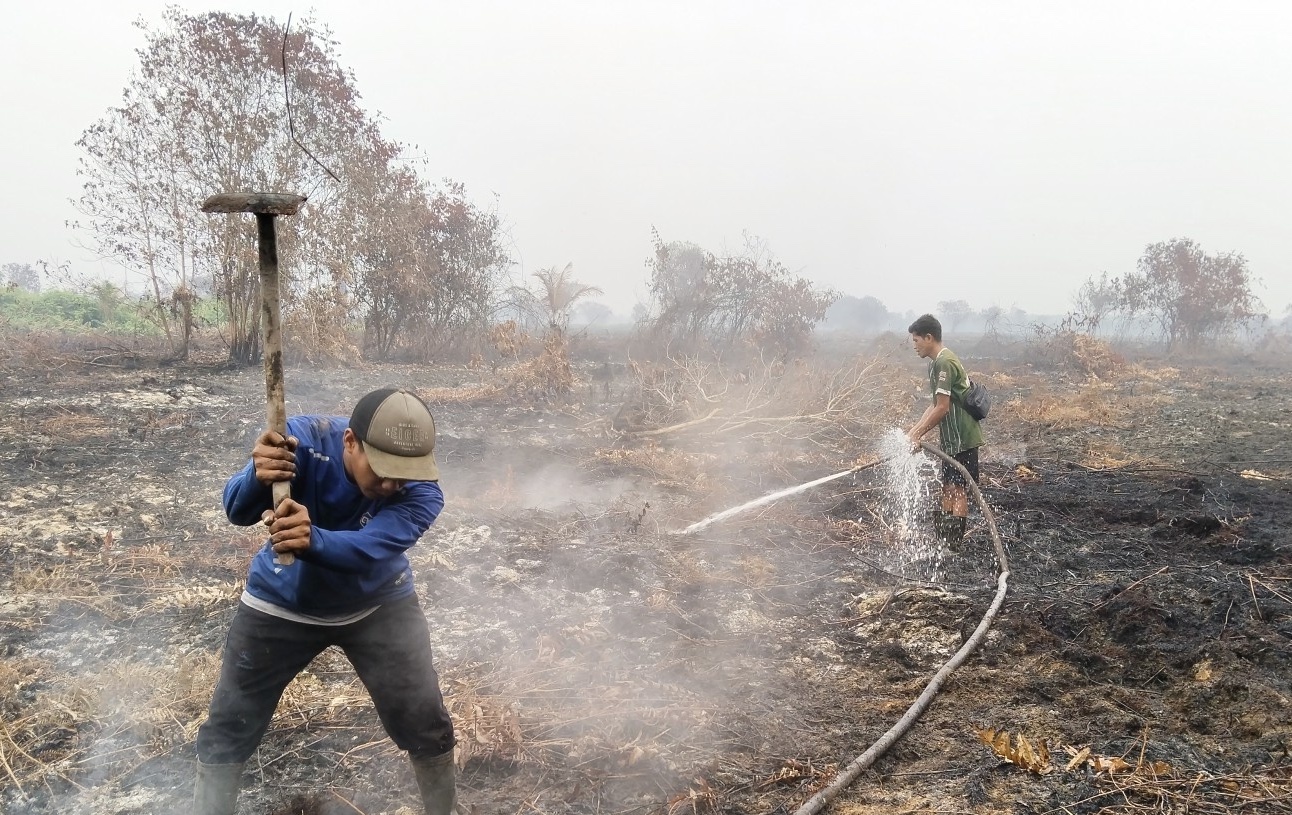
Fueled by El Niño, Indonesia’s extended dry season exposed some 12.5 million people to fire and smoke between January and September this year.Rich in combustible peatlands, Indonesian Borneo, known as Kalimantan, typically bears an outsize portion of the country’s fire activity.As fire seasons intensify due to climate change, communities and organizations in Kalimantan are seeking to shift traditional slash-and-burn farming to fire-free methods.Farmers who have adopted fire-free agriculture report benefits, but practitioners say more widespread adoption and government support is needed for it to scale up. In Kalimantan, the Indonesian portion of the island of Borneo, rain is bringing relief to the months-long fire season. Around 684,000 hectares (1.69 million acres) of land burned between January and September, amounting to 36% of the national total, despite the region comprising just 28% of the country’s land area. However, even with the rain, the threat has not completely passed. Satellite data from NASA show many fires continuing to burn in the forests of Kalimantan, while observers told Mongabay fire hotspots have shifted to other, drier areas. This year’s intense fire season has been fueled by the super El Niño weather pattern, which dramatically reduced seasonal rainfall across the country and prompted the dry season to last unusually long — even longer than during the catastrophic fire events of 2015 and 2019. By September, some 12.5 million people in Indonesia had been impacted by fire or smoke, according to the Indonesian Ministry of Health. Katarina Rina, 53, is one of those affected. Rina, a farmer from Hulu Sungai subdistrict in the hills of the Gunung Naning protected forest in Ketapang district, West Kalimantan province, said the level of fire activity was unprecedented in her area. “We have had fires before, but they were quickly controlled, it has never been this bad,” she said in a video interview with Mongabay. “This time the fires spread into the forests and farmland. It was very traumatizing.” Rina told Mongabay her jengkol (dog fruit) garden was “completely burned,” which is a “big loss” as it was one of her family’s main sources of income. Rina added that while the fires have now finally been contained thanks to rainfall, residents are still suffering from smoke exposure. Motorcyclists ride shrouded in smoke from wildfires around Palangkaraya, Central Kalimantan, on August 28, 2026. Image by Wiki Mod 526 via Wikimedia Commons (Public domain). Fire-free agriculture solutions Many of Indonesia’s wildfires began as intentionally set burns to clear vegetation. Such slash-and-burn, or swidden, techniques are commonly used by small-scale farmers and industrial plantations alike to clear land for cultivation. Kalimantan’s vast peatlands, composed of carbon-rich, waterlogged soil, are highly combustible when drained, which is done primarily for industrial plantation crops such as oil palm and pulpwood. Once ignited, a peatland fire is particularly difficult to extinguish. Traditional slash-and-burn fire mitigation practices rely on farmers working together to prevent fires from spreading into surrounding areas. But in this El Niño-fueled extended dry season, and with climate change more broadly, these methods are no longer working, according to Anindya Hadi, director of community organization Gawi Bapakat, based in Seruyan district in Central Kalimantan province. “Now even farmers in upstream areas where there is mineral soil [which is less likely to burn than peat] are experiencing the same situation as fires in other parts of Kalimantan,” Hadi told Mongabay during a video interview. “They cannot really control the fires from spreading anymore.” But farmers say they can’t afford alternatives to slash-and-burn methods, even as the risks of wildfires intensify. “Farmers are actually aware that burning is not sustainable, but they also do not have the support they need to make the change, and they have to make a living,” Saro Halawa, 39, a farmer living near Rina’s village in Ketapang district, told Mongabay during a video interview. To address this gap in support, community-led programs have been developed in several regions of Kalimantan by NGOs in partnership with local governments. Rina is part of a farmers’ group that is receiving training and equipment to adopt climate-smart agriculture (CSA) methods via a program run by the NGO Planet Indonesia. One of the aims of the CSA program is to reduce the use of fire in small-scale agriculture. A farmer in Sintang, West Kalimantan, tends to crops grown through a climate-smart agriculture project. Image courtesy of Planet Indonesia. Through the program, farmers also learn how to plant fruit and native trees on fallow land no longer used for single-season crops, using agroforestry techniques that blur the line between farmland and forest. The objective is to help families get more from land that’s already in production so there’s less pressure to clear more forest, according to Planet Indonesia field officer Hanna Runtu. The trained farmers then become mentors, and demonstration plots are established to show incoming farmers how the model works, she said. “It’s difficult to ask farmers to change practices that have been passed down for generations without first showing them that the alternatives actually work,” Runtu told Mongabay over a video call. “It’s a gradual process, and the idea is to help farmers move away from burning step by step, as they gain confidence in these alternatives on their own land.” Halawa said the program has been helpful for him. “It takes some time to make the shift to farming in one place. But once the shift has been made, it’s easier because I no longer have to keep moving around [for new areas to cultivate],” Halawa told Mongabay. “But the practice is still new, and not all farmers around have adopted it.” Over in Central Kalimantan’s Seruyan district, one of the areas hit hardest by fire, a similar approach is being rolled out by community organization Gawi Bapakat, part of Indonesian NGO Kaleka. Debuted in Seruyan in 2024, Gawi Bapakat’s fire-free agriculture (FFA) program is focused on helping farmers in six Indigenous Dayak villages adopt farming techniques that do not rely on burning. Under the FFA program, farmers are provided with equipment such as hand tractors, along with seedlings and training in how to make alternative, organic fertilizer, according to Gawi Bapakat field staff member Alfiyan Amruddin. A farmer uses a hand tractor to prepare farmland as part of a climate-smart agriculture project. Image courtesy of Planet Indonesia. “The farmers normally use ash [from slash-and-burn techniques] as fertilizer, but we try to educate them that there are so many options for making their own organic fertilizer with no cost to help them to transition to fire-free agriculture,” Amruddin told Mongabay during a video call. One advantage of this approach is that farmers can have more than one planting cycle, whereas with slash-and-burn they can only plant once. “The fire-free agriculture method means they don’t have to keep opening forest to move to a new area, they can utilize the exact same place without using fire,” Hadi told Mongabay during a video interview. Yadi, 66, a Dayak farmer from the village of Tumbang Gugup, who is participating in Gawi Bapakat’s program, said the alternative fertilizers are superior to ash. “When the land is burned, the fertility doesn’t last long,” he told Mongabay via a video call. “When it isn’t burned, the soil stays fertile for a long time, especially with the organic fertilizer. That’s what I’ve experienced. The soil also doesn’t dry out quickly.” A single planting can produce up to four harvests, potentially providing a yield three times that of burned land, Yadi said. However, he added that productivity has been affected by this year’s drought conditions. Participants in Gawi Bapakat (which means “working together” in the local dialect) said they are also working with communities to protect forests from further deforestation and to restore degraded peatland areas so that they can avoid repeated fires. To help farmers offset the costs associated with transitioning to fire-free methods, Gawi Bapakat purchases patchouli harvests grown within agroforestry plots by member farmers and has established a patchouli oil distillery in Seruyan. Yadi said his first patchouli harvest in June 2026 produced a yield of 62 kilograms (137 pounds) and served as a positive example to others who are interested in joining the program. Yadi (right) and Gawi Bapakat field staff member Harmin with Yadi’s patchouli crop. Image courtesy of Gawi Bapakat. Fire-free agriculture practices are gradually being adopted by communities beyond the original intervention villages, even without direct support from the FFA program, according to Hadi. However, many farmers still rely on fire. “It is not like only one group — smallholders or [industrial oil palm] companies — are involved, everybody has a responsibility to prevent these fires from becoming so huge,” Hadi said. Sitting on a bench at his farm, a dense wall of orange-tinged smoky haze visible in the air behind him, Yadi lamented that despite the serious impacts of the fires to health and livelihoods, “a lot of people around here do not care and keep doing their burning activities.” Sofyan Ansori, an anthropologist at the University of Indonesia whose research has focused on community-led fire governance, said fire-free agriculture programs can work well as pilot initiatives, but they face challenges when they are scaled up and the support to incentivize farmers is no longer continued. “For traditional farmers, the cost of changing from swidden agriculture is very big,” Ansori said. “Without managing their land with fires, they will need hand tractors, gasoline, herbicides and pesticides. It is becoming extremely costly for farmers to manage their own cultivations.” Farmer Halawa said he believes that moving away from burning is possible, but that farmers need more long-term and consistent support from government agencies to make that change. “It’s not hard to replicate this fire-free agriculture approach, but it needs the support of local government to be able to provide access to necessary equipment to more communities across the district,” said Gawi Bapakat’s Anindya Hadi. The initial expectation had been that Gawi Bapakat’s program could be expanded beyond the pilot sites with support from the local government. But cuts to national and regional budgets under the government’s austerity measures have constrained partnerships between local governments and community organizations. “After more than three years of working through Gawi Bapakat, this has been our most frustrating year,” Hadi said. “Communities are ready to adopt fire-free practices, and the local government supports the transition to sustainability, but national and regional budget cuts are limiting our ability to turn that commitment into action.” Hadi’s frustration echoes wider anger at the government’s response to the fire crisis, which critics say has been too slow and which has sparked widespread protests. Mongabay contacted Indonesia’s Ministry of Finance, which is responsible for disbursing funds to the country’s fire-mitigation programs. While a ministry spokesperson said the inquiry had been sent to the secretariat-general, comment was not provided by the time this story was published. Farmers in Sintang, West Kalimantan, tend to crops grown through a climate-smart agriculture project. Image courtesy of Planet Indonesia. Part of a pattern After decades of deforestation and peatland drainage for landscape change, research is showing that Kalimantan, along with other oil-palm-dominated landscapes, is becoming more vulnerable when exposed to extreme weather conditions such as El Niño. And this has continued to worsen with each major fire season as previously burned areas are more prone to fire. Researchers from the environmental NGO Sustainable and Innovative Areal Management Research (SIAR), based in West Kalimantan, have been mapping recent fire activity in the province and comparing it to wildfire hotspots over the past 10 years. They found that the majority of fire activity — 63% — fell inside licensed oil palm areas, and almost half of that is in previously burned areas of peatland. “Looking at where the land has been burned previously over the last 10 years (totaling 500,000 hectares)” — or 1.24 million acres — “and the current hotspots, it’s in the same area,” SIAR director Erlangga Ananta told Mongabay in a video interview. “There’s not much outside the licensed land.” These findings square with an analysis of recent haze source data by Greenpeace Indonesia and Malaysia. In a report published in October, Greenpeace investigators write that their results “show an increasingly clear pattern” of fires reemerging within the same landscapes and in areas that are partly held or managed by corporate entities. “The more haze source points are found within an entity, particularly in peatland areas, the stronger the need to view the forest and land fire problem from the standpoint of land governance, the obligations of area managers and the effectiveness of state oversight,” the report states. Ananta also called on the government to refocus its priorities on preventing fires on peatland. “Time and again it has been proven that once peat is burning, it is almost impossible to put out,” he said. “I think the government should be preparing more on the restoration of burned areas and prevention of future fires because we have learned enough from the past historical fire disaster events.” Banner image: Firefighters work to extinguish a blaze smoldering in a peatland near the village of Mengkalang Jambu in West Kalimantan. Image courtesy of Planet Indonesia. Feedback: Use this form to send a message to the author of this post. If you want to post a public comment, you can do that at the bottom of the page. Credits Topics
As Indonesia burns, communities look to fire-free agriculture for relief
Full Article
Original Source
Read the full article at News →KhanList aggregates and links to publicly available news content. We do not host full articles from third-party sources. Always verify important information with original sources.