
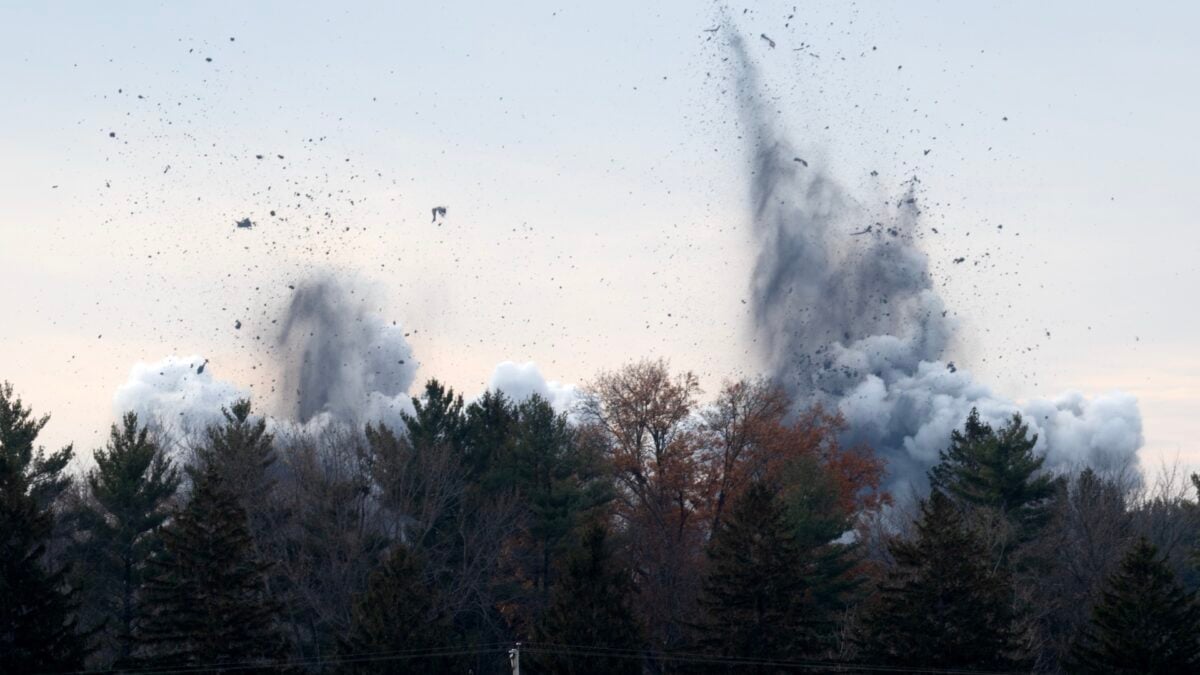
The U.S. Army detonated an enormous stockpile of lead azide explosives at the Iowa Army Ammunition Plant in Middletown, Iowa, on Wednesday morning. People within a five-mile radius were told to evacuate, and a plume of smoke is now making its way to the southwest into Missouri. The planned detonation of almost 5 tons (68 barrels) of explosive material set off a national debate last week about whether the U.S. government was acting recklessly, given the fact that lead is toxic to humans, especially children. C-SPAN aired live video of the explosion seen from a distance. The reporter on the ground described the blast and how he felt the shock wave that spread out across the local area. “We could feel that percussion from that explosion,” the reporter noted. “And I could actually visibly see the shock wave coming through.” EPA administrator Lee Zeldin appeared on CNN about half an hour after the explosion at 9 a.m. local time in Iowa and gave a phone number that local residents could call with any questions. CNN’s anchor told Zeldin live on air that the news outlet tried the number, but it wasn’t working. CNN instead provided the EPA hotline. The Environmental Protection Agency set up an online dashboard showing the air sampling stations in the area. None of the stations have shown lead in the air thus far. Middletown has a population of 363, and locals in the wider area, including the towns of Augusta and Burlington, received an alert on their phones an hour before the detonation that warned: “evacuation is no longer safe or advised.” All residents within 20 miles were told to shelter in place immediately. Officials with the Army described the detonation as “successful” and exceeding expectations during a press conference after the explosion. “I believe, absolutely, that we reduced, as close to zero as it’s absolutely humanly possible, the risk to the health and safety of the people of Middletown and the extended communities throughout Iowa,” Maj. Gen. Eric Shirley said, according to the Associated Press. The officials appeared to be mirroring President Donald Trump’s earlier post on Truth Social where he wrote: “Early reports from Iowa are that the Army’s mitigation efforts have far exceeded expectations.” Journalists prepare to document events while the U.S. Army detonates several tons of highly volatile, degraded lead azide on the grounds of the Iowa Army Ammunition Plant on November 25, 2026, in Middletown, Iowa. © Photo by Scott Olson/Getty Images The country’s entire stockpile of lead azide was collected from military bases across the country and stored in Iowa starting around 2009, according to PBS News. The stockpile was inspected in March, and military officials reportedly decided it was safer to detonate it all rather than try other methods of disposal. The detonation was originally planned for last Friday, and local residents were only given a few days’ notice. Residents have appeared on TV news in recent days expressing confusion about what they should do and what kind of health impact there may be on the local community. NASA has been monitoring the detonation from the air using a P-3 Orion and Gulfstream III from the space agency’s Langley Research Center in Virginia, according to WJAC. A Beechcraft King Air B200 was also brought in. A NASA aircraft makes low passes over the town Middletown and the blast site after the Army detonated several tons of highly-volatile, degraded lead azide on the grounds of the Iowa Army Ammunition Plant on November 25, 2026 in Middletown, Iowa. © Photo by Scott Olson/Getty Images Josh Turek, the newly elected Democratic senator from Iowa, has called for an investigation into the failures that led to the detonation, why it was allowed to degrade to such a state, and what other dangerous materials may still be at the Iowa Army Ammunition Plant in Middletown. “The public also deserves answers as to why the U.S. Army’s communication — both with the public and with Iowa officials — was delayed and inadequate from the beginning,” Turek wrote on X. People who evacuated are unsure when they’ll be able to return to their homes, according to CNN, since they’ve been advised to tape up their windows and the American Lung Association has told people not to return for 24-48 hours. Darwin Pierce and Liz Garst watch from from along a rural gravel road about two miles from town as the Army prepares to detonate several tons of highly-volatile, degraded lead azide on the grounds of the Iowa Army Ammunition Plant on November 25, 2026 in Middletown, Iowa. © Photo by Scott Olson/Getty Images Residents in the area have also been advised to wet-wash outdoor surfaces and to be on the lookout for any symptoms like constipation, stomach pain, vomiting, or seizures.
The U.S. Army Just Blew Up Nearly Five Tons of Toxic Explosives in Iowa
Full Article
Original Source
Read the full article at Gizmodo →KhanList aggregates and links to publicly available news content. We do not host full articles from third-party sources. Always verify important information with original sources.