
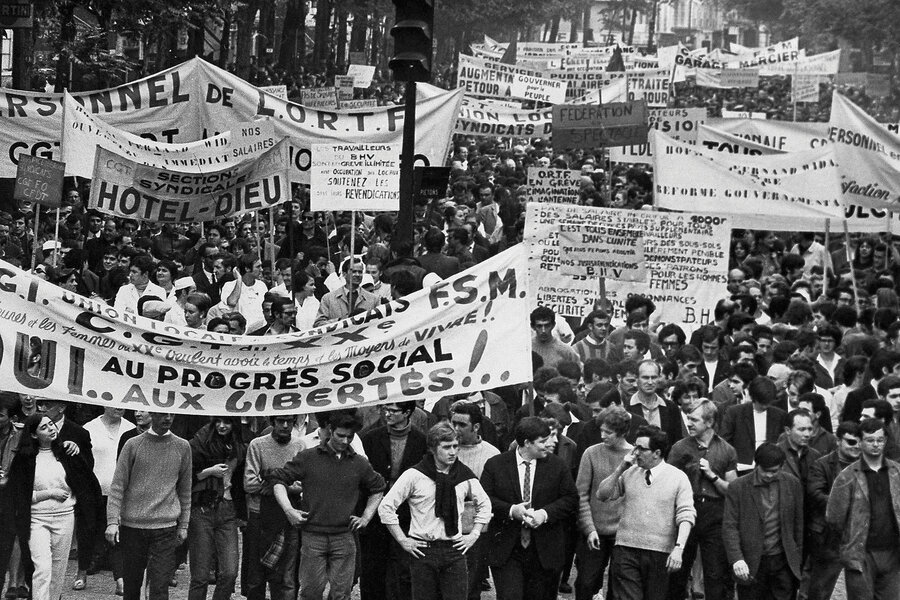
Paris | Nov. 06, 2026, 12:00 p.m. ET | 7 min read Sylviane Bequin was 13 years old when French students started a revolution.It was May 1968, and young people were taking to the streets. At university campuses across France, students barricaded roads and hurled cobblestones at police, angry over an outdated education system and a government they said no longer represented them.Within weeks, students had inspired millions of French workers to go on strike, pushing for higher wages at a time when the economy was growing. Sylviane’s father, a factory worker at a Renault car plant, was one of them. “He felt it was his civic duty to protest,” she recalls.Now, nearly six decades later, Ms. Bequin is on the streets herself. She’s carrying a cardboard sign reading “Grandmother in Solidarity” as a new generation of French students leads protests over the state of the public education system. Colette DavidsonSylviane Bequin (left) and her daughter Pia Moulin, shown demonstrating in Paris on Oct. 17, 2026, say they feel a sense of duty when it comes to protests. Ms. Bequin recalls her father taking part in protests in May 1968. Since early October, hundreds of thousands of people have joined them, demonstrating across France over the high cost of living at a time of fiscal constraint. They expect the government to provide the strong safety net they see as central to national identity. But with public finances under strain, the promises underpinning that system are becoming increasingly difficult to sustain.At this potentially pivotal moment, protesters are looking to spur a social and political revolution similar to the one that shook the country in May 1968 and ushered in modern France. “Young people have been asking for change for years and years,” says Ms. Bequin, shouting above the boom of a stun grenade during a recent protest in Paris. “Their anger is massive. But so is ours. Maybe there will be another uprising.”Student complaints go nationalThe youth protest movement began in late September, when students at a high school in suburban Paris aired their grievances about shortcomings in France’s public education system.The school’s ceilings leaked, toilets were out of order, and students were forced to bring blankets to class in winter because the heating didn’t work. School days lasted from 8 a.m. to 6 p.m., and many students went months without some classes because there weren’t enough substitute teachers.As other student bodies echoed their complaints, protests spread. By early October, students throughout the country had joined in the demonstrations, blocking the entrances to their schools with garbage cans and metal barriers. And when the government announced a budget that included €54 billion (about $60 billion) in public sector cuts, workers’ unions joined in, calling for widespread strikes. Thibault Camus/APThe marches in France today see students and workers in the streets protesting against the rising cost of living, in Paris, Oct. 24, 2026. Since then, hundreds of thousands of people have demonstrated, inspiring similar youth-driven protest movements in Italy, Belgium, Albania, Spain, and Portugal. Protesters say their governments haven’t shielded them from rising gas prices due to the Iran war, the high cost of living, and deteriorating public services such as education and housing.But analysts say the French people’s grievances reflect deeper disappointment – that what they give the government is more than what they get back.“The postwar liberal order ... was associated with a powerful expectation, that economic growth, education, and individual effort would allow each generation to live better than the previous one,” says João Ferreira Dias, a political scientist at the European Center for Populism Studies. “That promise has become increasingly difficult to sustain.”France’s biggest strike everFor France in 1968, the cracks began to show just before May. The country was in the midst of a postwar economic boom, and optimism was high. But brewing beneath the surface were stagnating salaries and grueling 45-hour work weeks. Discontent was growing among young people over French President Charles de Gaulle’s paternalistic leadership and an outdated education system, characterized by segregated dorms, a rigid curriculum, and overflowing classrooms.On May 6, students in Paris staged a massive demonstration at Sorbonne University, leading to hundreds of arrests. Over the next week, students clashed with police, barricading streets and rioting in the Latin Quarter. Trade union leaders called for strikes in support of students, and by the end of May, several million people had refused to go to work, grinding public life to a halt.“Stores were closed [and] there wasn’t enough to eat,” says Ms. Bequin. “The general strike seemed to last forever.”May ’68 remains the seminal protest movement for most French people. Though there have been other student protests, “none of them have acquired this kind of omnipresent shadow in the way 1968 has,” says Daniel A. Gordon, a historian and expert on contemporary France. “It was the biggest strike in the history of France, and the idea of students being the detonator of a wider movement, that’s the kind of thing that people are trying to re-create and that governments are fearful of.”Though the protest that year was spurred by student idealism, it did not stay peaceful over the six weeks it lasted in May and June. Images of students hurling cobblestones at police and setting cars on fire have become symbols of the movement. Police violence has been widely documented. About a half dozen people died. The 2026 protests are “nothing compared to back then,” says Jacques, a May ’68 protester and now retired railway worker, who declined to give his last name for privacy. “They were brutal.”The birth of modern FranceBut May ’68 is revered by the French partly because it succeeded in pushing the government – which looked at times near collapse during the protests – to the breaking point, effectively forcing change. As a result of the movement, the government raised the minimum wage by 35% and improved worker protections. May ’68 ushered in women’s liberation and created a path for the legalization of abortion.It was also the launchpad for the creation of France’s modern welfare state. It laid the groundwork for universal healthcare, increased minimum pension payouts, and unemployment protections – all supported by the baby boomers.Though France’s generous welfare state was hard-fought, it has also been difficult to maintain. As the boomers aged, the ratio of workers to pensioners flipped, putting more demand on modern workers to pay for retirees. France’s economy has since struggled through several periods of sluggish economic growth.By the 1990s, the French government was forced to raise taxes to fund its generous social security system. Today, France is one of the most highly taxed countries in the developed world. Yet successive governments have spent more money than they recoup from the tax setup. The French government is now under pressure to rein in its public debt, which has skyrocketed to €3.6 trillion (about $4 trillion) – 119% of its gross domestic product.That has made answering young people’s calls for €10 billion more in spending on public education exceedingly difficult. France already allocates around €64 billion to education, plus an additional 28% in teacher pensions. Any extra budget for school renovations is allocated to regional governments – which must decide how that money is spent.“I go ballistic when students say there aren’t enough toilets in high schools,” says a former French minister, who agreed to speak on the condition of anonymity. “We need democracy in schools. We need a deep reform. “But we also need to listen to kids, to not think of them as a threat or a problem, but as an asset.”The persuasion of presidentsThat, today’s youth protesters say, is all they want from the French government.French President Emmanuel Macron has only publicly spoken about the protest movement twice. And he has rarely caved to public pressure during his time in office, even amid protests such as the “yellow vest” demonstrations between 2018 and 2020 over the cost of living, or the demonstrations against his pension reform bill in 2023.“We’re getting used to Macron not responding to our concerns,” says Milan, a 15-year-old who has been blocking the entrance of his Paris high school, Lycée Turgot, since late September. Because he is a minor, he asked that his last name not be used. “The government treats us with utter contempt.”Those feelings are similar to what pushed young people in May 1968 to rise up. Though de Gaulle was once viewed as a leader who united the French against Nazi Germany during World War II, many came to see him as paternalistic and out of touch by the late 1960s.Still, de Gaulle was not nostalgic, according to Frédéric Fogacci of the De Gaulle Foundation in Paris, and “he constantly looked towards the future.” The French leader was singularly motivated by bringing his people together through a common struggle. But he also knew when to give up.Nearly a year after the May ’68 protests, de Gaulle lost a public referendum to reform the Senate. The next day, he resigned.“We’re not afraid”With six months until the end of his mandate, observers say Mr. Macron’s early departure is unlikely, even as his approval ratings sink to as low as 15%. “There is a loss of confidence in the government and French institutions,” says Pierre Bréchon, a professor emeritus of political science at Sciences Po Grenoble. “Whether we’ll move towards calm or more tensions is really anyone’s guess.”In October, the French government promised to immediately unlock 3,000 substitute high school teacher posts and 15,000 positions in higher education. Deepen your worldviewwith Monitor Highlights.Politics with respectGet political stories with respectful analysis.There‘s a world of new ideas in everyBooks newsletter.There‘s more to life, enrich yours withCulture & Learning weekly.Follow humanity‘s discoveries withScience & Nature stories in your inbox.Gain a spiritual perspectivefrom the stories in your inbox.Want to understand the deeper impact of critical events? Learn the Monitor‘s insight.Already a subscriber? Log in to hide ads. Still, many young protesters call such measures “breadcrumbs” that have only strengthened their resolve. Up against a system that doesn’t work for them anymore, they say they will continue, just like generations of protesters before them did.“We’ll keep moving forward. We’re not afraid,” says Anna Augé, a member of the Fédération Syndicale Unitaire, the largest trade union representing France’s education sector. “Nothing can stop us until we are heard.” ALREADY A SUBSCRIBER? LoginReal news can be honest, hopeful, credible, constructive.The Christian Science Monitor was founded in 1908 to lift the standard of journalism and uplift humanity. We aim to “speak the truth in love.” Our goal is not to tell you what to think, but to give you the essential knowledge and understanding to come to your own intelligent conclusions. Join us in this mission by subscribing.
As French students protest, they bear the mantle of May ‘68
Full Article
Original Source
Read the full article at Csmonitor →KhanList aggregates and links to publicly available news content. We do not host full articles from third-party sources. Always verify important information with original sources.